Before watching the videos
This series of videos taken from Operation Ouch! link to the statutory relationships and health education guidance, and the non-statutory PSHE programme of study.
As with all PSHE-related content,a safe teaching and learning environment should be established before class viewing. It is important to watch the video before viewing, to ensure it is suitable for your pupils and works within your curriculum planning.
Please ensure you have read the teacher guidance before using in the classroom
You may want to show the anxiety video, then the video about stress to demonstrate the techniques of breathing and body scanning as a way to calm anxiety.
Watch the video – anxiety
Anxiety
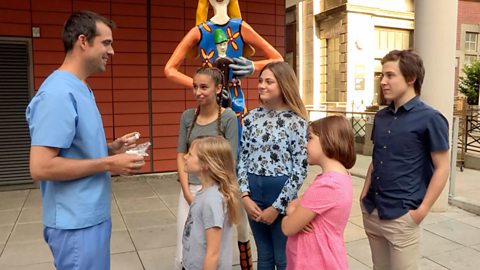
XAND: Can anyone describe to me what the feeling of being anxious is like?
ARAV: You feel very frustrated.
DEBI: A bit angry and a bit scared.
JAYDEN: You can feel, like, really under pressure.
VOICEOVER [CHRIS]: That's spot on.
VOICEOVER [RONX]: When you start feeling anxious you can find it harder to breathe. As you start to get panicky you try to breathe deeper and quicker than normal.
VOICEOVER [CHRIS]: This is called hyperventilation. It means that the amount of carbon dioxide in your blood starts to fall and that leaves you feeling dizzy.
VOICEOVER [CHRIS]: Sometimes it can cause chest discomfort because your body re-leases adrenaline making your heart beat faster.Everyone feels anxious at some point. If you feel this way, here are three simple things you can do to help yourself.
VOICEOVER [CHRIS]: Number one, slow your breathing down.
XAND: You'll feel your heart rate come down and you'll start to calm down.
LILY: I feel like I'm breathing out all my worries.
VOICEOVER [CHRIS]: Number two, distract yourself.
DEBI: Just go do something that you like to do that will take your mind off it.
EMILIA: Play a game.
XAND: What sort of games do you enjoy playing?
EMILIA: Stuck in the Mud.
XAND: Any kind of running around is not only a great distraction but also it makes your body re-lease endorphins which make you feel happy and less anxious.
VOICEOVER [CHRIS]: Number 3, talk to someone.
EMILIA: Kind of letting other people know so they can help you. And it feels good.
VOICEOVER [CHRIS]: And one more thing to help reduce anxiety, Today's Mind Tip, sleep.
CHRIS: Get a good night's sleep. When we're tired, everything is harder to deal with. And the way to do it is to get up and go to sleep at roughly the same time each day, read a paper book before you go to bed and don't have any screens in your bedroom. Charge your phone in the kitchen. Good night.
Anxiety: video summary
This video begins with Dr. Chris and Dr. Xand engaging a group of schoolchildren in a discussion about anxiety. The children are encouraged to describe what anxiety feels like and to identify its physical symptoms. The doctors then explain why these symptoms occur, helping to build children's understanding of the connection between physical and mental health.
The video also introduces practical strategies for managing anxiety in the moment, such as breathing exercises and the importance of talking to a trusted adult. To conclude, the video offers proactive tips for reducing anxiety, including the benefits of regular physical activity and good sleep habits.
Watch the video – stress
Stress
RONX: Ahhh, time to relax. Omm. [CELL PHONE RINGS]
RONX: Not now, Xand! I'm meditating. I'll call him back later. Om. [CELL PHONE RINGS]
RONX: Stop stressing me out! Argh! Xand, what now?
XAND: I've got whipped cream on the ceiling!
RONX: What? Whipped cream on the ceiling?
XAND: Yeah, I was making trifle. Look, it's not a problem.
RONX: How are we gonna get—
XAND: I can just hose it off.
RONX: You're gonna use a hose?
XAND: I'm gonna use the hose.
RONX: No, not with a hose.
XAND: It's fine. I've already got it out.
RONX: Xand, not with—
XAND: Don't worry.
RONX: Xand, not with the h—
XAND: I'm starting the hose. Aaaaaaaah!
RONX: Arrrrrrrgh!
RONX: Today I want to talk about stress. Does anybody have any stress-busting tools?
KUBA: You could play calm music.
LEILA: I like to do yoga.
AQUILA: You can meditate.
RONX: Great ideas. One type of meditation that I use is called Mindfulness. Who wants to give Mindfulness a go?
CHILDREN: Me!
VOICEOVER [CHRIS]: Sometimes the feelings we have can pile up on one another and we feel overwhelmed. Mindfulness helps you to organise that pile and work out what you're feeling at that moment and why.
VOICEOVER [RONX]: A good exercise to help do this is Balloon Breaths.
RONX: Close your eyes.I want you to imagine that you have a balloon in your belly. Every time you take a deep breath in, that balloon blows up. And every time you take a deep breath out, that balloon deflates. If your mind wanders, bring it back to your breathing.Now I want everybody to slowly open their eyes. Well done! How was it for you?
ALISHA: I felt really calm.
BRUNO: I felt like I was sleeping in my bed.
ZAHRAH: I felt like I completely zoned out and I was in paradise.
RONX: Awesome!
CHRIS: Being aware of our body can help us understand the emotions we're feeling too.
XAND: A brilliant exercise you can use is a Body Scan Meditation.
RONX: We're gonna scan our bodies with our mind. Think about your whole body. Start with your toes, then slowly work your way up, all the way until you reach your head. How does everything feel? Did you find any tension?
BRUNO: Here on my neck.
ZAHRAH: I felt tension in the back of my neck and also in my legs a bit.
JATIN: My hands and my shoulders.
RONX VO: If you have any tension in your muscles it could be a sign of stress, so why not give Mindfulness a try?
RONX: Great! Well done, everybody! Whoo! High-five!
Stress: video summary
In this video, Dr. Ronx's meditation session is suddenly interrupted by a stressful phone call. This sets the stage for a discussion with a group of schoolchildren about what stress feels like and how it can affect us.
Together, they explore a range of stress-busting strategies, with a particular focus on mindfulness. The children are guided through practical techniques, including a body scan meditation, to help them recognise and manage stress in a calm and focused way.
Suggested activities
Before watching the anxiety video, discuss the feeling of anxiety, and how it can make someone feel.
Watch the video, then ask pupils to think of situations that might cause anxiety for different people. Remind them that people respond to different situations in different ways, and that some might experience anxiety while others don’t.
Ask pupils to draw a person, or the outline of a body. Ask them to use the list of feelings associated with anxiety to indicate where in or on the body we might feel these things.
As a class, discuss some ways of alleviating anxiety and ask pupils for their own top tips (if they want to, they can share ways that help for them). Why do they think these things help?
Focus on the part of the video that describes how and why breathing can change when someone is anxious. Watch the Stress video to see how breathing and body scanning techniques can be used to help calm anxiety.
Teach pupils how to use the techniques in the following ways:
Breathing: ask pupils to sit somewhere comfortable and close their eyes. Ask them to bring their attention to their own breathing and try to listen to it, and slow it down if they are breathing quickly. Then ask them to breathe in, counting to three slowly in their heads (or count out loud to help them), then breathe slowly out for a count of three. As they breathe they should imagine a balloon blowing up inside them, as suggested in the video. They could also pause for a moment at the top of the breath before letting it out. As pupils get more experienced at this technique you could vary the number of breaths, or the way they breathe (e.g. in slowly for three, out in one big breath or vice versa; breathe in through the nose and out through the mouth etc.).
Body scanning: again, ask pupils to sit somewhere comfortable and close their eyes, and listen to their own breathing. As they breathe, ask them to bring their attention to particular body. You could guide them in a particular order: for example, feet, knees, stomach, chest, fingers, hands, shoulders, neck, face, head, brain. Speak slowly and pause at each to allow pupils to focus on that body part before moving on to the next. Another way of doing this is to ask them to tense that body part, then completely relax it before moving on to the next. Afterwards, ask pupils to open their eyes and just observe how they feel. They can share these feelings if they wish.
It can be a good idea to regularly practice both techniques with the class so that pupils instinctively do it independently when they feel anxious.
You can watch more Operation Ouch! on iPlayer.
More videos from this series
Grief. video
Dr. Chris and Dr. Xand discuss the topic of grief with a group of schoolchildren.
Immune system video
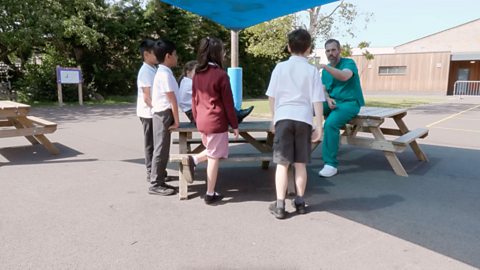
Dr. Xand and Dr. Chris investigate how our immune systems work.
Vomit. video
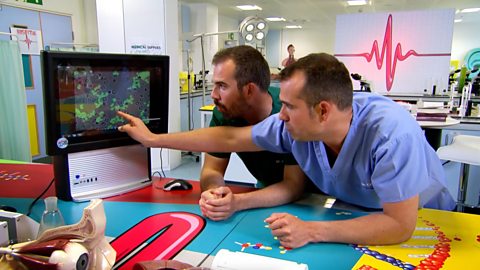
Dr. Xand and Dr. Chris look at the biological process of vomiting.

Diarrhoea. video
Dr. Xand and Dr. Chris look at the causes and symptoms of diarrhoea.
Food. video
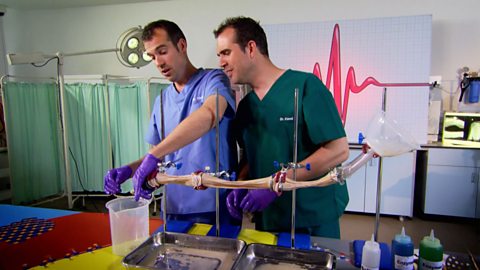
Dr. Xand and Dr. Chris test the energy values of different foods.
Healthy heart video
Dr. Ronx teams up with a group of schoolchildren to explore how to keep the heart healthy.
Spots. video
Dr. Xand and Dr. Chris explain why we all get spots.
Sleep. video
Dr. Chris looks at why we need sleep and why children need more than adults.