Narrator:
These are four of the most famous feet in all of history.On the left, they’re adult size 9. The first feet ever to walk on the moon.And on the right, a stonking size 10! Possibly the very first feet ever to reach the North Pole.
These feet belonged to Neil Armstrong and to Matthew Henson.Two men, both explorers from the USA, but who lived very different lives.
Neil Armstrong fell in love with flying when he took his first plane ride, aged just 6. When he was 16, he’d already got his pilot’s licence. He became a US Navy pilot and then was chosen to train as an astronaut.
Matthew Henson was born much earlier. His parents died when he was young, and he had to work hard to survive. But he always dreamed of travelling.
And when he was 13, in 1879, he got a job working on a ship. The ship’s captain saw how clever he was, and taught him all about sailing and how to read.
Later, he started working with an explorer named Robert Peary, a man who was interested in the Arctic.
That’s how Matthew Henson ended up aiming for the North Pole in 1909, and Neil Armstrong for the moon in 1969.
Very different places, but both are so cold, and so harsh, that anyone making a mistake - even a tiny mistake - could easily die. And so the two expeditions took a lot of preparation.
Henson and Peary spent 20 years learning about the Arctic. Henson stayed with the people who lived there - the Inuit - for a long time. He learned everything he could from them, about how to travel with dog teams, how to make and fix sleds, how to hunt, even how to make clothes.
Armstrong, and his fellow astronauts, spent years training in models of their real spacecraft. They had to know how to deal with all the different things which might go wrong in space, and think so quickly that they could fix anything that went wrong in just seconds.
It was lucky he had all that training, because he nearly had a crash landing!
At the moment he took the first step on the moon, he was already world famous. Down on Earth, hundreds of millions of people were listening and watching as he planted the American flag.
‘It’s one small step for man, one giant leap for mankind.’
Henson planted a flag too, but for him, things were very different. He couldn’t be sure that he was exactly at the North Pole - because there’s nothing there!
He was the first one to get to a point that he calculated was the right one. Peary didn’t agree - and went to a different point. Even today, nobody is sure who was right…
And even though they were the first people ever to have got there, they couldn’t tell anyone. They had no radios!
It was only when they’d got all the way back to their ship, and sailed far enough south, that they could send news of their big success.
Even then Matthew Henson wasn’t famous. All the news talked about was ‘Robert Peary, the man who reached the North Pole’.
Maybe that’s because he was the boss. But it might also be because, at that time, stories about heroes and adventurers were often about white people. Henson’s story didn’t get told until he was an old man.
So, the two explorers had very different experiences. But there were some things they were both very good at. Like making friends!
When you’re stuck in a tiny tent… Or crammed into a tiny space capsule… you have to get on with people without arguing. And it helps if your feet don’t smell too bad!
Video summary
This animated film compares the lives and adventures of two different explorers, Neil Armstrong and Matthew Henson.
Armstrong famously became the first person to walk on the moon in 1969, having spent years training as an astronaut.
60 years earlier, in 1909, Henson claimed to have been the first Arctic explorer to reach the North Pole.
Teacher Notes
Themes in the film include:
- How we learn about new and different places
- How technology has changed
- How we gather historical sources
Additional notes
- Recognition and Fairness
The film looks at how the television may have contributed to Armstrong’s rise to fame, while Henson lived in relative obscurity after he returned from the Arctic.
Henson was a Black man born in the USA in 1866, only months after the 13th Amendment abolished slavery. Throughout his life, the USA was segregated and discrimination may have shaped how others looked at his achievements.
Before the video
Before the video, establish what pupils already know about Neil Armstrong. You can show photographs of him and the video of the moon landing clip.
Ask questions:
- What does ‘explore’ mean? If you're an explorer, what kind of person might you be?
- Have you ever imagined going to a new and exciting place? Where would you like to go?
Show them a variety of props. For example, a torch, a map, flip flops, a musical instrument, and a fiction book can be included. If they could take three items on their ‘adventure’, what would they choose, and why?
Explain three bits of key vocabulary they’ll be hearing:
- Arctic
- Inuit
- Expedition
During the video
00:43 - What job did Neil Armstrong have before he was an astronaut? (He trained as a pilot)
01:18 - Who went on their expedition first? (Matthew Henson)
01:52 - What did Matthew Henson learn from the Inuit people? (He learnt to travel using dog teams, hunt (or fish), fix sleds and make clothes)
02:30 - This family is watching Neil Armstrong land on the moon. What are they watching on? (A television)
03:07 - Why did Matthew Henson have to travel back before he could tell people? (He had no radios)
03:14 - Who did the newspapers talk about, instead of Matthew Henson? (His boss, Robert Peary)
After the video
Ask questions:
- How were Neil Armstrong and Matthew Henson’s lives different?
- But what did they have in common?
- What do you think about Neil Armstrong being famous right away, but Matthew Henson not getting famous until later?
- Do you think the men were heroes? Why?
- Have you ever had an adventure? How did you get ready for it?
Reflect back on the items they chose for their adventure.
- Would they be useful for either Neil or Matthew’s expedition? Why or why not? Would they choose any different item
This film is suitable for teaching History at KS1 in England, Wales and Northern Ireland and 1st Level in Scotland.
More from this series:
Queen Elizabeth I and Queen Elizabeth II. video
This animated film compares the lives and different time periods of two of the most famous British monarchs of all time, Queen Elizabeth I and Queen Elizabeth II.
Emily Davison and Rosa Parks. video
This animated film compares the lives of Emily Davison and Rosa Parks, two activists from different times and places, who both successfully protested against unfair rules.
Vincent Van Gogh and Frida Kahlo. video
This animated film compares the lives of Vincent Van Gogh and Frida Kahlo, two famous artists from different time periods, who both found passion and purpose through their unique painting styles.
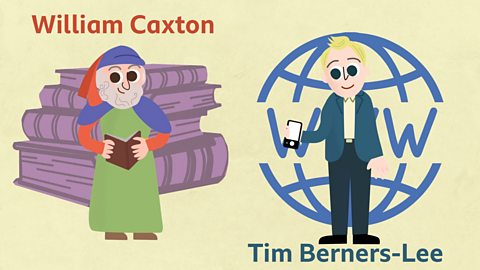
William Caxton and Sir Tim Berners-Lee. video
This animated film looks at the big ideas of William Caxton and Sir Tim Berners-Lee. Both changed how we share information today, even though they lived over 500 years apart.
Ada Lovelace and Alan Turing. video
This animated film compares the lives of Ada Lovelace and Alan Turing, two mathematicians from different eras whose bold and creative ideas helped develop the first computers.