Narrator:
Ada Lovelace and Alan Turing both loved maths and computers.
But the thing is that Ada was born in 1815, and Alan was born in 1912. They both started writing computer programs before any computers had even been built!
So how is that possible?
In the 1800s, women weren’t expected to be interested in maths or science.But Ada Lovelace was, and she was lucky enough to be from a rich family who encouraged her to be creative.
When she was a young woman, she met an inventor called Charles Babbage, and they became friends. He’d had an amazing idea, a way of building a calculating machine that would be able to do difficult sums. At that time, there was no electricity so his idea was to use parts of clocks.
The machine was so complicated that he only ever managed to build a section of one. And most people didn’t even understand what it was for.
But Ada Lovelace did! She kept thinking about what the machine did with numbers, and what people could use it for.
And she showed that it would be able to work with any kind of pattern - even words, or music.
She wrote instructions for the machine - which, today, we would call a ‘computer program’.But because the machine hadn’t been finished, she couldn’t test her ideas to see if they would really work!
When Alan Turing was born, nearly a hundred years later, technology had moved on but there were still no computers.
At school, Alan spent a lot of time playing chess and reading about science.
When he was older, he became an expert mathematician. And just like Ada Lovelace, he started thinking about how machines that could do maths might work.
In 1936, he had an amazing idea. He called it the Universal Computing Machine.It worked with electrical circuits. And it had a sort of memory.Because it could save information, you could give it different instructions, and get it to do different kinds of calculation.
His idea changed the world! Soon after, scientists started making the first electrical computers. They were based on Alan Turing’s design.
And when World War 2 began in 1939, these new machines had an important role to play for Britain. Alan Turing used them to unscramble codes that the German army were using to keep their communications secret.
The codes were very complex, and breaking them was only possible because the new computers could do the same calculation work as hundreds of people!
‘Attack on Tuesday’
But Alan knew that it would be possible to make machines that were able to do much more. He thought that in the future, computers would be able to speak to people or even have their own ideas.
‘Hello, how are you?’
Both Ada Lovelace and Alan Turing were amazing because they understood so much about computers before they could even be made! Long after her death, the instructions that Ada Lovelace wrote were tested with electronic computers – and they worked!
All of our modern computers come from Alan Turing’s design. And today, we can have conversations with computer programs – just like he predicted!
‘The weather today is sunny.’
Video summary
This animated film compares the lives of Ada Lovelace and Alan Turing, two mathematicians from different eras whose bold and creative ideas helped develop the first computers.
Born in 1815, Ada was encouraged by her family at a young age to study mathematics.
She met inventor Charles Babbage, who told her about an idea he had for a ‘calculating’ machine: a large contraption that could do complicated sums. Ada immediately saw the potential in the machine and wrote groundbreaking ideas about it.
Alan Turing, born nearly a century later in 1912, imagined an electrical machine that could store information, like a ‘memory’, which could therefore do more complicated work than other machines. His ideas shaped the development of the first electrical computers, which became instrumental during World War II for deciphering German codes.
Both Alan Turing and Ada Lovelace understood the potential of computers before they were even built. Through their creativity and forward-thinking, they imagined and shaped the technology we have today.
Teacher Notes
Themes in the film include:
- Technological advances
- Significant individuals who have shaped the technology we use and how we communicate
Additional Notes
- The Importance of Ada’s Family
It was unusual for women to be able to study mathematics at that time. Women's access to formal education was limited, especially in scientific and mathematical fields.
There was very little choice of job at the time for women and the majority involved long hours of physical work, low wages and very little emphasis on education or development.
Ada’s ability to study and contribute to mathematics was exceptional and made possible by both her privileged background, which meant she didn’t need to work, and her supportive family, who encouraged her education and creative pursuits.
- Ada showed it could work with “words and music”
Ada wrote about Babbage’s machine, explaining how the machine could be developed to handle complex patterns. And not just numbers - it could even work with other types of information, like words and music.
She saw the potential in early computing over a century before the technology existed, including the fact we would use computers to read, write and develop creative works. She left instructions for this future machine and, once computers existed, the instructions worked! Because of this, she’s often called the world's first ‘computer programmer’.
Before the video
Establish what they know about computers and show them a few photographs of old computers: Alan Turing’s large WW2 decoding computer, a 1980s desktop computer, a laptop and a new mobile phone
- Which of these do you think is biggest?
- What do you think it does? What sound does it make? How do you think people use it?
Ask them to guess what order they were invented in.
Explain four bits of key vocabulary they’ll be hearing:
- Inventor
- Computer program
- Mathematician
- Technology
During the video
00:48 - What did Charles Babbage want his machine to do? (Solve difficult mathematical sums, like a calculator does)
01:30 - What did Ada write that was important? (She wrote instructions for the future machine, even though it wasn’t finished)
02:08 - What special thing did Alan’s machine have? (It has a kind of ‘memory’ using electricity, so it can store a lot of information.)
02:52 - What machine did Alan use to unscramble codes? (Computers. They were a new invention that Alan helped create, which could do a lot of calculations quickly)
03:18 - Why were Ada and Alan amazing? (They understood lots about computers before they had been made, because they were imaginative)
After the video
- Who was born first, Alan or Ada?
- What do we use to power computers today? How was Ada’s machine powered? How was Alan’s computer powered?
- What made Ada different to other women who lived at the same time as she did?
- Why couldn't Ada Lovelace test her ideas for the machine?
- What was based on Alan Turing’s design?
- How did humans use computers to help them in WW2?
- Is there anything that Ada imagined that came true?
- What did Alan predict would happen in the future? Was he correct?
Return to the photographs of the different computers and ask if they can put them in chronological order of when they were created, using clues from the film. Emphasise how smaller they’ve got as the technology has improved.
Ask them to draw what type of computer they think might come next, or which they would like to use in the future.
More from this series:
Queen Elizabeth I and Queen Elizabeth II. video
This animated film compares the lives and different time periods of two of the most famous British monarchs of all time, Queen Elizabeth I and Queen Elizabeth II.
Emily Davison and Rosa Parks. video
This animated film compares the lives of Emily Davison and Rosa Parks, two activists from different times and places, who both successfully protested against unfair rules.
Neil Armstrong and Matthew Henson. video
This animated film compares the lives and adventures of two different explorers, Neil Armstrong and Matthew Henson.
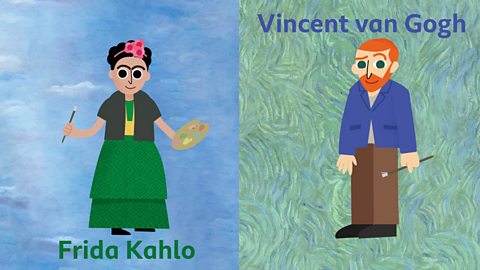
Vincent Van Gogh and Frida Kahlo. video
This animated film compares the lives of Vincent Van Gogh and Frida Kahlo, two famous artists from different time periods, who both found passion and purpose through their unique painting styles.
William Caxton and Sir Tim Berners-Lee. video
This animated film looks at the big ideas of William Caxton and Sir Tim Berners-Lee. Both changed how we share information today, even though they lived over 500 years apart.