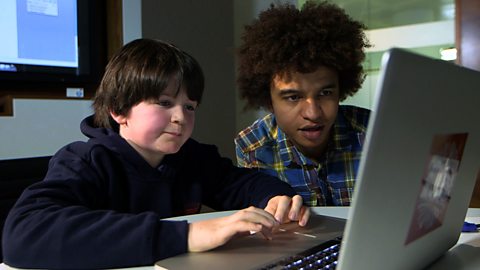
RADZI CHINYANGANYA: This is Manchester Central Library which is home to over half a million books and books are amazing things. With words alone they can take you to a new fantasy world or perhaps even on a dramatic adventure. You can develop characters in your mind which you love or even hate.
RADZI: The job of an author is to create these stories. When they're writing they pay particular attention to punctuation. It helps the reader understand what is happening and without punctuation the sentences would be difficult to read. The great thing about punctuation is that it helps us to make sense. If you put punctuation in the wrong place it makes the wrong sense. And if you leave out punctuation altogether again it doesn't really make sense.
So I'm reading a really interesting book here. It's a refugee diary. It's called Gervelie's Journey by Anthony Robinson and Annemarie Young. Now it's very well punctuated. But let's imagine it was wrong. And I could read something like this. 'You could go in for extra lessons if you wanted and I always did finally. Everything seemed to be going well for Dad and me. Now it's not the way it should be you see because what it should say is 'But you could go in for extra lessons if you wanted and I always did. Finally everything seemed to be going well for Dad and me. So that 'finally' it's very important that there's a full stop in front of it and a comma after it so that it tells us that that's the last bit coming at the very end. That's just one example. So full stops and commas they help you break things up in the right kind of way so that things make sense.
Well it is time for our next challenge and this one involves you Syafikah. So if you'd like to come and sit here.
Now this is a story about an escaped alligator. It's got text in which needs punctuating. Let's take a look. Using the illustrations Syafikah must work out where the inverted commas go in the text. She must also demonstrate the correct use of the question mark and full stop. What do you think? See if you can have a go yourself.
Let's see how Syafikah does in this task. You may start now.
'How on earth has he escaped?'
Nice one.
'I honestly thought I had trained him well.
Yes. Well done.
'Everybody else's have done the same.'
You're doing well.
'It's all part of an alligator's development Mum.'
Syafikah let's see how you did. Syafikah expertly used the speech bubbles and the illustrations to decide which character said what and related that to the text to help her decide where the inverted commas went. She also used a question mark after Mum's line 'How on earth has he escaped?' One thing Syafikah forgot was the full stop at the end of the child's sentence. 'It's all part of an alligator's development Mum.' Syafikah well done. But who fancies another challenge?
ALL: Me!
Let's go.
Video summary
Presenter Radzi and a group of children visit Manchester Central Library to learn how to identify correct punctuation (inverted commas, full stops, question marks) in a paragraph of a story.
Author Michael Rosen reads an excerpt from a book and explains how important punctuation is.
The children are set a task involving punctuating direct speech in a paragraph.
The task is presented as speech bubbles and a paragraph, and errors are corrected.
This short film is from the BBC series, Punctuation Rules.
Teacher Notes
This short film could be used as an introduction to writing dialogue in a narrative.
You could create similar based tasks with speech bubbles for pupils to convert into paragraphs, or pupils could read a paragraph and pull out the examples of dialogue to insert into speech bubbles.
This short film is relevant for teaching English language and literacy at KS2 and KS3 in England, Wales and Northern and 2nd Level in Scotland.
Using punctuation in advertising - brackets, commas and dashes. video
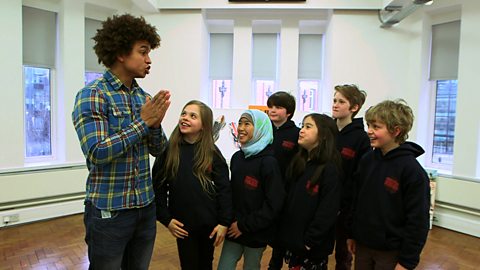
Radzi and a group of children visit an advertising agency to learn about the importance of punctuation in advertisements.
Verbs, adverbs and fronted adverbials in sports journalism. video
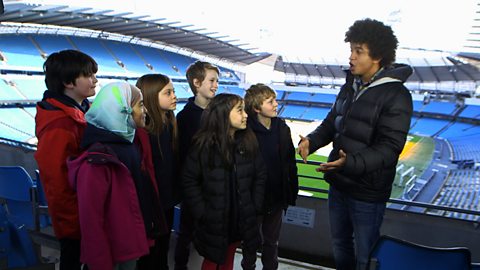
Radzi and a group of children visit Manchester City Football Club to learn why grammar and punctuation are so important in sports journalism.
Confusing sentences - using commas and hyphens. video
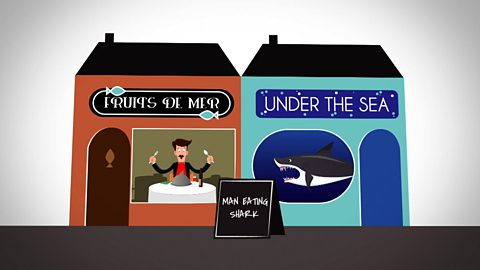
Radzi and some children visit a shopping arcade, where they look at a series of boards with confusing messages.
Why is punctuation important in news? video
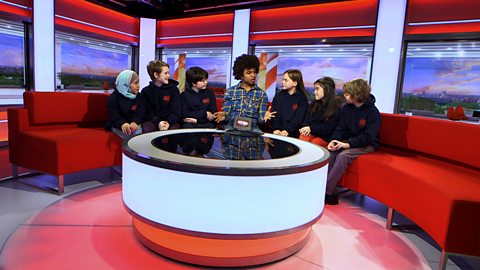
Radzi and a group of children set out to discover why punctuation is important for clarity in the BBC newsroom.
Using punctuation in presentations - colons, semi-colons and bullet points. video
Radzi and a group of children visit a law firm to learn about using punctuation in presentations, finding out about colons, semi-colons and bullet points.