RADZI CHINYANGANYA: Guys welcome to BBC Sport. BBC Sport don't justcover television they also cover radio and online as well and the amount of sports they cover is unbelievable. They cover everything from rugby football and cricket to athletics darts and snooker as well and the sports journalists which you can see and maybe hear around me they watch they review and they analyse all of the sporting developments which they then later write up into articles. BBC Sport journalists report on major sporting events around the world. They must write up their stories using short punchy sentences with the correct punctuation to make that impact.
So I've got a question for you - how many of you like football?
ALL: Me!
Me too and that's a very good reason. It's one our nation's favourite sports so what better place to complete our next challenge than in a Premier League football stadium? Who wants to go there?
ALL: Let's go.
Yes! I've got some very good news for you today cos we are here at the home of Manchester City Football Club the Etihad Stadium. Feast your eyes upon this beautiful creation! It is phenomenal and it's also the place where we'll be doing our challenge with you Charlie… Yes! … which is a football match report. Let's take a look at it.
WHISTLE BLOWS This is a game of two halves. At kick-off Charlie needs to identify the fronted adverbials in these sentences and correctly place the comma. If you're wondering what a fronted adverbial is then take a look at this.
OK so do you remember what a verb is? It's a doing or action word. For example… The verb in that sentence is 'ate'. An adverb is a word that describes the verb. The adverb in this sentence is 'quickly'. It tells us how Zak ate his breakfast. An adverbial phrase is a group of words that act together as an adverb giving more information about the verb or adjective in the sentence. Unlike an adverb it's used to explain how where or when something happened. The adverbial phrase in this sentence is 'before sunrise'.
When does Zak eat his breakfast?
Before sunrise.
Fronted adverbials are fronted because they've been moved to the front of the sentence before the verb. In other words fronted adverbials are words or phrases at the beginning of the sentence used to describe the action that follows. As in 'Before sunrise Zak quickly ate his breakfast'. The fronted adverbial is 'before sunrise.' After the fronted adverbial a comma is normally used. Let's see how Charlie does.
WHISTLE BLOWS
So Charlie this challenge sounds harder than it actually is. Your time will start when I blow this whistle. Three two one…
HE BLOWS WHISTLE
'Last weekend.'
That's the fronted adverbial Radzi.
Yes.
'After an intense warm-up'?
I think that's one.
Yes! He knows what he's doing.
THEY CHANT: Charlie! Charlie!
'Within minutes.'
That's one.
ALL: Goal!
What a finish!
HE BLOWS WHISTLE
Charlie you dominated possession in the first half so now we're going to look at your possession of the plural kind the plural possession in the second half.
After half-time Charlie needs to use the apostrophe correctly to show plural possession. For example for plural nouns that end in an 's' simply add an apostrophe to the word after the letter 's'. Why don't you have a shot at this punctuation challenge? Let's see how Charlie does.
Charlie you will start when I blow this whistle. Three two one…
HE BLOWS WHISTLE"
'Both teams' spirits.'
ALL: I've… Ooh!
How many teams would there be?
Yes. Two. There we go.
THEY CHEER
You're on a roll. And there.
ALL:
RADZI BLOWS WHISTLE
Goal!
That is full time Charlie and let's see how you did. Charlie had his eye on the ball at all times and was quick to identify all the fronted adverbials and use the comma correctly.
'Last weekend a football match took place.' The fronted adverbial in that sentence is 'last weekend'.
When did the football match take place?
Last weekend.
'After an intense warm-up both teams took their position on the pitch and the whistle was blown.'
The fronted adverbial in that sentence is 'after an intense warm-up'.
When did the team take their position on the pitch?
After an intense warm-up. 'Within minutes the half-time whistle was blown.'
The fronted adverbial in that sentence is - yes you're right - 'within minutes'.
When was the half-time whistle blown?
Within minutes.
Charlie hesitated in the early part of the second half but quickly regained his composure and delivered two beautiful touches to plural possessive words 'teams' and 'others'.
They think it's all over… It is now!
THEY CHEER
Charlie you were fantastic but it is now time for our next challenge. Let's get going!
Video summary
Radzi and a group of children visit Manchester City Football Club to learn why grammar and punctuation are so important in sports journalism.
They are challenged to identify fronted adverbials in a match report and insert the comma in the correct place.
Radzi explains what a verb, adverb and fronted adverbial are in a very visual way before the task begins.
The second part of the task is to use the apostrophe correctly to show plural possession.
There are a number of very clear examples displayed before this task begins.
Radzi returns to the task to check the contestant’s answers and correct responses are clearly highlighted.
This short film is from the BBC series, Punctuation Rules.
Teacher Notes
Pupils could apply their knowledge from this short film and write a sports report for a real school event.
Teachers may also choose to do recount writing after this activity.
Some pupils may benefit from more practice using the apostrophe to show plural possession.
This short film is relevant for teaching English language and literacy at KS2 and KS3 in England, Wales and Northern and 2nd Level in Scotland.
Using punctuation in advertising - brackets, commas and dashes. video
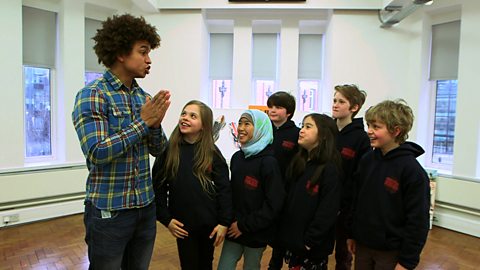
Radzi and a group of children visit an advertising agency to learn about the importance of punctuation in advertisements.
Confusing sentences - using commas and hyphens. video
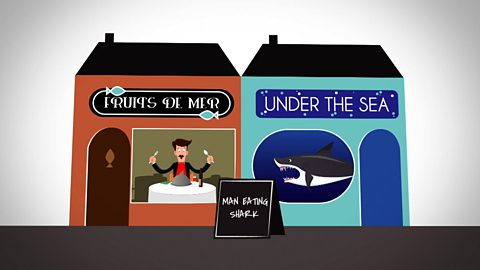
Radzi and some children visit a shopping arcade, where they look at a series of boards with confusing messages.
Why is punctuation important in news? video
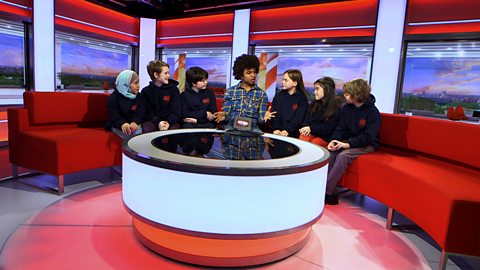
Radzi and a group of children set out to discover why punctuation is important for clarity in the BBC newsroom.
Punctuation in story-writing - inverted commas, full stops and question marks. video
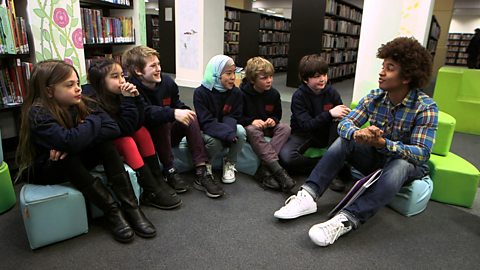
Radzi and a group of children visit Manchester Central Library to learn how to identify correct punctuation in a paragraph of a story.
Using punctuation in presentations - colons, semi-colons and bullet points. video
Radzi and a group of children visit a law firm to learn about using punctuation in presentations, finding out about colons, semi-colons and bullet points.