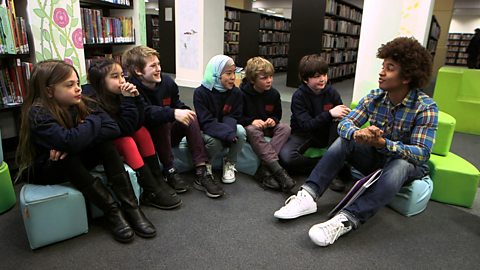
RADZI CHINYANGANYA: We are at DWF which is a really large corporation with over 2500 people working for the company up and down the country. This company specialises in law.
RADZI: UK law is a serious subject matter. Here in the 14 boardrooms a lot of very important meetings take place." We want people to listen carefully and…
RADZI: Often people have to present complicated information in concise ways so everyone can understand. And punctuation helps to do this. The next challenge involves two pieces of text which need punctuation in order to help organise them for a presentation just to make it that little bit more resourceful. This one will involve you Arthur so let's all go into the boardroom and find out more about it.
So Arthur using just bullet points colons and semi-colons you need to organise the text to list the information. Let's take a look at the first text. In the first part of this challenge Arthur will be using a colon and bullet points. Bullet points are visually appealing and are used to draw attention to important information within a document so that our reader can identify the key issues and facts quickly. Also bullet points tend to have more impact if the text is relatively short. Try and have a go at deciding where the colon and the bullet points go in this text. In our first text we can only use a colon and bullet points to list the text. Arthur you may begin the task… now!
Oh. Is there a bit of pressure?
Yeah I forgot which one is…
Ah yes. What made you put that colon there?
Well it's a break from a sentence.
And a bullet point there. Why is that?
Because it wouldn't make sense all together.
So you're putting it into a list? What else is in that list?
Oh you've got the hang of this.
Oh I forgot which one was meant to go in there!
If you read it out loud maybe it will make more sense.
So regular breaks are built into the schedule and a screen…
'And' doesn't need to be there.
So you got rid of the 'and' why was that?
Because if you put a bullet point in it wouldn't make sense.
OK Arthur it's time to see how you did. Arthur did really well spotting the part of the text that introduced the list and correctly used a colon. He also deleted the 'and' word before the last item in the list. Great work Arthur!
Let's take a look at your next text. Arthur must use a colon and semi-colons to list the information in this text. Here a colon is used to introduce a list of items. And the semi-colon is used in a descriptive list because the sentence is extended with the description of each item. Can you find where the colon and semi-colons go in this text? Let's see how Arthur does.
In this text we can only use colons and semi-colons to list the information. Arthur you can start now.
Straight away with a colon. What made you put that there?
Well it is the start of a list and colons show you that you are starting a list.
Perfect. What made you put that semi-colon there?
Because it's the next item that has been found.
And why did you put that semi-colon there?
Cos it's another item on the list. And there doesn't need to be a semi-colon there because it's the end of the list and you need to put an 'and'.
OK Arthur let's see how you did. Arthur did fantastically well in finding the right places for the colon and semi-colons. He also correctly identified that in a descriptive list the word 'and' remains before the last item. Amazing job Arthur!
CHEERING
Video summary
Radzi and a group of children visit a law firm to learn about using punctuation in presentations.
They find out what a board meeting is, and about presenting information in a precise manner.
They insert colons and list items from a paragraph into bullet points.
Radzi and the children have a conversation about the use of ‘and’ in a bullet point list.
In the second part of the task, the children need to use a colon and a semi-colon.
Using a colon to introduce a list and semi-colons to separate items in a descriptive list are explained.
This short film is from the BBC series, Punctuation Rules.
Teacher Notes
If pupils are working on a piece of non-fiction writing, they may need to understand how to use bullet points.
Pupils will be able to practice their understanding of skimming and scanning to illustrate that they have understood the main points of a text.
Using semi-colons in a descriptive list could be a practical activity where pupils create their own sentences in a particular context – what a doctor needs, how to be a top goal scorer, how to apply gel nails, etc.
This short film is relevant for teaching English language and literacy at KS2 and KS3 in England, Wales and Northern and 2nd Level in Scotland.
Using punctuation in advertising - brackets, commas and dashes. video
Radzi and a group of children visit an advertising agency to learn about the importance of punctuation in advertisements.

Verbs, adverbs and fronted adverbials in sports journalism. video
Radzi and a group of children visit Manchester City Football Club to learn why grammar and punctuation are so important in sports journalism.

Confusing sentences - using commas and hyphens. video
Radzi and some children visit a shopping arcade, where they look at a series of boards with confusing messages.
Why is punctuation important in news? video
Radzi and a group of children set out to discover why punctuation is important for clarity in the BBC newsroom.

Punctuation in story-writing - inverted commas, full stops and question marks. video
Radzi and a group of children visit Manchester Central Library to learn how to identify correct punctuation in a paragraph of a story.