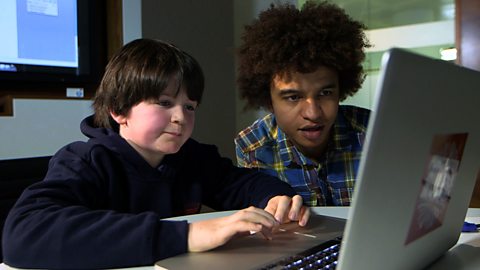
RADZI CHINYANGANYA: This right here is the BBC newsroom. BBC News are responsible for gathering and broadcasting news and current affairs and here journalists will collect information and carry out research forbreaking news stories which they then write about. The department is the largest broadcast news organisation in the world. The newsroom works around the clock every day of the year so a lot of writing takes place here.
Punctuation plays a vital role in the writing of BBC journalism and using it correctly is of crucial importance. Being a television journalist and being a television news presenter I often have to read other people's words and so they have to make sense and that is why punctuation is so important because punctuation makes a sentence make sense. If the sentence isn't correct we're going to read it wrong and therefore it's going to make no sense to the viewer. The punctuation points are essential the capital letters in a sentence are absolutely essential because they can change an entire meaning and it I read it wrong it means the viewer is not getting the true meaning of that sentence.
Welcome to the home of BBC Breakfast. This is where news gets broadcast every single day. You're on the very sofa. Now it's also the home of our very first challenge because Connie you're going to be taking on the challenge. It's a news story which involves a school and a family of hedgehogs.
There you go.
Let's take a look at the news story. This report is to be read out at BBC Breakfast News but you'll notice that some punctuation is missing. Connie must correct the punctuation in the text for the BBC newsreaders otherwise they'll read it wrong and the viewers will not understand the report. Connie will need to add the following punctuation. Capital letters a full stop a question mark an exclamation mark commas to separate items in a list and an apostrophe where letters are missing. These punctuations should already be familiar to you but it's always good to remind ourselves. So here goes.
Capital letters are used for the start of sentences names of people and places and the pronoun I. A full stop looks like this and is used to mark the end of a sentence. A question mark looks like this and is used at the end of a sentence to show it's a question. Questions often begin with the words… An exclamation mark looks like this and can be used when someone is excited or shouting or if they're saying something that's surprising or forceful. A comma looks like this and is used between each item in a list except for the last item when you use 'and'. And finally an apostrophe which looks like a comma but is used differently. You can use an apostrophe to show possession - that one thing belongs to another. You can also use apostrophes to show that you've left some letters out in a word or when joining words together using contractions - that's two words shortened to make one - like these. It makes your writing easier to read and more friendly.
Let's take anotherlook at that news report. Try and have a go at this challenge in your home or in the classroom. Now let's see how Connie got on.
OK Connie you can begin your task now!
Good. Straight away you've got that one. Nice one!
What could that be?
Full stop.
Yes. Good. Well done.
That one's a bit tricky.
Yes! Go on Connie.
THEY CHEER
OK Connie let's see how you did. Connie made a promising start with the news report and was quick to notice that the head teacher's name needed to begin with capitals. But she wasn't able to spot the apostrophe needed in the word 'wasn't'. She did however place the full stop in the correct place at the end of the sentence. Connie did really well in spotting where the question mark needed to go. And successfully used the comma to separate items in a list. And finally she used the exclamation mark to show that hedgehogs congratulating each other was indeed a surprising thing for the hedgehogs to do. All in all Connie did an excellent job.
MUSIC: BBC Breakfast Theme Tune
Good morning. This is Breakfast with Bill Turnbull and Louise Minchin. Local primary school children decided to hold a winter fair with a difference after the discovery of a family of hedgehogs in their school grounds. Initially the head teacher Mr Seuss wasn't too keen on the children's idea to organise relay races. I mean hedgehog racing is a bit cruel isn't it? However once he had watched the family of hedgehogs organise themselves into teams he was convinced. Yes the hedgehogs appeared to understand the rules including lining up in teams passing the leaf racing to the finish line and even congratulating each other!
MUSIC: BBC Breakfast Theme Tune
So Connie task successfully completed. High-five! Are you excited for another one?
ALL: Yeah!
Video summary
Radzi and a group of children set out to discover why punctuation is important for clarity in the BBC newsroom.
The importance of getting your punctuation right in news and journalism is highlighted.
One of the children has to put the correct punctuation into a paragraph, including full stops, question marks, exclamation marks, capital letters, commas and apostrophes.
The function of each punctuation mark is clearly explained and further examples are given to consolidate learning.
Her correct answers are clearly highlighted and her incorrect responses are corrected and explained.
This short film is from the BBC series, Punctuation Rules.
Teacher Notes
Pupils could peer assess the contestant or take part at home or in the classroom.
You could repeat this activity with a different text after using this short film as a stimulus.
This short film is relevant for teaching English language and literacy at KS2 and KS3 in England, Wales and Northern and 2nd Level in Scotland.
Using punctuation in advertising - brackets, commas and dashes. video
Radzi and a group of children visit an advertising agency to learn about the importance of punctuation in advertisements.
Verbs, adverbs and fronted adverbials in sports journalism. video
Radzi and a group of children visit Manchester City Football Club to learn why grammar and punctuation are so important in sports journalism.
Confusing sentences - using commas and hyphens. video
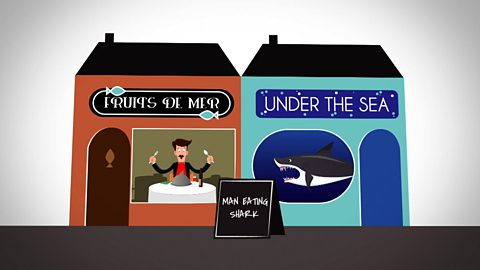
Radzi and some children visit a shopping arcade, where they look at a series of boards with confusing messages.
Punctuation in story-writing - inverted commas, full stops and question marks. video
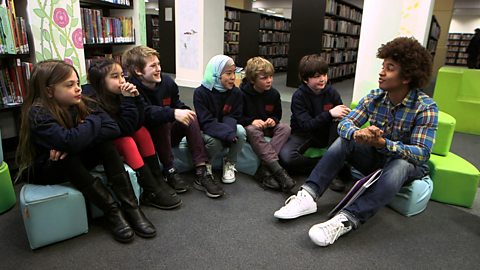
Radzi and a group of children visit Manchester Central Library to learn how to identify correct punctuation in a paragraph of a story.
Using punctuation in presentations - colons, semi-colons and bullet points. video
Radzi and a group of children visit a law firm to learn about using punctuation in presentations, finding out about colons, semi-colons and bullet points.