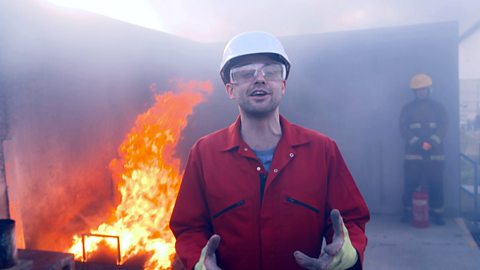
PRESENTER:One of the most famous events at a Strongman contest, is the truck pull. Where one man attempts to pull a truck like this.
PRESENTER:And the mountain stood behind me is Eddie Hall. The strongest man in Britain.
PRESENTER:Eddie.
EDDIE:Hi.
PRESENTER:Thanks for being here. How heavy is this truck?
EDDIE:This one has been weighed in at 12 tonnes, so it's a pretty light truck considering.
PRESENTER:OK, it's a light truck?!
EDDIE:Yep.
PRESENTER:And what about today? We're going about 10 metres? This is easy, is it?
EDDIE:Yeah, it should be, minus the rain.
PRESENTER:OK.
EDDIE:But I'm wearing rock climbing shoes that should hold up in the wet weather, so… Should be all well.
PRESENTER:Alright. Let's do it.
PRESENTER:Alright Eddie. Three, two, one. Go!
PRESENTER:Come on Eddie!
PRESENTER:Eddie, Eddie, Eddie!
CHEERS
PRESENTER:Come on Eddie!
PRESENTER:Yes!
PRESENTER:Just one more metre. Come on, Eddie! Come on Eddie. Yes!
EDDIE:Ow.
PRESENTER:Did that get a little bit harder at the end there?
EDDIE:Yeah, I think there's a bit of an incline. So it got… Yeah… Usually it gets easier as you get going but that got harder.
PRESENTER:Flipping heck.
EDDIE:But got a good pump on.
PRESENTER:Congratulations.
PRESENTER:So what did you think of that?
ALL:Really good.
PRESENTER:It was amazing wasn't it. It looked really hard, didn't it… Could you do it, do you think?
ALL:No.
PRESENTER:No way. No way.
PRESENTER:Do you think as a group, all six of you together, you could be as strong as Eddie?
ALL:No.
PRESENTER:There's no way. OK, well I'm going to set a challenge for you now. The challenge is… As a group… You're going to pull that truck.
PRESENTER:Alright?
CHILD #1:No.
PRESENTER:Yes. Because… We're going to use science.
PRESENTER:Alright, this is Olivia. She's an engineer from the University of Sheffield.
PRESENTER:'Olivia's easily lifting that heavy weight. Maybe it's because she's incredibly strong Or maybe it's because she's using a pulley system. But could a pulley system help these children pull a 12 tonne truck?'
PRESENTER:A pulley is just a wheel, like this.
PRESENTER:But it's a wheel that has a groove running all the way around it. Which means you can thread some rope in there. And the rope will run around the groove, like that.
PRESENTER:'Sophia has accepted the bucket lift challenge. Olivia has connected up a single pulley.'
OLIVIA:Go on then. Is that difficult?
PRESENTER:'It's difficult because the pulley is connected with just one rope on the bucket. So Sophia is carrying all the weight.'
OLIVIA:We're going to see now if another pulley will help.
PRESENTER:'Now there are two ropes supporting the bucket.'
OLIVIA:Do you think that's easier?
SOPHIA:I think it's easier.
PRESENTER:'The weight is shared between two ropes and Sophia feels half the force. It's like the difference between lifting a heavy weight on your own
PRESENTER:'and sharing with friends. When four of you lift together, the weight is shared between four. And pulley's work the same way.
PRESENTER:'With more pulley's it's even easier. To find out how much easier, just count the ropes supporting the weight.'
OLIVIA:How much easier do you think it is?
SOPHIA:I think it might be six times easier… Because there's six ropes.
PRESENTER:Right, Olivia, I'm trying to get my head round this because it seems like pulley's make everything easier. So we should just put pulley's on everything. It's like free strength.
PRESENTER:'But you can't get strength for free. And Olivia is going to prove it.'
OLIVIA:So what I've done here is I've marked a point on the rope and we're going to pull this one metre and see how far the bucket moves.
PRESENTER:Alright, here we go. One metre.
OLIVIA:Yup, so I've got the rope now and if you measure the distance between the table and the bucket.
PRESENTER:Ah that's nowhere near a metre, is it?
PRESENTER:So… that… is about… 16 centimetres.
OLIVIA:So that's a sixth of the distance that you pulled.
PRESENTER:So sixteen centimetres is about a sixth of a metre?
OLIVIA:-That's right.
PRESENTER:-So it's six times easier But I have to pull it six times further. And I end up doing the same amount of work. I see. Clever. Very clever.
PRESENTER:'Engineer Olivia has found a pulley system strong enough to pull a truck.'
PRESENTER:Right, so what system have we got here?
OLIVIA:So this is a six to one pulley system.
PRESENTER:-So what? Six times easier?
OLIVIA:-Yeah.
OLIVIA:Which means we'll have to pull six times further.
PRESENTER:'It's time for the children to attempt to match Britain's strongest man. They look a bit nervous.'
PRESENTER:Alright. We’re hooked up. Are you ready?
ALL:Yeah!
PRESENTER:Yeah? Are you confident?
ALL:Yes.
PRESENTER:You think you can do it?
ALL:Yes.
PRESENTER:Alright, let's give it a try. We'll do it on the count of three. Everyone get in position… Get ready. Alright. Three, two, one! Go!
LAUGHS
EDDIE:Come on guys.
PRESENTER:Yes come on.
PRESENTER:Come on, this way a little bit.
PRESENTER:Yes! It's moving. You are moving a truck.
EDDIE:Come on guys, move forward.
PRESENTER:This is amazing.
PRESENTER:'The pulley's made it much easier for the children than for Eddie. But look how far they had to go.'
EDDIE:I think that's it guys. I think we're over the line.
PRESENTER:Yes!
PRESENTER:You're over the line guys, yes!
ALL:Yeah!
EDDIE:Well done
PRESENTER:We did it. Thanks to Olivia, our engineer, thanks to Eddie, who showed us how it's done and thanks to the science of pulleys.
CHEERS
After observing Britain’s strongest man pulling a 12 tonne truck a group of children are challenged to work as a team, using science, to pull the truck too.
An engineer from Sheffield University demonstrates how using pulleys can make it easier to lift a heavy weight.
After explaining what a pulley is, the children take part in a simple demonstration to show that the more pulleys you use, the easier it is to lift a weight.
This is explained as the weight being ‘shared’ between the pulleys. The more pulleys, and hence the more ropes, the easier it is.
Measurements are taken to quantify the relationship between the number of pulleys used and the distance that the weight is moved, e.g. with six pulleys the weight is lifted one sixth of the distance.
The children then apply this knowledge to help them complete the challenge of pulling the truck.
This short film is from the BBC series, Operation Awesome, in which students explore a range of amazing practical science challenges with presenter Steve Mould.
Teacher Notes
Key Stage 2
This short film could be used to introduce the idea that some mechanisms, including pulleys, allow a smaller force to have a greater effect.
Pupils could be set a challenge of their own to design and make their own pulley system to lift a heavy load.
They could research other examples found in history where pulleys were used e.g. pulleys were used to get water out of a well, or in constructing large buildings.
They could explore real life examples where pulleys are used today e.g. flagpoles, theatre curtains, window blinds etc.
Key Stage 3
This short film could be used to introduce the idea that simple machines give a bigger force but at the expense of smaller movement (and vice versa): product of force and displacement unchanged.
Pupils could carry out an investigation themselves using pulleys, measuring the size of the force and the distance moved for different numbers of pulleys, plotting the results on a graph, and calculating the work done to identify a pattern in the results.
They could explore and research more complex examples of pulleys in real life e.g. in exercise equipment, rock-climbing, cranes etc.
Curriculum Notes
This short film will be relevant for teaching science at Key Stage 2 or Second Level in Scotland, or physics at Key Stage 3 or Third Level in Scotland.
More from Operation Awesome
Will gears let children pull a piano uphill with their bikes? video
Presenter Steve Mould challenges a group of cycling 10 and 11 year olds to pull a piano up a hill. They investigate gears to see how bikes could complete the challenge.
Helicopter rescue and the science of floating. video
Steve Mould’s treasure is lost underwater. Children use the science of floating and displacement to raise it from the bottom of the pool with the smallest amount of air.
How to make the fizziest bath bomb. video
Challenged by Steve Mould to make the fizziest possible bath bomb, children test a range of recipes. They work out how to measure ‘fizziness’ (the amount of CO2) and make sure it’s a fair test.
How dinosaurs footprints get made in solid rock. video
A group of children are challenged to find real dinosaur footprints on the beach – and discover why it takes many millions of years for footprints to be made in solid rock.
How to calculate the height of a dinosaur from its footprint. video
How do you find the height of the dinosaur from dinosaur footprints? Because human and dinosaur legs are similar, you can do it by measuring the length of your own leg and foot.
Seeing through smoke - the heat camera. video
A group of 10 and 11 year olds have to rescue someone from a smoke filled building in the dark. They get to choose a special camera to help. How will they pick the right one?