STEVE:This is nice, isn't it? Out in the countryside on our bikes.
STEVE:What is that?
STEVE:You alright mate?
PIANIST:Ah no, my, my, my car's broken down, I need to get this piano up the hill. I'm late for the concert.
STEVE:Well good luck.
STEVE:Wait. I've got an idea. It's going to sound crazy but we can get that piano up the hill using our bikes.
ALL:What?
STEVE:And do you know what? Someone's joining us right now, she's a cycle expert and she might be able to help, shall we try it?
ALL:OK.
STEVE:Alright. Sophie, thank goodness you're here.
SOPHIE:Hi Steve.
STEVE:Now Sophie, is a hill climb cycling champion. She's an Olympic hopeful as well so she knows a thing or two. And look I don’t know if this is a crazy idea, hoiking a piano up a hill. What do we need to know?
SOPHIE:Bikes can do all sorts, what you really need to know about is gears.
STEVE:Gears OK, so we need to do some investigation. Alright so if you sit tight. Come on let's go.
STEVE:It's all about gears. Tell me more about gears.
SOPHIE:Well on the children's bikes, there's gears one to eight and those make a difference to how the bikes go.
STEVE:I tell you what, let's set everyone to first gear.
STEVE:Are we all in first gear?
ALL: Yes.
STEVE:Alright let's do it.
STEVE:'We've started off in gear one, which is very easy. Each time we change up to a higher gear the bike goes faster and faster but gets harder and harder to pedal.'
STEVE:Eighth gear is hard but you go faster. First gear is easier but you go slower. So if eighth gear is going fast, what's the point of having low gears?
ALL:For going uphill.
SOPHIE:We need to try going uphill.
STEVE:For going uphill? OK great.
STEVE:Alright we're on a hill now so we can test this. Tell you what we'll split into two. So you four be in first gear, we'll be in eighth gear, right? Alright here we go. Three, two, one.
PANTS
STEVE:'It's almost impossible to get started in gear eight, but look at those guys in gear one, they can just spin those pedals.'
SOPHIE:Get a move on Steve.
STEVE:Right, well I think that proves it. So a high gear is good because you can go fast but it's hard. So a low gear makes it easier to cycle, especially uphill.
STEVE:What is a gear anyway? It's just a circle with some teeth around the outside. And the reason it's got teeth is so you can join it onto another gear, like this.
STEVE:So when this one moves, this one moves as well. And look, this one's going clockwise but this one's going anti-clockwise. So when they join together like this, they go in opposite directions.
STEVE:But what we're really interested in, is gears of different sizes. So let's have a look at this one.
STEVE:This gear has 48 teeth whereas this one has 24. Now, 48 is 2 times 24. So let's see what happens to the small gear when we rotate the big gear through a full revolution. It goes around once, twice.
STEVE:So you get two revolutions of this one for every one revolution of this one. So we call it, a 2:1 ratio gear.
STEVE:Let's have a look at this one. We've got 48 teeth again but this smaller one has got 12 teeth. So, 48 is 4 times 12 so let's see what happens to the small one when the big one goes through a full revolution. It goes around once, twice, three times, four times.
STEVE:So you get four revolutions of this one for every one revolution of this one. So we call it a 4:1 ratio gear.
STEVE:To link that back to gears on a bike you say you've got a high gear on a bike, when you've got a high ratio gear. Like this one is higher than this one for example.
STEVE:'On the bike, when you select low gear the chain moves onto the bigger gear wheel.
STEVE:'When you select high gear, the chain moves onto the smaller gear wheel.
STEVE:'But what difference do the different gears make on the road?'
STEVE:I want to see how gears change how far we travel when we use the bikes. So if we can do an experiment. So if you guys set this one to a high gear and you guys set this one to a low gear and then we'll do one turn of the pedal and see which one goes further. Three, two, one, go.
STEVE:Stop this one, and this one keeps going. Stop. OK, so higher gear, makes us go further. Lower gear doesn't go as far.
STEVE:'And because it goes less far, cycling in lower gear is easier.
STEVE:'It's decision time. We've got to pull the piano up the hill but should we choose a high gear, or a low gear.'
UNKOWN MALE:I think we need a lower gear 'cause, as you can feel, it's easier to pedal.
STEVE:Do you agree Eesha?
EESHA:Yeah, I think a low gear too.
STEVE:OK, Sophie?
SOPHIE:Definitely.
STEVE:Alright so, we're gonna go for a low gear which means a big gear ring.
STEVE:So we've phoned around and we've found some help. We've found 18 bikes that have incredibly low gears.
STEVE:So look, a really small gear ring there and a really big gear ring there and we've done the calculations, we reckon we need 18 bikes to pull this piano up so I've got all of these people.
CHEERS
STEVE:Alright, here we go. Is everyone ready?
ALL: Yeah.
STEVE:Alright, three, two, one, go.
STEVE:Yes! Yes! We’re off!
STEVE:'The bikes low ratio gear is letting us pedal fast but the piano goes nice and slow.'
STEVE:Sophie we did it. Guys we did it!
CHEERS
Children meet an Olympic hill-climb cycling champion to learn about gears on a bike. They find out why their bikes have eight gears, the difference between high and low gears, and when you should use them.
They experience that the lowest gear (gear one) makes it easier to cycle but they go slower, whereas the highest gear (gear eight) makes it harder to cycle but they go faster.
How gears work is explained using model gears, linked together in pairs on a board.
By counting the number of teeth on different-sized gears, and counting the number of times each linked gear turns, they learn about gear ratios.
They then carry out a simple experiment on their bikes, to demonstrate the distance travelled for one turn of the pedal in different gears.
The bike with a high gear (high gear ratio) has a smaller gear wheel and moves further than the bike with a low gear (low gear ratio).
The bike with the low gear is easier to pedal.
Children then use their understanding of gears to decide which gear they will need to use to pull the piano uphill.
This short film is from the BBC series, Operation Awesome, in which students explore a range of amazing practical science challenges with presenter Steve Mould.
Teacher Notes
Key Stage 2:
This short film could be used to introduce the idea that some mechanisms, including gears, allow a smaller force to have a greater effect.
This could be used to prompt discussion around their own experience of cycling with gears. They could explore other real-life examples of machines that use gears to make work easier e.g. egg-whisks/food mixers, tin-openers, clock gears etc.
Your pupils could investigate gear ratios themselves, using sets of ‘cogs’ made out of bottle tops fixed to a board, with corrugated cardboard round them to form the teeth, and count the number of turns of each cog.
The quantitative concept of gear ratios can be used to challenge the more able.
Key Stage 3:
This could be used to introduce the idea that simple machines give bigger force but at the expense of smaller movement (and vice versa): product of force and displacement unchanged.
They could extend your pupils' understanding of bicycle gears by considering the combined effect of both front and rear gear wheels.
Pupils could explore other examples where gears are used in real life e.g. simple examples such as egg-whisks/food mixers, tin-openers, clock gears and more complex examples such as car gearbox, rack-and-pinion gears in car steering etc.
Pupils could be encouraged to consider gears as a type of lever or ‘force-magnifier’, identifying the fulcrum or turning point, the effort force and the load force, in different gear systems and calculating the total work done.
Curriculum Notes
This short film will be relevant for teaching science at Key Stage 2 or Second Level in Scotland, or physics at Key Stage 3 or Third Level in Scotland.
More from Operation Awesome
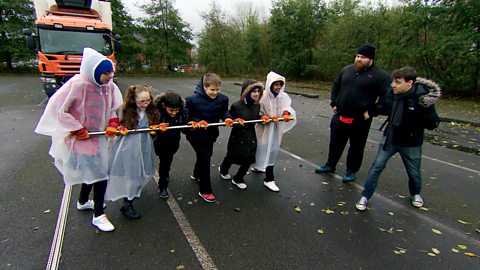
Will pulleys allow children to beat Britain’s strongest man? video
Britain’s strongest man pulls a 12 tonne truck. Steve Mould challenges a group of 9 and 10 year olds to use the science of pulleys to do the same.
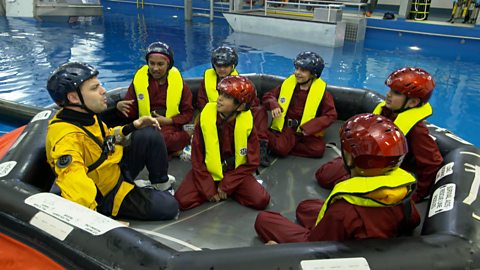
Helicopter rescue and the science of floating. video
Steve Mould’s treasure is lost underwater. Children use the science of floating and displacement to raise it from the bottom of the pool with the smallest amount of air.
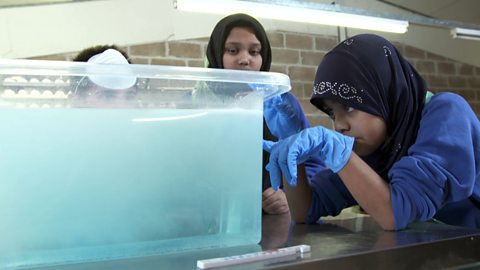
How to make the fizziest bath bomb. video
Challenged by Steve Mould to make the fizziest possible bath bomb, children test a range of recipes. They work out how to measure ‘fizziness’ (the amount of CO2) and make sure it’s a fair test.
How dinosaurs footprints get made in solid rock. video
A group of children are challenged to find real dinosaur footprints on the beach – and discover why it takes many millions of years for footprints to be made in solid rock.
How to calculate the height of a dinosaur from its footprint. video
How do you find the height of the dinosaur from dinosaur footprints? Because human and dinosaur legs are similar, you can do it by measuring the length of your own leg and foot.
Seeing through smoke - the heat camera. video
A group of 10 and 11 year olds have to rescue someone from a smoke filled building in the dark. They get to choose a special camera to help. How will they pick the right one?