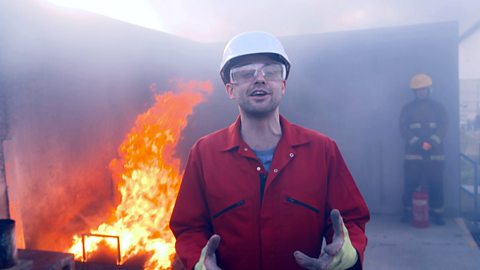
STEVE:There's nothing I like more after a hard day being me, than a long hot soak in a bath. And yes sometimes I like to make it a bit special with some mood lighting and soft music and a bath bomb.
MUSIC STOPS ABRUPTLY
STEVE:Hold on a second, this isn't how it's supposed to be. Where's the fizz?! This is very upsetting.
STEVE:You know, I'm not angry, I'm disappointed. I'm gonna fix this.
STEVE:'To fix my fizz, I'm off to a bath bomb workshop in Cardiff and to help, children from Ninian Park Primary.'
STEVE:So, my challenge to you is you're going to make my next bath bomb, right? But it has to be, the fizziest you can possibly make it.
STEVE:Right? Do you accept?
ALL:Yes.
STEVE:So, we want to make the fizziest bath bombs we possibly can but we have no idea how to make bath bombs at all, can you show us what we need to do?
BATH BOMB MAKER:Absolutely.
STEVE:Brilliant, go for it.
BATH BOMB MAKER:OK, so first of all you need bicarb and in here you've got your colour and your fragrance.
STEVE:So bicarb, that's bicarbonate of soda.
BATH BOMB MAKER:That's correct.
STEVE:That's one of the really important ingredients in a bath bomb.
BATH BOMB MAKER:You then add your citric acid and make sure that we sieve it first because you get lots of lumps in citric acid.
STEVE:Oh OK.
BATH BOMB MAKER:So we're gonna rub it together so you just want to make sure it's all evenly distributed.
STEVE:OK and these are the moulds here.
BATH BOMB MAKER:These are the moulds. Fill up one, you need to mound it up with your mixture. And then you get your second half, Put it on the top, and press it down and then you've got your perfect bath bomb then.
STEVE:So the important thing is the recipe. How much bicarbonate of soda? How much citric acid?
BATH BOMB MAKER:I can't tell you exactly Steve, you're gonna have to find that out for yourself–
STEVE:What?!
BATH BOMB MAKER:because it's top secret. So yeah, you'll have to do that today.
STEVE:Alright fine, we'll do some experiments.
STEVE:'Because Charlotte won't reveal her recipe, we're going to test different mixtures of bicarbonate of soda also known as bicarb.'
STEVE:What mixture have you made?
CHILD #1:One to one.
CHILD #2:One bicarbonate of soda and one citric acid.
CHILD #1:One to one.
STEVE:One to one.
STEVE:'We'll have some bath bombs with more citric acid, some with more bicarb and some with equal parts of both.'
STEVE:And what mixture have you made?
CHILD #3:-One cup of citric acid and two cups of bicarbonate of soda.
STEVE:The main ingredients in a bath bomb are bicarbonate of soda and citric acid because they react together but you'll notice, when I mix these two ingredients…
STEVE:nothing happens
STEVE:and that’s because there's another ingredient missing which is water. So we're gonna add water now which is what happens when you put your bath bomb in the bath.
STEVE:OK now we have a chemical reaction. The sodium bicarbonate is reacting with the citric acid to produce bubbles of gas.
STEVE:That gas is carbon dioxide, which is the same as the bubbles in your fizzy drink.
STEVE:Another one of the things that's made by this reaction is salt. Which dissolves harmlessly into your bath but the question is - how do you measure the fizziness?
STEVE:All these bath bombs have now hardened so they're ready for us to test and we've got different ratios of bicarbonate of soda and citric acid.
STEVE:So, over here we've got 3:1, that's three parts citric acid to one part bicarbonate of soda. Then we've got 2:1, 1:1, 1:2, 1:3 and 1:4. So that is one part citric acid to four parts bicarbonate of soda.
STEVE:So, how are we gonna test which one of these is the fizziest? Is there something we can measure? Yeah?
CHILD #1:How much gas?
STEVE:So we can capture the bubbles in a container and then we'll be able to measure how much gas is in that container. Brilliant. Does that sound good?
ALL:Yes.
STEVE:'The team is measuring the volume of gas from each bath bomb.
STEVE:'We're trapping the bath bomb in a kitchen sieve, then quickly moving a big bottle filled with water over the top.
STEVE:As the bath bomb fizzes, the CO2 gas bubbles rise into the bottle pushing the water out.
CHILD #2:1900 millilitres.
STEVE:'It's marked in millilitres so we can easily measure the volume of gas.
STEVE:'If there's more gas than our big bottle can hold, we have a second one standing by.'
STEVE:So that one had filled up. Now we're filling up this second one.
CHILD #1:Yeah quite big.
STEVE:'Everyone is using the same sized bath bombs made the same way, and the water temperature is always the same'
STEVE:and that should mean that the only thing that changes is the mixture of sodium bicarbonate and citric acid and if we can do that, then we call it a fair test.
STEVE:'The results are in. For each bath bomb mixture, we recorded the amount of gas.
STEVE:'And the winner is - The 1:1 mixture With 14000 millilitres, or 14 litres of gas!'
STEVE:And I want the fizziest one, which means the most gas so which one should I use?
ALL:1:1
STEVE:1:1, that produced the most gas, didn't it?
STEVE:'But when I checked with Charlotte, they use one part citric acid to two parts bicarbonate of soda.
STEVE:'Why would they do that?
STEVE:Don't people want lots of bubbles?
BATH BOMB MAKER:And the reason is, the bath bomb just last that little bit longer in the bath.
BATH BOMB MAKER:So you've got a little bit more time in the bath to enjoy your bath bomb rather than it being over in ten seconds.
STEVE:So I was a bit obsessed with producing the most gas but actually people like to have a long fizz time.
BATH BOMB MAKER:Exactly, it's all about the relaxation with bath bombs.
STEVE:That's brilliant, thank you.
BATH BOMB MAKER:No problem.
STEVE:So we've figured out how to make the fizziest possible bath bomb but after speaking to Charlotte, maybe fizziness, isn't everything.
This is an effective example to illustrate the way that scientists work, in devising a fair test and collecting evidence to inform their conclusion.
The reaction between sodium bicarbonate and citric acid is demonstrated and explained.
The products of the reaction are carbon dioxide gas and salt.
The children carry out an investigation to find the best ratio to use to make the fizziest bath bomb.
They design a fair test, deciding what variables they will need to keep the same (temperature of water, amount of mixture, size of bath bomb), which one they will they will change (ratio) and what they will measure (volume of carbon dioxide gas).
The children then carry out the experiment and present the results to identify which ratio produces the most gas.
The scientist then introduces another factor to be considered – how long the fizz lasts.
The final decision as to which ratio is best is then made.
This film is from the BBC series, Operation Awesome, in which primary pupils explore a range of amazing practical science challenges with presenter Steve Mould.
Teacher Notes
Key Stage 2:
This could be used as an effective example from a real-life context to illustrate how to design a fair test.
Pupils could be asked to identify the different types of variables involved and justify the decisions taken in the film.
They could be asked to identify risks and how these have been addressed.
They could be asked to present the results from the experiment as a graph.
Pupils could then be asked to evaluate the method and to suggest how we could make the results more reliable (for example, by taking repeat readings).
Key Stage 3:
This could be used as an effective example of a real-life context where scientists need to design a fair test.
They could identify the control, dependent and independent variables.
They could evaluate the method and suggest improvements to improve the accuracy and precision of the results.
They could present the results as a graph and discuss the reliability of the data and how it could be improved.
They could be asked to write a word equation or a balanced symbol equation for the chemical reaction between sodium bicarbonate and citric acid.
Curriculum Notes
This film will be relevant for teaching primary science at Key Stage 2 or Second Level in Scotland or chemistry at Key Stage 3 or Third Level in Scotland.
More from Operation Awesome
Will pulleys allow children to beat Britain’s strongest man? video
Britain’s strongest man pulls a 12 tonne truck. Steve Mould challenges a group of 9 and 10 year olds to use the science of pulleys to do the same.
Will gears let children pull a piano uphill with their bikes? video
Presenter Steve Mould challenges a group of cycling 10 and 11 year olds to pull a piano up a hill. They investigate gears to see how bikes could complete the challenge.
Helicopter rescue and the science of floating. video
Steve Mould’s treasure is lost underwater. Children use the science of floating and displacement to raise it from the bottom of the pool with the smallest amount of air.
How dinosaurs footprints get made in solid rock. video
A group of children are challenged to find real dinosaur footprints on the beach – and discover why it takes many millions of years for footprints to be made in solid rock.
How to calculate the height of a dinosaur from its footprint. video
How do you find the height of the dinosaur from dinosaur footprints? Because human and dinosaur legs are similar, you can do it by measuring the length of your own leg and foot.
Seeing through smoke - the heat camera. video
A group of 10 and 11 year olds have to rescue someone from a smoke filled building in the dark. They get to choose a special camera to help. How will they pick the right one?