STEVE:Fire can be incredibly dangerous but there are things you can learn to stay safe and this place teaches fire safety.
STEVE:'I'm here learning about fire and fire extinguishers with children from Westgate primary, in Newcastle.'
FIREFIGHTER:What do you think's gonna happen if I put water onto that diesel fire?
MALE STUDENT #1:It's gonna make it grow stronger.
ALL:Wow!
STEVE:'We're also joined by 13-year-old Ross, from Gateshead who's a young firefighter.'
ROSS:A young firefighter is someone who is a part of the fire service 'and they learn about fire safety and fire drills 'and practice them.'
STEVE:'The danger from fire isn't just from getting burned by flames, it's also the smoke. Smoke can stop you from breathing and it can be frightening as well so next we're gonna learn how to escape from a smoke filled room. 'This is the smoke house. The team from Westgate Primary are finding their way in a room so smoky, they won't be able to see a thing.'
ROSS:One through.
FEMALE STUDENT #1:Two through.
STEVE:'This strange dance is called the B.A. shuffle. Firefighters use it when they are using breathing apparatus, or B.A. Ross shows how it's done. One arm sweeps the wall, feeling for a door, the other checks for anything in front of his face and his front foot clears away anything he might trip over.'
ROSS:One down.
STEVE:'Communication is key. At every stage, team members count themselves in so they know everyone has made it. Ross opens the door, checks for flames and they count themselves into the smoke-filled corridor.'
ROSS:One through.
FEMALE STUDENT #1:Two through.
FEMALE STUDENT #2:Three through.
STEVE:'In the smoky corridor, they've found the stairs.'
ROSS:Stairs clear.
STEVE:'Using their training, they head up the stairs, through another door to safety.'
STEVE:How was that?
FEMALE STUDENT #4:I couldn't see a thing.
STEVE:But you did it though, 'cause you weren't sure whether you could do it.'
FEMALE STUDENT #4:We were trying to see our hands but it was actually pretty hard 'cause there was so much smoke.
STEVE:So next, were gonna do it in a smoke filled room in the dark. How do you feel about that?
FEMALE STUDENT #4:OK.
STEVE:Yeah, OK, yeah I see you're excited about that. I'm gonna make it harder though because it's gonna be a rescue situation. So someone's gonna go missing in a burning building. We've got some equipment to help you. We've got a couple of cameras here. They both help you see in the dark but they work in different ways.
STEVE:So you can only take one of them and you need to figure out which is the best camera to take in. 'Night vision camera one, is an attachment for a smartphone. Camera two looks more like a standard video camera. To make the test fair, the teams use each camera in the light and the dark.'
STEVE:'They'll have to use what they find out to predict which of these night vision cameras works best in smoke. Camera two sees in the dark because it has a special built in light, which shines light humans can't see, called infrared. The pictures are very clear, but would it be good in smoke.'
STEVE:'Camera one works in a completely different way and Abit has worked out what's happening.
ABIT:This is a thermal imaging camera and it sees things through heat. At the moment you're looking quite hot because you're all warm blooded–
STEVE:Yeah?
ABIT:Whilst the floor is blue and that means it's colder…
STEVE:OK.
ABIT:than you are because well, it's not alive or anything.
STEVE:Alright, so we need a final decision from you. Which of these two cameras do you want to use in your rescue mission?
ABIT:I think the thermal imaging camera because what we need to be searching for is the person we need to rescue and if we see something that would be warm then we would know instantly that that would be a person.
STEVE:What do you think would happen with these different cameras when you fill the room with smoke, what would you see in this one?
FEMALE STUDENT #5:I think we would just see–
FEMALE STUDENT #4:In black and white.
FEMALE STUDENT #1:A greyish kind of colour.
STEVE:You'd just see the smoke wouldn't you?
FEMALE STUDENT #4:Yeah and you wouldn't really see that person. You can't really see it cause it's invisible.
STEVE:So, you think that this is the best camera to use.
FEMALE STUDENT #1:Yeah.
FEMALE STUDENT #5:That senses where we are.
STEVE:So let's try it then. 'I've arranged for Connor, the instructor, to go missing in the smoke filled corridor. The team has to rescue him but to make it tougher, this time the lights are out too. Their only hope is their thermal imaging camera. Let's hope that's the right one.' Alright guys are you ready?
ALL:Yes.
STEVE:OK, remember, it's a man down in there we've lost Connor, he's in there somewhere, you've got to rescue him It's a rescue mission OK?
ALL:OK.
STEVE:I need to hear commentary from the people with cameras as you're going. Are you ready?
ALL:Yes.
STEVE:Alright, go, go, go. 'So that we can see what happens, I've borrowed a professional heat camera. This is what the team can see with their eyes. Totally dark. And here's the view from the night-vision camera they rejected. It's working but it can't see through the smoke.'
STEVE:'But with the thermal phone camera, it's a completely different picture. With the heat camera, they've spotted Connor and our crew at the top of the stairs. They've done it. Ross and the team lead Connor through the door to safety.'
STEVE:OK so, what happened? Tell me what happened.
ABIT:I was still able to see people with this so this means that it could still see in the dark even though there was a lot of smoke.
FEMALE STUDENT #4:Yeah we could just see Connor glowing and just sitting on the top of the stairs and then I had to tell everybody, he's up there, he's up there–
STEVE:So you saw on the camera and then you told everyone else Connor's on the stairs. Alright so you made it, brilliant and you rescued Connor as well, amazing.
Pupils visit a Fire Safety teaching centre to learn about fire safety and fire drills.
A fire-fighter demonstrates the use of breathing apparatus and the ‘BA Shuffle’ technique for walking through a smoke-filled room.
Focusing mainly on the dangers of smoke, pupils are provided with two types of night-vision camera which will enable them to see in the dark.
One uses infra-red light and the other is a thermal-imaging camera.
They are asked to carry out comparative tests on the two cameras, comparing their ability to detect objects and people, in both the light and the dark.
Using their observations they are asked to report on their findings and decide which would work best in a smoke-filled room, explaining their choice.
They then use their chosen camera in a simulated fire-rescue situation, successfully locating and rescuing a person from a smoke-filled room in the dark.
The children choose the thermal-imaging camera, explaining that it will detect the body heat from a human.
This short film is from the BBC series, Operation Awesome, in which students explore a range of amazing practical science challenges with presenter Steve Mould.
Teacher Notes
Key Stage 2:
This is an effective example of the application of science to real-life contexts.
Your pupils could produce a fire-safety poster and could suggest safety issues when putting out various types of fires.
They could use it to form the basis of discussion on planning different types of scientific enquiry when working scientifically.
When learning about how we see objects, by visible light reflecting off surfaces, this could be used to provide cognitive conflict by asking pupils to explain why we cannot see through smoke.
Key Stage 3:
This is an effective example of the application of science to real-life contexts.
Pupils could discuss why visible light cannot pass through smoke.
They could use this as a stimulus to further study on the different wavelengths of light in the electromagnetic spectrum.
Alternatively, it could be used as part of a teaching sequence on how we see objects, with pupils explaining why light does not travel through smoke, and why our eyes cannot detect infra-red light.
The use of the thermal-imaging camera could be used when teaching about respiration, to illustrate that some of the energy released is produced as heat.
When learning about types of chemical reactions this could be used to stimulate discussion on the reactants and products of combustion.
Pupils could then learn about the fire triangle and how to tackle different types of fire.
Curriculum Notes
This short film will be relevant for teaching science at Key Stage 2 or Second Level in Scotland, or physics at Key Stage 3 or Third Level in Scotland, and Cambridge IGCSE Physics.
It is relevant for teaching the following topics: Light & Dark (colours, how we see and the transmission of light through different materials), Fire & Safety, Chemical Changes (combustion as a chemical reaction), Science Skills.
More from Operation Awesome
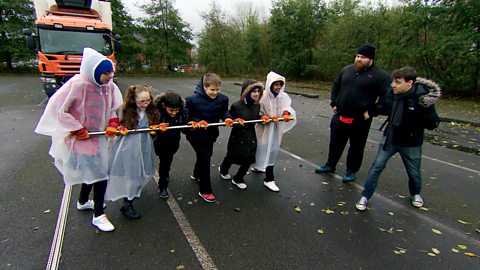
Will pulleys allow children to beat Britain’s strongest man? video
Britain’s strongest man pulls a 12 tonne truck. Steve Mould challenges a group of 9 and 10 year olds to use the science of pulleys to do the same.
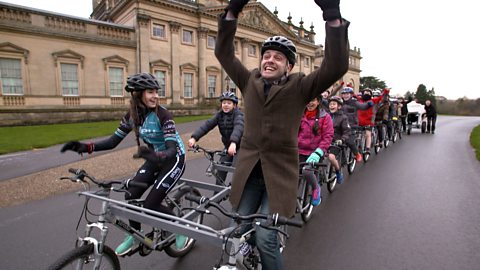
Will gears let children pull a piano uphill with their bikes? video
Presenter Steve Mould challenges a group of cycling 10 and 11 year olds to pull a piano up a hill. They investigate gears to see how bikes could complete the challenge.
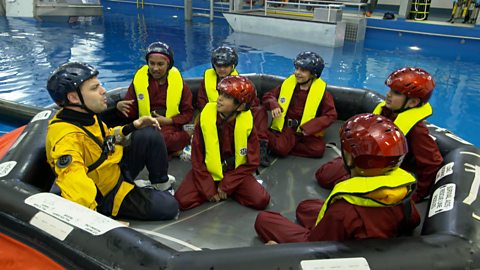
Helicopter rescue and the science of floating. video
Steve Mould’s treasure is lost underwater. Children use the science of floating and displacement to raise it from the bottom of the pool with the smallest amount of air.
How to make the fizziest bath bomb. video
Challenged by Steve Mould to make the fizziest possible bath bomb, children test a range of recipes. They work out how to measure ‘fizziness’ (the amount of CO2) and make sure it’s a fair test.
How dinosaurs footprints get made in solid rock. video
A group of children are challenged to find real dinosaur footprints on the beach – and discover why it takes many millions of years for footprints to be made in solid rock.
How to calculate the height of a dinosaur from its footprint. video
How do you find the height of the dinosaur from dinosaur footprints? Because human and dinosaur legs are similar, you can do it by measuring the length of your own leg and foot.