This is a diary that was kept by a Sergeant in 1915.
We can learn more about World War One from diaries.
It’s good to keep diaries because people in the future can find out what happened at that time.
Kathleen Jane Morgan. Twenty two years old. It’s just a school exercise book. It only cost a penny to buy but it’s the most precious thing that I possess.
My husband, Captain Wilfred John Morgan of the Royal Welsh Fusiliers, wrote in this book every single day. Sometimes he was too tired to scribble more than a couple of words but every day he wrote something.
Someone’s spilt coffee on this page and look…here …it’s been trodden on by muddy boots. And here the corner of the front cover has been nibbled. A rat I think.
I often read this page. The last page.
Friday 6th July 1916 . Mametz Wood. The Somme. Then he writes “It’s 8.30 at night. Still light and very warm. Earlier I talked to my men about the big push tomorrow. Told them that when we went over the top they were to stick together and follow their sergeants. Told them not to run but to keep walking steadily until they reached the German lines. Said we weren’t expecting much trouble from the enemy because our guns had been shelling their lines for three days and they’d probably all run away by now. Then I wished them all luck and told them to try and get some sleep. ‘It’s going to be alright men,’ I said. ‘We’re going to be fine.’
There isn’t any more. They found this book on his body the next day. When they told me they were going to send it to me I was frightened that I might find blood on it or a bullet hole or something. But there’s nothing. Just a coffee stain and a muddy footprint and the missing corner where a rat had its breakfast.
Video summary
This short film is for teachers and review is recommended before use in class.
School pupils examine diaries written during the war years and discuss what we can learn from them.
The value of first-hand accounts and primary source materials is illustrated.
A dramatic monologue introduces Kathleen Jane Morgan, 22 years old, who reads the final entry from her husband’s diary, kept while he was at the front.
This clip is from the series WW1 A to Z.
Teacher Notes
Pupils could freeze the frame to view details of one of the diary entries shown.
What can they discover about the life of the man who wrote the diary?
The children could go to search online and in printed texts for diary entries from the war years.
The website of the National Archives has examples of war diaries on open access.
Pupils could compile a collection of telling phrases to form a wall display about first-hand reactions to the war.
They could respond to the question, ‘What can first-hand accounts tell us that history books and websites cannot?’
This short film is suitable for teaching history at Key Stage 2 / Second Level or above.
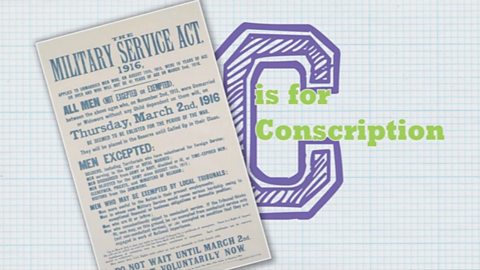
C is for Conscription. video
Newsreel and dramatic footage describe how Britain introduced conscription - compulsory army recruitment - in 1916.
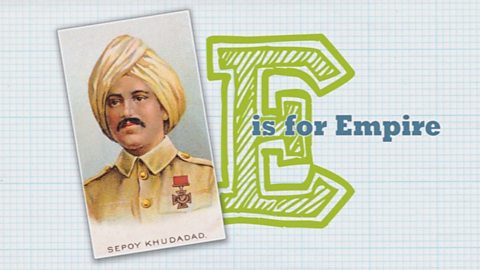
E is for Empire. video
Newsreel and commentary explain how the British Empire helped in WW1. An Indian soldier describes his brave actions in battle in a monologue based on a true story.
F is for Food. video
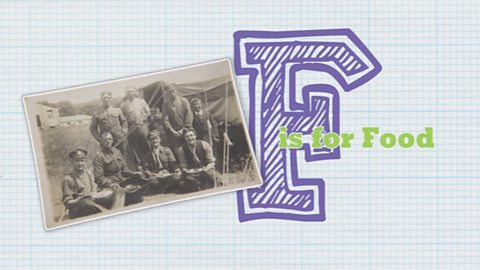
Newsreel, commentary and a monologue from an army chef in his field kitchen illustrate what soldiers in the WW1 trenches were given to eat.