British Empire colonies sent more than two and a half million men to fight.
India sent more than a million men.
Indian soliders were called Sepoys.
4050, Khudadad Khan, Sepoy - Indian Army. Twenty six years old.
When we Sepoys arrived in France last year we were determined to show the world that we were brave fighters. We didn’t have to wait long to prove ourselves.
In October 1914, the Germans attacked in Northern Belgium. We were rushed to the front lines and told to stop the enemy advance but nothing could stop the Germans that day. We tried to hold them back with our machine guns but they just kept coming.Wave and wave of Germans rushing towards us.
We Sepoys were outnumbered five to one but each man fought bravely. We knew we had to hold that line. Men were coming to help us. We had to keep the Germans back just long enough.
One by one our men were hit until mine was the last gun firing. And then I was hit too. A bullet smashed into my left shoulder. But I was the last man left. I had to keep going. Keep firing. That was my job.
Then I heard this huge explosion and the next thing I knew I was lying on the ground. I heard footsteps and voices whispering in German and so I lay very still and pretended that I was dead. I tried to crawl back to our lines but I must have fainted. When I woke up I heard different voices. Voices whispering in my language. I was safe. I had found my regiment.
Our actions that day held the Germans back long enough for our reinforcements to arrive. And stopped them breaking through . And that is why His Majesty, King George V came today to this hospital on the 25th January 1915, and gave me, Khudadad Khan, The Victoria Cross.
Video summary
This short film is for teachers and review is recommended before use in class.
Newsreel and commentary explore the contribution of the British Empire to the war effort.
Britain’s colonies sent over two-and-a-half million fighting men to the European front, more than one million from India alone.
In a dramatic monologue based on a true story, Sepoy Khudadad Khan, 26 years old, gives his account of a 1914 battle in northern Belgium.
Sepoy Khudadad suffered severe injuries. But he survived to receive the Victoria Cross for his gallantry, from King George V.
This clip is from the series WW1 A to Z.
Teacher Notes
Pupils could find out what other resources the colonies contributed, in addition to troops.
Why do pupils think these countries supported the British war effort?
The children could discover when each of Britain’s colonies gained its independence.
This short film is suitable for teaching history at Key Stage 2 / Second Level or above.
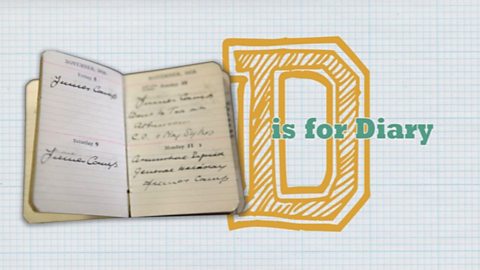
D is for Diary. video
Pupils examine wartime diaries and discuss the value of first-hand accounts. In a monologue, a war widow reads from her husband’s diary.
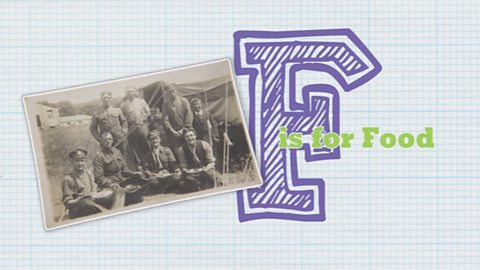
F is for Food. video
Newsreel, commentary and a monologue from an army chef in his field kitchen illustrate what soldiers in the WW1 trenches were given to eat.
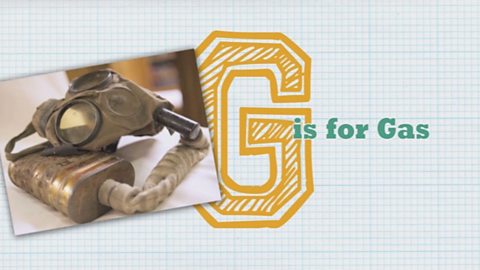
G is for Gas. video
School pupils handle a British gas mask from WW1. Newsreels of the period show soldiers using gas masks in training and at the front.