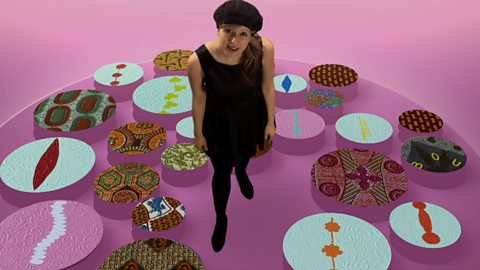
Presenter:Oh, you're just in time. This is my favourite part of the day.
Presenter:Everyone's gone, they turn out the lights, and I can look up through the windows at the stars and planets moving across the sky.
Presenter:It must have been amazing when scientists first started discovering everything up there. In space. You don't get much of that in older paintings.
Presenter:It's probably because for ages artists were told to stay away from science and stick to painting historical stories or landscapes or people like old Sir Winbag here.
Presenter:A man called Wright thought this was totally wrong. Everyone ended up calling this man Joseph Wright of Derby because guess what, he was from Derby.
Presenter:He painted this picture in 1766. Wright loved science. And he loved giving long names to his paintings.
Presenter:This one's called… A Philosopher Giving That Lecture On The Orrery In Which A Lamp Is Put In Place Of The Sun.
Presenter:Well I know about lamps and the sun but… I have no idea what an orrery is. I reckon I should probably go and join in the talk.
Presenter:Oop!
Presenter:Oh, oop! Sorry.
Presenter:I think that might have been someone's toes. It's a bit dark in here.
Presenter:Okay. I can just about see some bookshelves, which makes me think we're in the library of someone's house. And that man in the red jacket, painted to look so big and impressive, is the scientist.
Presenter:And this must be the orrery that he's showing the group. Let's see if I can get a closer look.
Presenter:Oh! Now I see! That golden ball in the middle is the sun, and all the other planets have been placed around it.
Presenter:There's a handle. Oh, that sends all the planets on their different orbits. Wow.
Presenter:There's Earth with our moon. And there's Mercury, closest to the sun. Which the scientist has decided to show with a burning, hot lamp.
Presenter:So why did they want to sit around watching this?
Presenter:Well we know lots about the planets now, but that's only because people like this clever clogs scientist found out about them.
Presenter:We've got films and computers to show us all of space but at the time of this painting, the orrery was the best way to show the universe in action.
Presenter:Perhaps these are the people that Wright saw when he went to one of these talks. A woman, deep in thought. A man, scribbling loads of notes. And children, trying to get as close as they can.
Presenter:In fact they're peering at Saturn, the closest planet to the sun.
Presenter:Hang on? What about Uranus or Neptune? And Pluto?
Presenter:Oh. They hadn't been discovered yet in 1766. So we are a little bit cleverer than him after all.
Presenter:Wright wants us to see how exciting this new science is. So he shows us everyone gathered together in the dark.
Presenter:Now a painter-- Oop, done it again.
Presenter:Now a painter uses the lamp just like the flash on a camera or the sun coming in through a window to light up objects in the dark.
Presenter:Artists like Wright knew that a face or a scene could look different depending on where the light source is coming from. The front.
Presenter:The side.
Presenter:From underneath.
Presenter:Look how everything's changing.
Presenter:Our eyes can only see where the light falls and we have to imagine everything else. For this painting, Wright knew exactly where he should put the lamp. In the centre, like the sun at the centre of the universe. With everyone leaning out of the dark to see the light.
Presenter:And the light is science. Helping people to see and understand new things in the world.
Presenter:If I told those two kids that now we're flying robots to Mars, I don't think they'd believe me.
Presenter:Imagine all the modern discoveries you could put in a picture, that those kids haven't even dreamed of. I wonder which one you'll paint for them first.
A statue comes to life in a magical gallery and walks into the painting 'A Philosopher Giving That Lecture on the Orrery where a Lamp is put in Place of the Sun' by Joseph Wright of Derby.
Inside the painting she explores Wright of Derby’s use of a single light source to draw attention to particular elements of the work, and discusses representation of the period of Enlightenment in works of art.
We explore the techniques Wright of Derby used to create his works, and his placement within the artistic world at the time of the painting and beyond.
In a mixture of live action, animation and elements of the painting itself, the clip brings the painting to life and ends by encouraging viewers to paint a modern invention or discovery in a way that explains its purpose.
This clip is from the series Your Paintings.
Teacher Notes
This clip is useful for introducing the concept of light and shade in paintings and drawings.
Children can use a hand torch as a light source which, when placed at different angles around an object (such as an apple or orange), produces not only light and dark areas on the fruit but also a distinct shadow.
This is a vital skill in artistic development and can be most easily done using drawing pencils or charcoal and white chalk to create monochromatic images to practice the principle.
This can then be applied to more complicated artwork in different media as children become more aware of the light source to their subjects - usually the sun directly or from a window or a nearby lamp.
Allow them time to experiment with the principle and to produce different images by applying what they have understood.
Curriculum Notes
This clip will be relevant for teaching Art and Design at KS2 in England, Wales and Northern Ireland and at 2nd Level in Scotland.

More from Your Paintings:
Henri Rousseau’s 'Surprised!' video
Presenter-led animated examination of Henri Rousseau’s 'Surprised!', exploring the use of imagination in painting.
L.S. Lowry’s 'Britain at Play' video
An examination of L.S. Lowry’s 'Britain at Play' exploring style, technique and context.
Paula Rego’s ‘Sleeping’ video
An examination of Paula Rego’s 'Sleeping' which explores storytelling through painting.
Andy Warhol’s ‘Marilyn Diptych’ video
An examination of Andy Warhol’s 'Marilyn Diptych', exploring the notion of celebrity.

Eileen Agar’s ‘Bride of the Sea’ video
An examination of Eileen Agar’s 'Bride of the Sea', introducing surrealism and collage.
Jan van Eyck’s ‘Arnolfini Portrait' video
An examination of Jan van Eyck’s ‘Arnolfini Portrait' looking for hidden meanings.
Kandinsky’s ‘Schaukeln’ video
A look at Wassily Kandinsky’s ‘Schaukeln’ which introduces abstract art and synaesthesia.
Yinka Shonibare’s ‘Line Painting’ video
Presenter-led animated look at Yinka Shonibare’s ‘Line Painting’ which introduces conceptual art and multiculturalism.