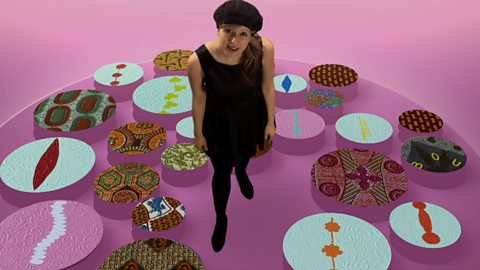
Speaker 1: Oh. It's you. For a moment I thought you were just another tourist wanting to take my photograph.I'm used to people staring and taking pictures.
It's part of a statue's job.But it does get annoying after a while.Nowadays everyone seems to want to be famous though, don't they? Chefs. Footballers wives.Singers with crazy hair on talent shows. Dancing dogs. Anyone can be a celebrity.But people don't always remember you for very long.Just ask Lord Posh Pants. He was very famous.
Speaker 2: Mmm!
Speaker 1: Hundreds of years ago.
Speaker 2: Eeuw.
Speaker 1: There was a time, though, when to be a celebrity you had to work really hard to be the very best at something that everybody loved.Like the actress Marilyn Monroe. In the 1950s she was one of the most famous and beautiful film stars in the whole world, and everyone wanted to know everything about her.I fancy going to meet a real celebrity.
Make a bit of room will you, Marilyn?Marilyn Monroe was a superstar. She had platinum-blonde hair, deep eyeshadow, and thick red lips that everyone wanted to kiss.If they'd had the internet then, she would have been the top story every day.
Now, this painting could have just been called "Marilyn". But in fact, it's called "Marilyn Diptych", which means it has two halves.Because unfortunately, Marilyn died when she was very young.And maybe that's why the second half feels sadder. The image is fading away, as if it represents both her life and the memory of her. And today, these pictures of Marilyn Monroe are as famous as she was.
They were made by an artist called Andy Warhol, who was living in New York and surrounded by celebrities.Everyone was already listening to the new popular - or pop - music.Now Warhol helped to create pop art'.He did this by making art from objects that people saw around them every day, like…cereal boxes.Or soup tins.Or pictures of Marilyn Monroe.
So, when Marilyn died, Andy Warhol decided immediately to make a portrait of her using this famous photograph.But he didn't just want to make one portrait of her.He made another.
And another… And another. And another…And another.And, yeah, he made loads.It looks more like an advert, doesn't it, on a wall.
It's not surprising, because Warhol used a printing technique that was big in advertising.He pulled inks through a screen mesh using a rubber squeegee.This meant he could quickly produce the same image on lots of different canvasses over and over and over again.
He used big bright colours to grab our attention and to make us look - at the colour of the eyes,the hair,and the lips.Soon, Warhol was making so many pictures he had to hire assistants and move to a big new space called The Factory.And he did all this to show how Marilyn could start to look like anything else made in a factory.It's like me. I'm a person. I've got feelings.But if you were to see my face over and over again in block colours,I would start to look just like the outside of a cereal packet or a magazine cover.
[MUSIC: "I Wanna Be Loved By You" sung by Marilyn Monroe]
Warhol did what artists have been doing for hundreds of years.He made us look at things we know in a new way.Because what I know is there's a real person in this photograph,yet the more I look at it the less I can seem to find of her.
So, maybe Warhol wanted to show us that we don't really know who Marilyn Monroe was after all.We only know her as a celebrity.And fame and celebrity don't last forever.
We're used to seeing celebrities faces everywhere nowadays…on T-shirts, on television, online, on our phones…but you can still be famous for being really good at something too.
So, if you were to become well known… what would it be for?
A statue comes to life in a magical gallery and climbs into the painting “Marilyn Diptych” by Andy Warhol.
Inside the painting she explores Warhol’s fascination with celebrity and the notion of celebrity as product.
We explore techniques Warhol used to create his works, and his placement within the artistic world at the time of the painting and beyond.
In a mixture of live action, animation and elements of the painting itself, the clip brings the painting to life and encourages viewers to question the nature of celebrity and prompts a discussion of what each of us would be famous for.
This clip is from the series Your Paintings.
Begin by looking at the works of Andy Warhol and other famous Pop Artists online. Use ICT software to trial printing and stamping before transferring to actual printing materials.
Share a selection of everyday packets, cans and containers to look at and discuss packaging designs.
The children could be offered simple printing equipment including blocks, stampers, printing foam and mono-prints to create repeated patterns or images on paper of copied designs, progressing onto their own when ready.
Encourage the children to experiment with colour schemes which aren’t necessarily true to the original subject, by allowing them to find complementary and contrasting colours and to apply them for specific effects, such as making the object stand out or look ridiculously unusual (eg a blue banana.)
This could be repeated with a variety of non-commercial items and re-printed many times over.
Curriculum Notes
This clip will be relevant for teaching Art and Design at KS2 in England, Wales and Northern Ireland and at 2nd Level in Scotland.

More from Your Paintings:
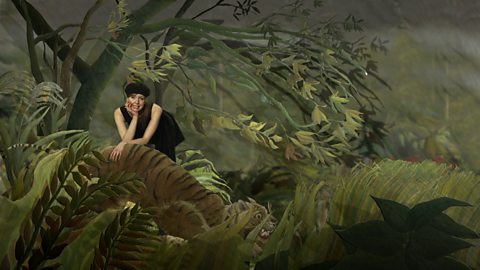
Henri Rousseau’s 'Surprised!' video
Presenter-led animated examination of Henri Rousseau’s 'Surprised!', exploring the use of imagination in painting.
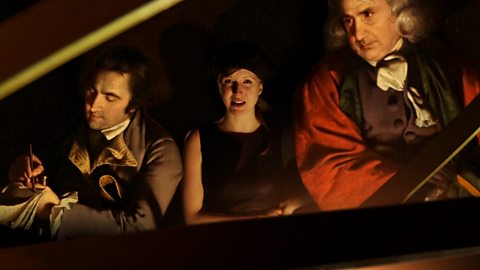
Joseph Wright of Derby’s 'Orrery' video
An examination of Joseph Wright of Derby’s 'Orrery' exploring the use of light.
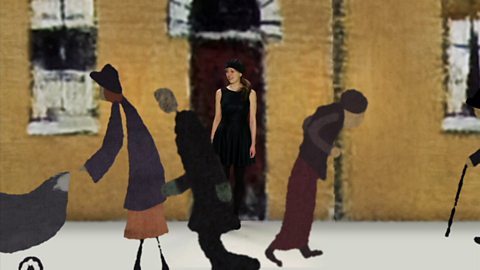
L.S. Lowry’s 'Britain at Play' video
An examination of L.S. Lowry’s 'Britain at Play' exploring style, technique and context.
Paula Rego’s ‘Sleeping’ video
An examination of Paula Rego’s 'Sleeping' which explores storytelling through painting.
Eileen Agar’s ‘Bride of the Sea’ video
An examination of Eileen Agar’s 'Bride of the Sea', introducing surrealism and collage.
Jan van Eyck’s ‘Arnolfini Portrait' video
An examination of Jan van Eyck’s ‘Arnolfini Portrait' looking for hidden meanings.
Kandinsky’s ‘Schaukeln’ video
A look at Wassily Kandinsky’s ‘Schaukeln’ which introduces abstract art and synaesthesia.
Yinka Shonibare’s ‘Line Painting’ video
Presenter-led animated look at Yinka Shonibare’s ‘Line Painting’ which introduces conceptual art and multiculturalism.