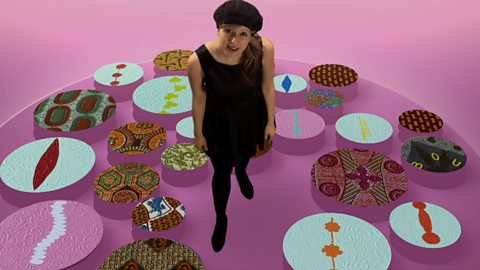
PRESENTER: Oh! [chuckles] Thanks for sticking around! Now it's quiet, I was just trying out some different ways of looking at the world.
Because there's more than one way, you know.
Just ask the Russian painter Wassily Kandinsky. Late one night in 1908, he was walking through his studio and he saw an incredible picture. It was just a collection of coloured shapes. He didn't know what it meant, but he LOVED it.
And then he suddenly realised. It was one of his own paintings hanging upside down!
A bit like this.
And he knew immediately that he liked it better that way.
Kandinsky spent the rest of his life trying to get that feeling into his paintings.
Like this one, which he painted in 1925. It's called "Schaukeln", which in English means "shaking".
I think I'll try and hitch a ride.
Argh!
For years, Kandinsky had been painting horses, and castles, fields, and mountains, and boats. The usual stuff.
But now that things got turned upside down, he couldn't do that any more.
Instead of painting things as he actually saw them, he used shapes and colours to show how he felt about life.
Because the world could be tough.
Ugh! It could be… exciting. It could be sad.
It could be happy. And it could be all of these things, all at the same time.
With these ideas, Kandinsky helped to create a whole new type of painting, called abstract art. But all those other painters, who'd spent years learning how to draw horses and castles, felt like their heads were going to explode.
"How could something have any meaning," they shouted, "if it didn't look like anything?"
Well, have you ever felt so happy you might burst?
What did that feeling look like?
Like this?
And if you're feeling really tired, what does that tired feeling look like? Like this? Or this?
Are green and brown a little lonely?
Do red and yellow shake the most?
Are some shapes hard and tough?
Are others warm?
These were the questions Kandinsky kept asking, because he wanted to paint the emotions inside us.
And he had another idea too.
Because one day, when he was listening to music he saw colours and lines flying right in front of his face.
And he realised…
he didn't just see colour, he could hear it too.
So what sound do you think yellow is?
VIOLIN PLAYS
Kandinsky thought it was a high sound. And blue?
CELLO PLAYS
That could be deep and low.
While red might be strong and sharp.
TRUMPET BLASTS
Kandinsky thought his paintbox was like a keyboard and the artist was the hand that played it. He even called some of his pictures compositions because he felt he was composing them.
They had the rhythm and movement of a song, and every one of the colours was a musical note.
Wow! So this–
this is how Kandinsky saw the world.
Definitely different!
But I bet you see the world in your own way, don't you? Everyone does.
Ooh!
MAN IN PAINTING: Euw…
PRESENTER: My head's spinning too after all that.
I feel excited, and exhausted, and wide awake, and sleepy!
I wonder how you paint all that…
CHIME
A statue comes to life in a magical gallery and climbs into the painting 'Schaukeln' or 'Shaking' by Wassily Kandinsky.
Inside the painting she explores Kandinsky’s role in the birth of abstract art, his discovery of his synaesthesia, and his use of colour to express feelings.
We learn about the techniques Kandinsky used in his compositions, and his placement within the artistic world at the time of the painting and beyond.
In a mixture of live action, animation and elements of the painting itself, the clip brings the painting to life and ends by encouraging viewers to paint their feelings.
This clip is from the BBC Two series Your Paintings.
Teacher Notes
This clip could be used to introduce the work of Kandinsky and the abstract artists and/or in a discussion about famous artists, art history, or painting.
It could also be used as a stimulus for painting sounds and emotions.
Curriculum Notes
This clip will be relevant for teaching Art and Design at KS2 in England, Wales and Northern Ireland and at 2nd Level in Scotland.

More from Your Paintings:
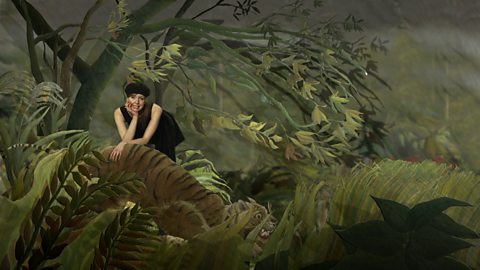
Henri Rousseau’s 'Surprised!' video
Presenter-led animated examination of Henri Rousseau’s 'Surprised!', exploring the use of imagination in painting.
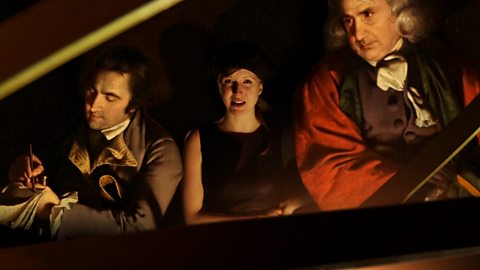
Joseph Wright of Derby’s 'Orrery' video
An examination of Joseph Wright of Derby’s 'Orrery' exploring the use of light.
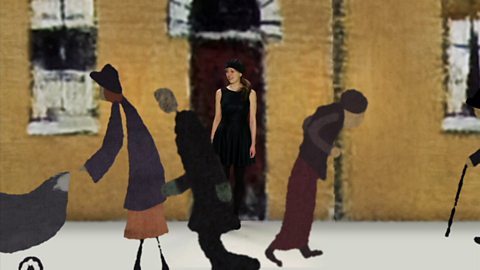
L.S. Lowry’s 'Britain at Play' video
An examination of L.S. Lowry’s 'Britain at Play' exploring style, technique and context.
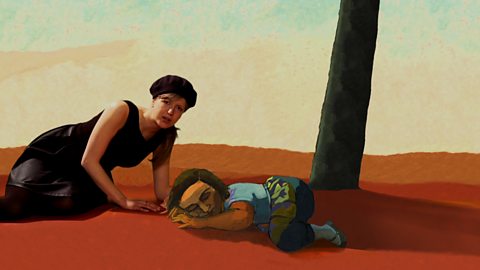
Paula Rego’s ‘Sleeping’ video
An examination of Paula Rego’s 'Sleeping' which explores storytelling through painting.
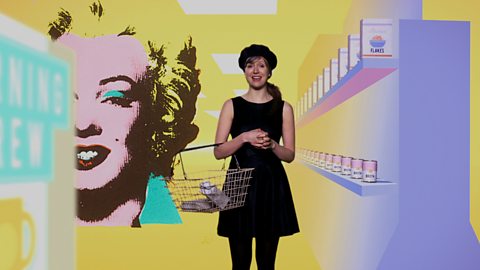
Andy Warhol’s ‘Marilyn Diptych’ video
An examination of Andy Warhol’s 'Marilyn Diptych', exploring the notion of celebrity.
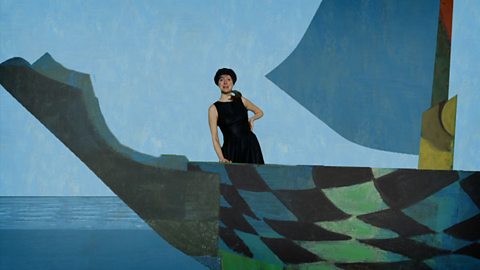
Eileen Agar’s ‘Bride of the Sea’ video
An examination of Eileen Agar’s 'Bride of the Sea', introducing surrealism and collage.
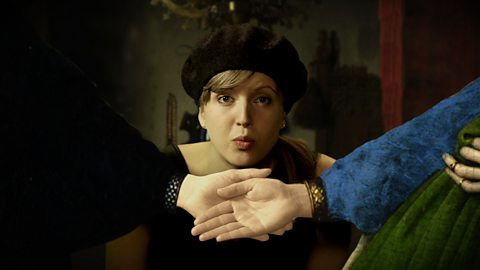
Jan van Eyck’s ‘Arnolfini Portrait' video
An examination of Jan van Eyck’s ‘Arnolfini Portrait' looking for hidden meanings.
Yinka Shonibare’s ‘Line Painting’ video
Presenter-led animated look at Yinka Shonibare’s ‘Line Painting’ which introduces conceptual art and multiculturalism.