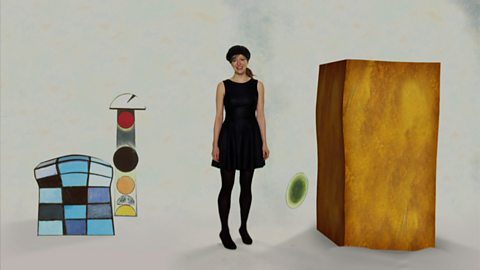
Presenter:Glad it's you and not that horrible security guard. You know earlier I heard him say I was just a bronze statue. I'm much more than that.
Presenter:But it did get me thinking. Who am I? Who are you? What makes you, you? Is it where you're born? Where you live? What you look like?
Presenter:Or is it all about where your parents are from, like my pal the Duke of Grumpyshire? Well… I think it's all of those things. And more. But definitely none of us is just one thing.
Presenter:The man who did this painting, Yinka Shonibare, was born in England in 1962 Grew up in Nigeria, in West Africa, and then moved back to live in London
Presenter:So he knows all about how one person can have lots of different parts to their life.
Presenter:Shonibare is a conceptual artist, which means he starts his work with a question or a concept, and then looks for images or objects to help us think about that idea.
Presenter:This picture is called Line Painting. Looks so beautiful and bright doesn't it.
Presenter:And if this is the answer, I want to know what his question was.
Presenter:Before making this work, Shonibare had been wondering what images people thought about when they imagined Africa.
Presenter:He remembered the traditional African fabrics for sale in his local market in London and he bought some.
Presenter:These fabrics were traditionally made by creating patterns on cotton with wax, which was then dyed and coloured. The designs were bright and eye catching, Some bold and strong, some delicate with tiny details.
Presenter:Everywhere in the world, West African men and women were known for using these fabrics. To make dresses, hats, shirts and trousers.
Presenter:So Shonibare was sure that he'd found an image that was 100% African. Right? Wrong.
Presenter:He soon discovered… So these fabrics weren't just about one story either. Because they're not just African. They're Indonesian too.
Presenter:Loads of these patterns and fabrics were first created there. But when Holland was in charge of Indonesia, the Dutch people started borrowing all the patterns and making them back at home. Some people even started calling them Dutch wax fabrics.
Presenter:So they're Dutch, oh and they're British too, because we started producing them in Manchester.
Presenter:The Dutch tried selling them back to the Indonesians but they liked their own fabrics, thank you very much.
Presenter:So around 100 years ago, the British and Dutch traders took their boats to West Africa instead. Their fabrics were a big hit there. The boats kept coming and going.
Presenter:In countries like Ghana and Nigeria these bright confident designs were what everyone wanted.
Presenter:Soon West Africans were making these fabrics too and wearing them all over the world.
Presenter:So perhaps that's why this picture's called Line Painting. Because although we can't see them, there are lines joining up all of these different cultures.
Presenter:And the end result… Is these complicated and colourful patterns
Presenter:Some of the patterns might look very old, others very new, but each one is unique.
Presenter:Some have got symbols on them, like this one for European money Or this animal. Looks like a lion to me. What do you think?
Presenter:Perhaps every one of these circles is like a country, each full of their own different traditions. And is this bigger circle like the world holding them all together?
Presenter:Or maybe a big bowl, where everything gets mixed up.
Presenter:Each person who looks at a piece of conceptual art, will see something different.
Presenter:I think it's great that Shonibare asked a question and went to his local market, because now I've discovered that African fabric isn't just African after all.
Presenter:In the same way I'm not just a bronze statue,
Presenter:I'm a statue made from copper and tin, in Cornwall, melted together in London.
Presenter:I'm also a big fan of art.
Presenter:I also love custard.
Presenter:I'm also running late.
Presenter:So there must be loads of different things that make you, you. How would you put them all together in a painting?
A statue comes to life in a magical gallery and climbs into the painting 'Line Painting' by Yinka Shonibare MBE.
Inside the painting she explores Sonibare’s concept of multiculturalism and origins, and his work as a conceptual artist.
We learn about the techniques Shonibare uses in his compositions, and his placement within the artistic world at the time of the painting and currently.
In a mixture of live action, animation and elements of the painting itself, the clip brings the painting to life and ends by encouraging viewers to discuss all of the many thing that make each of us unique.
This clip is from the series Your Paintings.
Teacher Notes
This clip could be used as an introduction to the work of Shonibare and current British artists and/or in a discussion about famous artists, art history, or painting.
It could also be used as a stimulus for debate or discussion around ethnicity, multiculturalism, origins or personality.
Curriculum Notes
This clip will be relevant for teaching Art and Design at KS2 in England, Wales and Northern Ireland and at 2nd Level in Scotland.

More from Your Paintings:
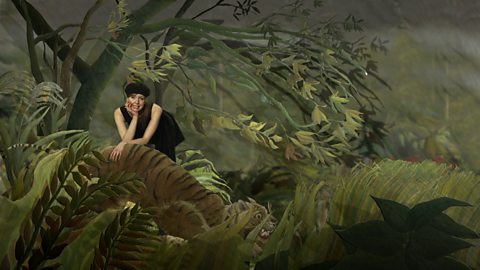
Henri Rousseau’s 'Surprised!' video
Presenter-led animated examination of Henri Rousseau’s 'Surprised!', exploring the use of imagination in painting.
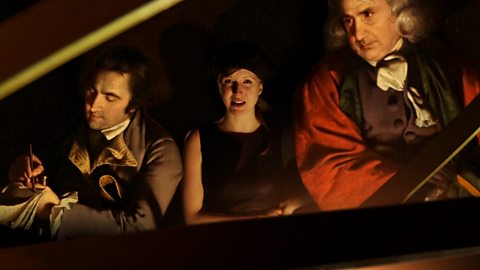
Joseph Wright of Derby’s 'Orrery' video
An examination of Joseph Wright of Derby’s 'Orrery' exploring the use of light.
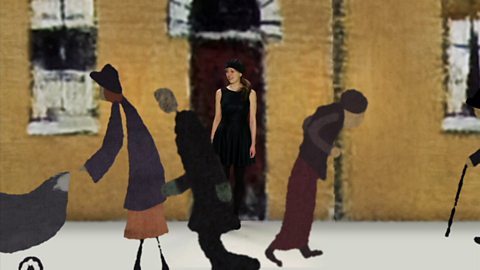
L.S. Lowry’s 'Britain at Play' video
An examination of L.S. Lowry’s 'Britain at Play' exploring style, technique and context.
Paula Rego’s ‘Sleeping’ video
An examination of Paula Rego’s 'Sleeping' which explores storytelling through painting.
Andy Warhol’s ‘Marilyn Diptych’ video
An examination of Andy Warhol’s 'Marilyn Diptych', exploring the notion of celebrity.

Eileen Agar’s ‘Bride of the Sea’ video
An examination of Eileen Agar’s 'Bride of the Sea', introducing surrealism and collage.
Jan van Eyck’s ‘Arnolfini Portrait' video
An examination of Jan van Eyck’s ‘Arnolfini Portrait' looking for hidden meanings.
Kandinsky’s ‘Schaukeln’ video
A look at Wassily Kandinsky’s ‘Schaukeln’ which introduces abstract art and synaesthesia.