Who was Elizabeth I and what were the key events of her reign?
NARRATOR: In 1558 one of the most famous monarchs in history inherited the throne: Queen Elizabeth I. She ruled for 45 years at a time when women were thought to need guidance from men. But even though she had a whole era named after her, her reign was one of threats and challenges, challenges that arose largely because of the actions of her father, Henry VIII.
HENRY VIII: I say!
NARRATOR: Let's take it back to untangle this story. Henry VIII had three children: Mary by his first wife, Elizabeth by his second and Edward by his third. Edward being the youngest child, but the eldest male child, became king when Henry VIII died in 1547, as back then mail heirs jumped to the front of the queue. However, Edward was a sickly boy and, at the tender age of15, he also died.
HENRY VIII: No! My only boy.
NARRATOR: But not before he named a cousin, Lady Jane Grey, as his successor in order to stop his Catholic sister, Mary, inheriting the throne. Nine days later, however, Lady Jane Grey found herself imprisoned and…well. So Mary inherited the throne after all. She married King Philip II of Spain. Keep him in mind, he'll be important later. But, alas, continuing the world'sdeadliest round of musical chairs, Queen Mary died and the the last of Henry's children inherited the throne: twenty-five-year-oldElizabeth.
Now, let's look at one of those challenges we mentioned. Mary Queen of Scots was, as her name suggests, theQueen of Scotland. Some people believed that she had a stronger claim to the English throne than her cousin Elizabeth, becauseHenry VIII, Elizabeth's father, had divorced Catherine of Aragon. The Catholic church did not recognise that marriage ashaving ended, so Catholics believed Henry's marriage to Elizabeth's mother, Anne Boleyn, was illegal. This made Elizabethseem like an illegitimate heir.
HENRY VIII: Don't listen to them! I'd put Mary and Elizabeth into my line of succession!
NARRATOR: Mary, Queen of Scots had had problems of her own and she had fled to England, seeking the protection of her dear cousin Elizabeth. Dear Queen Elizabeth, however, was no fool. She recognised the threat of her cousin's claim and had herimprisoned upon her arrival in England. Mary, Queen of Scots remained there for 19 years, until she was caught plottingto overthrow Elizabeth and promptly lost her head.
Now, remember King Philip II of Spain? Mary, Queen of Scots' execution angered him greatly. He, too, was Catholic after all, and so he launched a fleet of ships, an Armada, across the sea. The plan was to overthrow England's Protestant Queen Elizabeth I, convert the country back to Catholicism and make Spain the ultimate power in Western Europe. As the Armada neared the English coast, fire ships with no crew were filled with burning materials and let loose by the English where they were carried bythe trusty wind towards the Spanish. Afraid their ships would set alight, the Spanish ships scattered to the open sea. Still determined, the Armada continued their would-be invasion. Incensed, Queen Elizabeth delivered a rousing speech to her loyal troops, a speech that is remembered to this day as one of the greats.
ELIZABETH I: My loving people…
NARRATOR: …she cried. And then some more important and inspiring stuff. But, er…
ELIZABETH I: …for my God and my kingdom…
NARRATOR: …she said, erm… Ah! Okay, here's the good bit!
ELIZABETH I: I know I have the body but of a weak and feeble woman, but I have the heart and stomach of a king and a king of England too!
NARRATOR: The Spanish Armada fled, sailing up the eastern coast of England. But the trusty English weather wasn't done with the would-be invaders and stormy seas destroyed half of the Armada. It was an astounding victory for Queen Elizabeth and England became one of the most feared naval powers in Europe. The defeat of the Spanish Armada was just one of the significant events inElizabeth I's time as queen. But content on her own, Queen Elizabeth chose to never marry and to never have any children.
ELIZABETH I: The kingdom of England is the only husband I will ever need.
NARRATOR: Then, childless, Queen Elizabeth I died. And with her ended than legendary House of Tudor.
3. Elizabeth I
Elizabeth I (1533 - 1603) would not have expected to become queen. Her younger brother - Edward (1537 - 1553) - became king on the death of Henry VIII in 1547. Edward didn't want his Catholic sister Mary (1516 - 1558) to inherit the throne, so named Lady Jane Grey (1537 - 1554) as his successor. She ruled for just nine days before Mary successfully claimed the crown and became Mary I. However, her reign was a short one and when she died in 1558, Elizabeth became queen.
Some of the key concerns of Elizabeth's reign arose because of the actions of her father, Henry VIII. Henry's divorce from Katherine of Aragon was not recognised by Catholics, who thus felt that his subsequent marriage to Anne Boleyn was illegal and that Elizabeth was thus not a legitimate monarch. This issue of legitimacy partly explains Elizabeth's actions regarding Mary, Queen of Scots (1542 - 1567) and also the Spanish Armada of 1588, the attempt by King Philip of Spain to overthrow Elizabeth and re-establish Catholic rule in England.
Elizabeth I never married. When she died in 1603, James VI of Scotland became simultaneously James I of England - the Tudor dynasty ended and the Stuart dynasty commenced.
Video questions
- When did Elizabeth become queen and how long did she rule for? (1558; 45 years)
- Which three children of Henry VIII are named in the animation? (Edward, Mary and Elizabeth)
- Why did some people feel Elizabeth's claim to the throne was weak? (Catholics did not recognise Henry's divorce from Katherine of Aragon and therefore thought his marriage to Anne Boleyn was illegal - making Elizabeth illegitimate)
- What happened to Mary, Queen of Scots, when she came to England? (She was imprisoned and later executed)
- Can you give two reasons why Philip of Spain wanted to invade England? (Angry at execution of Mary, Queen of Scots; make England Catholic; establish Spain as the dominant country in Europe)
- Why did the Tudor dynasty end with Elizabeth I? (She chose not to marry, therefore did not have any children)
Further resources
Teacher Notes
Download / print the Teacher Notes for this episode.

Downloadable Transcript. document
Download / print the transcript for this episode.
This film is relevant for teaching History within the National Curriculum at KS2 in England and Northern Ireland and equivalent levels in Scotland and Wales.
2. Henry VIII. video
Exploring the circumstances that led Henry VIII to marry six times.
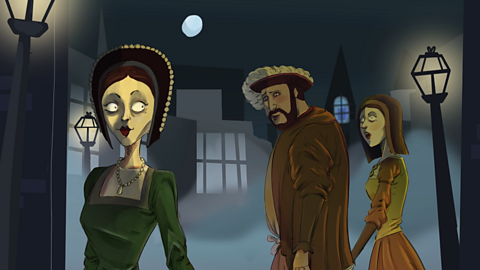
4. Crime and punishment. video
In Tudor times even relatively minor crimes could lead to very grisly punishments.
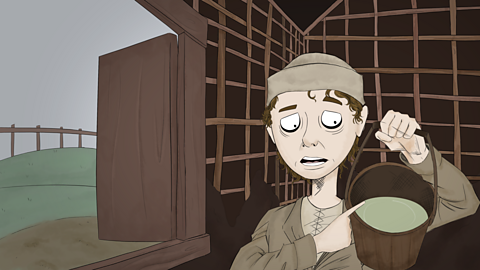
5. 'Trust me, I'm a Tudor doctor' video
Meet Tudor doctor Edward Strangeways, to discover the Tudors' weird and wonderful approach to treating illness.
See also...
Music - Songs about life in Tudor times - a collection of songs about life in Tudor times
Dance - The reign of King Henry VIII - exploring the time of Henry VIII through movement and dance
The Tudors - Audio - comic sketches and powerful dramas exploring life during the Tudor dynasty
