For both rich and poor, crime in Tudor times could lead to some very grisly punishments!
NARRATOR: Tudor life was punishing. For poor people it was an everyday struggle. The rich? Well, they had it a little easier. But one thing remained the same: rich or poor, if you committed a crime, there were some very grisly punishments just around the corner.
ARCHIBALD: Look, this place is so riddled with rats and disease we can't even drink the water. Too much sewage. So what's to drink? Weak ale for me and for the kids weak ale as well. And the food? The food is tasteless, vile muck. Look. Look at this rye bread. You see that? That's not a raisin. That's the first step to dysentery, a very severe case of the runs. The pottage? This thick stew of boiled veg and grain here, is grim. And the spiced meat? Well the only way I can get that is if I steal it. If I'm caught, I'm tied to the whipping post in town and whipped for all to see.
NARRATOR: Yep, the Tudors were all for public punishments. Embarrassment and humiliation were supposed to stop people from committing more crimes and the public loved them. The chance to pelt people with rotten food and worse was too good to miss.
ARCHIBALD: Oi! That's my lunch!
NARRATOR: For those living in towns and cities, life wasn't much easier. Packed streets meant disease was rife and there were some incredibly violent punishments for in some cases, pretty minor crimes.
FRIEDA: Servant life? Yep, fine. Wages, clothing, food, lodgings. Tick. Great. But working around the clock attending to my master's needs is non-stop. Before I even get out of bed, I have to bake bread and pies, wash and dry laundry - never does anything for himself!
MASTER: Tattling again, Frieda? You know what that means.
FRIEDA: No, no, no. I'm sorry. I didn't mean it!
NARRATOR: The scold's bridle - or brank - was often used to punish people who gossiped. A contraption made of iron used to gag the mouth, its purpose was to publicly humiliate as a means of keeping law and order.
RICHARD GOTOBED: She got the scold's bridle, did she? Well, serves her right. This is my abode. The roaring fire. The huge, thick curtains. Welcome to my manor house. Look at all of these books. I can read you know. And that smell is rich elm. That'll be my huge bureau à gradin. Poor people make furniture for practical uses. Us noble folk, for pleasure, to show our grandeur and importance. I don't drink water, no. Water is polluted. So I have to drink wine. Although for wine, this seems a little off.
ALICE GOTOBED: Life? Life is fine for us a richer folk. Grand banquets of pies, lamb, venison. People working all hours to cater to my every need. But it isn't all roses, I tell you. See, I had no say in who I married. I met my husband on my wedding day and we only got married so my family would benefit financially and quite frankly, I've had enough of him.
NARRATOR: A pillory was a punishment used for a wide variety of crimes - which might include attempted poisonings. The person being punished would be locked in a place for several hours to be jeered by passers-by. They might even be branded with a hotiron.
LOTTIE: Oh, she got pilloried? Ooh, that's such a shame. Well, rumour has it, she was a witch. Oh, you thought witches were all haggard and croaky voiced. Nope. Well, I love a witch hunt and I think we got another. You're a witch. And you're a witch. And the worst that comes of falsely accusing people of being witches? Why the ducking stool of course. Look, it's nice to be rid of all these lice and to be clean once in a while, but frankly, this is getting a little dangerous.
NARRATOR: The ducking pool was a form of punishment for women who told lies or made false accusations. Tied to the end of a chair, the woman would be dunked repeatedly into a lake or pond.
LOTTIE: I stop short at petty treason though. You won't catch me saying anything about my own masters. Disobedience spellsserious trouble!
NARRATOR: Disobedience, or petty treason, could lead to the accused being burnt at the stake. High treason - or speaking ill of the monarch - led to a more gruesome ending.
JL BIRD: For the first five seconds, that rack felt incredible. A crick here, a crack there. Really sorted out my back. Would have paid good money for that! Now I'm here. Technically, I should be crushed between two large rocks for the crime of keeping quiet duringmy trial. But speaking ill of Queen Liz trumps that, so I'll be hanged, drawn and quartered. Love a technicality.
NARRATOR: Yeah, life for the Tudors, both rich and poor, was pretty tough!
4. Between a rack and a hard place
Punishments in Tudor times could be extremely severe - even for relatively minor crimes. There was no police force at the time and people believed that if a punishment was severe enough - painful enough - it would act as a deterrent. It wasn't just physical pain though that the Tudors employed; a key factor was making punishments public, thereby humiliating those being punished.
The forms of punishment included in the animation (but typically not shown) are:
- the whipping post - the criminal would be tied to the post and flogged
- the brank or scold's bridle - used against women accused of gossiping, a metal mask would be locked around the head, with a protruding metal strip arresting the tongue
- the pillory - a wooden device with locks for the head and hands; passers-by could add to the punishment by throwing things
- the ducking stool - another instrument used against women, this time to determine whether they were witches
- burnt at the stake and hung, drawn and quartered - two of the most gruesome punishments, and reserved for crimes such as treason.
Video questions
- Why did people enjoy seeing criminals tied to the whipping post? (There wasn't much entertainment in Tudor times, so punishments became public entertainment)
- Why do you think 'gossips' were given the scold's bridle, rather than being tied to the whipping post? (To make the punishment fit the 'crime' - because gossips are those accused of talking too much and the bridle physically stops a person from talking)
- Why do you think the punishments for crimes against the king and queen were so brutal? (To act as the greatest possible deterrent)
- Do you think life was easier for poor people or rich people in Tudor times?
Further resources
Teacher Notes
Download / print the Teacher Notes for this episode.

Downloadable Transcript. document
Download / print the transcript for this episode.
This film is relevant for teaching History within the National Curriculum at KS2 in England and Northern Ireland and equivalent levels in Scotland and Wales.
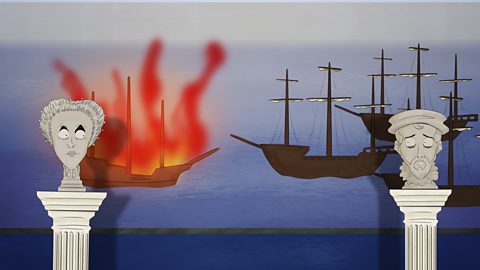
3. Elizabeth I. video
Exploring the key events of Elizabeth's long reign, including the Spanish Armada.
5. 'Trust me, I'm a Tudor doctor' video
Meet Tudor doctor Edward Strangeways, to discover the Tudors' weird and wonderful approach to treating illness.
6. Tudor travels and the Mary Rose. video
Famous Tudor explorers - Cabot, Raleigh and Drake - and the fate of the Mary Rose.
See also...
Music - Songs about life in Tudor times - a collection of songs about life in Tudor times
Dance - The reign of King Henry VIII - exploring the time of Henry VIII through movement and dance
The Tudors - Audio - comic sketches and powerful dramas exploring life during the Tudor dynasty
