This episode explores some of the changes in forms of transport which have happened within living memory in the UK.
The video
Changes within living memory: Transport
There are lots of different types of transport.
This is a type of transport…
And these are all types of transport!
But how is transport now different from the past?
Here’s our timeline! Let’s look at transport from the 1950s to the 2020s to find out more…
Many different types of transport existed in the 1950s and owning a car was already quite common.
As cars became more popular, new roads were built to help people travel further, quicker.
Back then, it wasn’t the law for people to wear seatbelts, and most transport used petrol or diesel fuel.
This had a big impact on pollution, because the engines released a lot of fumes and smoke into the air.
Then, in the 1980s, it became the law to wear seatbelts in cars and it was more common for cars to have a radio.
And in the 2000s, it became the law for babies and young children to use car seats.
Then in the 2010s, it became more popular to own a car powered by electricity, instead of petrol or diesel fuel. And a lot these newer cars, have screens that can show you maps.
And now, even more land transport, like trains, buses and coaches are powered by electricity.
Who knows, maybe in the future, big passenger jet aeroplanes might also be powered by electricity!
Transport has changed a lot over time…
It has! Can you remember what a 1980s car was like?
Let’s compare these photographs. Is the 1980s car A, B or C?
The car in this photo doesn’t have seatbelts.
The car in this photo has seatbelts and a car radio.
The car in these photos has seatbelts, a screen that can show maps, and a children’s booster seat.
I think the photo from the 1980s decade is…
B!
You’re right!
This is Siggy…
He has lots of stories to share about different types of transport.
So, what would you like to know?
When you were a child, what transport did you use?
I was born in Barbados in the 1930s. When I was a child, we didn’t have a car, or a train and we used the bus or we used the bicycle.
What do you remember most about transport as a child?
When I was a child in Barbados, we walked everywhere because the island was a very small island. When I came to the UK, I came on a big ship, and it took us 14 days.
How can we find out about transport from the past?
We can visit train stations or museums and you can see what kind of trains we had before.
If we look at a picture of a train, how can we tell if it is old or new?
Trains now are completely different. Trains now have lots of new technologies. Most of the trains that we use are powered by electricity. In those days, we had stream trains, which were very smoky, and when you’re travelling, you have your own compartment.
Transport has changed a lot since the 1950s. Transport now is much more advanced and people use it in different ways.
Now it’s your turn… Can you describe the types of transport you’ve used… and find out how they’ve changed?
Changes within living memory: Transport
Archive section
This episode explores some of the changes in the ways we travel which have happened within living memory in the UK, ie within about the last 75 years. It covers:
- the popularity of cars and thus the need to build roads
- changes in the ways vehicles are powered, from fossil fuels, like petrol and diesel, to electric vehicles
- car safety, including seatbelts and child 'booster' seats
- the use of technology - including car radios, compact disc players, Bluetooth and satnav
By the 2010s, cars powered by electric batteries were gaining in popularity. By the end of 2022, nearly 25% of UK cars sold were either fully electric or a plug-in hybrid. (Source: Department for Transport / SMMT)
Quiz
The quiz shows car interiors from three contrasting decades and invites the children to use what they have learned in the archive section to identify the car from the 1980s.
Interview
The interview is with station assistant, Siggy Cragwell.
Siggy talks about using the bus and a bicycle, which were the most common forms of transport when he was growing up in Barbados in the 1930s and 1940s. He describes travelling from Barbados to the UK on a ship, which took 14 days.
He compares older trains, including steam trains, with newer trains which are powered by electricity and make greater use of technology. He describes how older trains often had separate compartments, whereas newer trains have open carriages with many seats.
Siggy suggests finding out about past forms of transport in museums.
Follow-up activities
Questions sheet
There are a number of heritage steam railways in the UK and also a number of transport museums, where you can see old buses, trams, trains and cars. If you live close to one of these places, this would be a great opportunity to explore transport from the past and make comparisons with the present day.
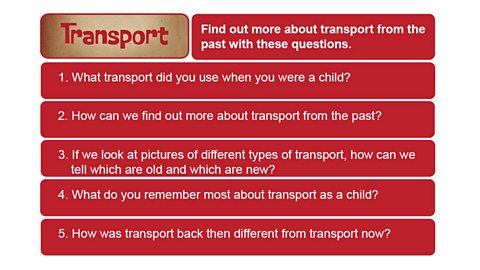
Use the questions sheet and invite some parents or grandparents to visit your classroom. Practise the questions with the children before the interview day and ask the visitors about the transport they remember using as a child. If this is not possible, you could use this as a home learning activity.
Sorting worksheet
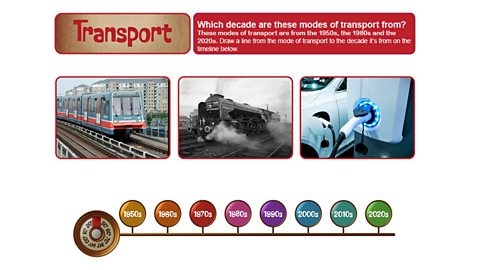
Use the sorting worksheet to match the pictures of transport to the correct decades on the timeline. Some children might add information about other forms of transport. Relate the pictures to what the children saw and learned in the archive section of the episode.
Resources
Teacher Notes
Click to download / print the Teacher Notes

Sorting worksheet. document
Click to download / print the sorting worksheet
Questions sheet. document
Click to download / print the questions sheet