This episode explores some of the changes to the homes we live in which have happened within living memory in the UK.
The video
Changes within living memory: Homes
There are lots of different types of home.
This is a home…
And these are all homes!
But how are homes now, different from the past?
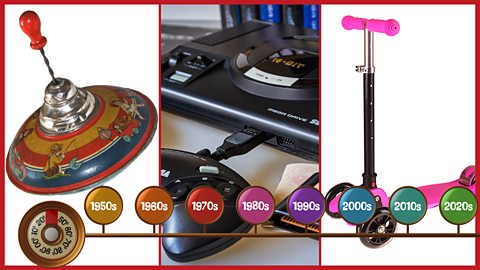
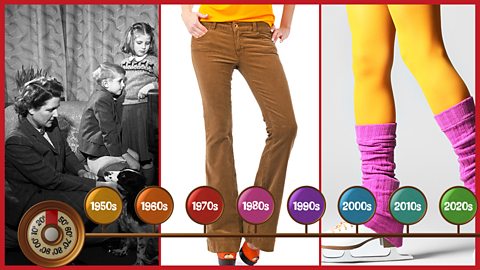
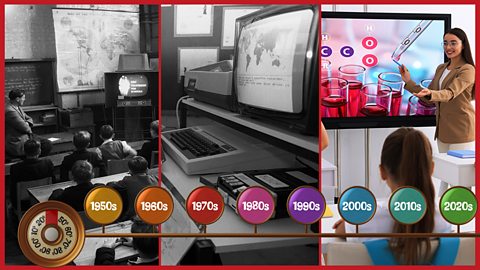
Here’s our timeline! Let’s look at homes from the 1950s to the 2020s, to find out more…
Kitchens in the 1950s were often small and basic.
Not many homes had a fridge, so people tried to keep items fresh, by storing them in a cupboard, called a larder.
But the larder wasn’t as cold as a fridge. So, many people had to go to their local shop each day to buy what they needed.
Back then, most cooking and cleaning jobs at home had to be done by hand, so they took a lot longer than they do now.
By the 1980s, most homes had lots of electric gadgets, like washing machines, microwaves and vacuum cleaners. Making cooking and cleaning jobs much quicker!
A lot of homes also had fridge freezers by then, so food and drink could be frozen at home or kept fresher for longer.
Now, most homes have even more gadgets than ever before.
A lot of modern kitchens are big rooms where you can do different things, like watching television or cooking together with friends and family.
Homes have changed a lot over time…
They have! Can you remember what most 1950s kitchens were like?
Let’s compare these photographs. Is the 1950s kitchen A, B or C?
In this photo the kitchen looks small. It doesn’t have any electric gadgets.
In this photo this kitchen is bigger. It has room for a table and chairs… and there are some electric gadgets!
In this photo the kitchen is even bigger. It has lots of room to do different activities… and it even has a TV!
I think the photo from the 1950s decade is…
A!
Well done!
This is Ian…
He has lots of stories to share about homes.
So, what would you like to know?
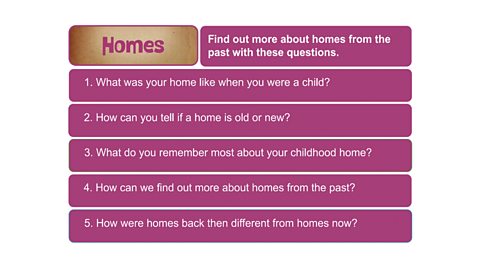
When you were a child, what was your home like?
When I was a child in the 1950s and 1960s, we lived in a flat above a café my parents ran, and my brothers and sisters and I, six of us, slept in one bedroom.
What do you remember most about your childhood home?
I remember as a child being sent out to play in the streets with the other children in the area, and using an outdoor toilet, which was shared by other people in the backyard. I remember we used newspaper as toilet roll.
How can we tell if a home is old or new?
Older homes are generally made out of brick and stone and slate. They have small windows so they’re often quite dark inside. Modern homes are much lighter, much more spacious.
How were homes back then, different to now?
It was completely different to the way we live today. There were no electrical appliances as we know now, there were no fridges, there were no dish washers or washing machines. There was no central heating, there were no televisions. Now, in towns and cities there are many tall buildings and towers and apartments, and I live at the top of one of those towers.
Homes have changed in many ways since the 1950s. Homes now are made of different materials and they come in lots of different sizes.
Now it’s your turn… Can you describe what your home is like… and find out how it’s changed?
Overview
Archive
This episode explores how homes have changed within living memory in the UK, ie within about the last 75 years. It covers:
- how domestic tasks once done by hand are now commonly done by appliances
- changes in the materials used to build new homes
- how modern lifestyles impact the design of homes and multifunctional spaces.
Quiz
The quiz shows three kitchens from contrasting decades. The children are invited to identify the 1950s kitchen.
Interview
The interview is with architect, Ian Simpson.
Ian recalls his home when he was growing up in the 1950s and 1960s and describes sharing a bedroom with six siblings, living in a terrace with a back yard, and living above his parents’ café. He remembers the outdoor toilet and bathing in a tin bath in front of the fire.
Ian considers some of the differences between old and new homes, including factors like the materials used for construction, the location and size of new homes, and the trend towards high-rise buildings.
He describes modern housing estates offering more space for front and back gardens, and compares older homes, which had smaller windows, with more modern homes that tend to have larger windows allowing more light inside.
Ian now lives in an apartment at the top of a tower in a city centre.
Follow-up activities
Local walk
If possible, take your class on a local walk near your school. Find two locations where you can stop and look at residential homes and ideally take some photos. Ask the children to make a list of the things that are similar and different about the homes, especially thinking about materials. If you can’t do this, you could look at photos taken of local homes. When do the children think they were built - a long time ago or recently? Why?
Questions sheet
Use the questions sheet and invite parents or grandparents to visit your classroom. Practise the questions with the children before the interview day and ask the visitors about their homes. If this is not possible, you could use this as a home learning activity.
Sorting worksheet
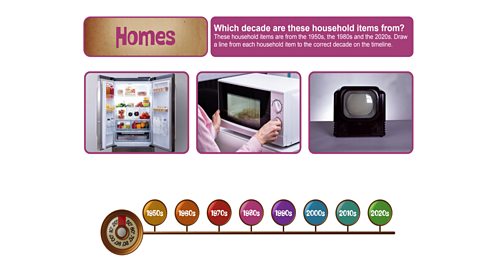
Use the sorting worksheet to match the different kitchens to the decades on the timeline. Some children might add information about other rooms or items in the home that were discussed in the interview or from their own knowledge.
Resources
Teacher Notes
Click to download / print the Teacher Notes

Sorting worksheet. document
Click to download / print the sorting worksheet
Questions sheet. document
Click to download / print the questions sheet