This episode explores some of the changes in the classroom which have happened within living memory in the UK.
The video
Changes within living memory: Schools
There are lots of different types of school.
This is a school…
And these are all schools! But how are schools now different from the past?
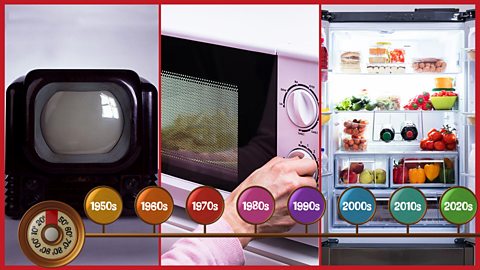
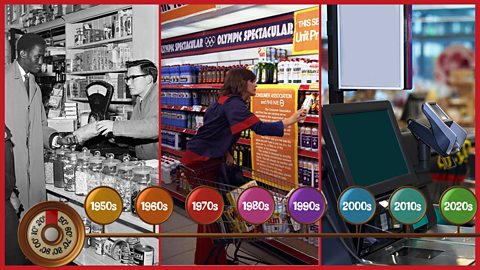
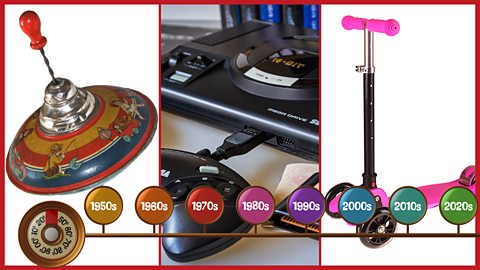
Here’s our timeline! Let’s look at schools from the 1950s to the 2020s, and find out more…
In most 1950s classrooms, children sat in rows of wooden desks and there was a blackboard at the front, which the teacher wrote on, using chalk.
Schools in the 1950s often gave children free bottles of milk each day to help them stay healthy!
Most lessons back then were similar to today – children learnt things like reading, writing and P.E.
And sometimes classes joined in with music or movement lessons by following instructions on the radio.
In the 1990s, most classrooms were more colourful, with plastic chairs and tables and schoolwork displayed on the walls. Some schools might have had one or more computers to share.
But most classrooms used an overhead projector – which was a machine that could show pictures and words, meaning teachers didn’t need to use a blackboard anymore.
Most schools in the 1990s also had a television set and a video cassette player, so classes could watch educational programmes during lessons. Now most schools have computers in classrooms, as well as an interactive white board and flat screen TVs, and special rooms where children can learn about computing or use different technology during lessons!
Schools have changed a lot over time…
They have! Can you remember what most 1990s classrooms were like?
Let’s compare these photographs. Is the 1990s classroom A, B or C?
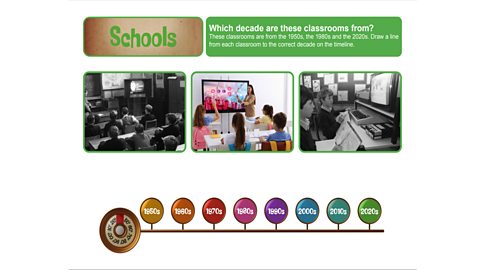
In these photos there’s a blackboard at the front of the classroom and lots of desks in rows.
In this photo there’s schoolwork on the walls and the children are using an old computer. In this photo the classroom is bright and has lots of space. There are chairs around tables and a modern computer and a flat screen on the wall.
I think the photo from the 1990s decade is…
B!
That’s right!
This is Tarun…
He has lots of stories to share about schools. So, what would you like to know?
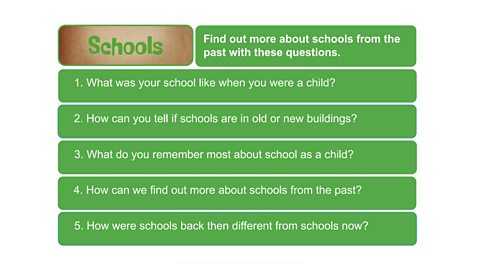
When you were a child, what was your school like?
Well, I was born in the 1950s and went to school in the 1960s. I had a small wooden desk with a lid on it, and inside that had my books. I also had something called an ink well, where I used to dip my pen in the ink and write on my paper. I’d watch the teacher writing on a blackboard with chalk. What do you remember most about school as a child?
When I was in primary school, I used to love P.E. lessons. We went into the hall, and you know, we had to listen to the radio to get the music so we could dance, so we could do gymnastics.
How can we tell if a school is old or new?
Most new schools are really shiny. They have big windows that let lots of light in. We have colourful displays on the walls and most schools have computers and screens around the place to help you learn.
How can we find out more about schools from the past?
If you want to find out more about schools, talk to people like me who went to school a long time ago. Ask questions. What was it like in the classroom? What was it like in the playground?… or you could go to the library and look at some books that have pictures and writing all about schools from the past. Schools have changed a lot since the 1950s. Schools now have more technology and equipment to help you learn.
Now it’s your turn… Can you describe what your school’s like… and find out how it’s changed?
Overview
Archive section
This episode explores changes in schools which have happened within living memory in the UK, ie within about the last 75 years. It covers:
- changes in classroom layout, from children sitting at rows of wooden desks to now sitting at shared tables
- teachers once using chalk to write on blackboards, then using overhead projectors and now interactive whiteboards and screens
- changes in technology, from schools once having a single television or computer to now having several computers and other devices
- that the design of schools has changed, eg to have bigger windows allowing more light.
Quiz
The quiz shows three classrooms from contrasting decades. The children are invited to use the information from the archive section to identify the 1990s classroom.
Interview
The interview is with education leader and former headteacher, Tarun Kapur.
Tarun recalls his time at school in the 1960s. He remembers that he used a small wooden desk with a lid and he kept his books inside. He used an inkwell and pen to write and the teacher used chalk and a blackboard.
Tarun remembers PE lessons and the class listening to the radio for dance or gymnastics lessons.
Tarun considers old and new schools. He explains that new schools have big windows to allow more light, often have colourful displays on the walls and that there are plenty of computers and screens to help children learn.
Tarun suggests we can find out about schools in the past by asking adults to describe their school days or by looking in information in books.
Follow-up activities
Questions sheet
Use the questions sheet and invite some parents or grandparents to visit your classroom. Practise the questions with the children before the interview day and ask the visitors about their memories of school. If this is not possible, you could use this as a home learning activity.
Sorting worksheet
Use the sorting worksheet to match the classroom with the right decade. Some children might add information with other facts they know about schools. You might want to discuss with the children that a lot of these things will match with more than one decade.
In the past worksheet
Use the In the past worksheet and invite the children to make a list of things they can see around their classroom. Write or draw the items in the ‘In my classroom’ column. Then ask the children if they think this was used in the past or if something else was used. Write or draw this in the ‘In the past’ column.
Resources
Teacher Notes
Click to download / print the Teacher Notes

Sorting worksheet. document
Click to download / print the sorting worksheet
Questions sheet. document
Click to download / print the questions sheet