This episode explores some of the changes in shops and shopping which have happened within living memory in the UK.
The video
Changes within living memory: Shops
There are lots of different types of shop.
This is a shop…
And these are all shops!
But how are shops now different from the past?
Here’s our timeline! Let’s look at shops from the 1950s to the 2020s to find out more…
In the 1950s, shops were often small and only sold a few items. So, it was normal for people to go to several shops in one day to buy what they needed.
A lot of these small shops, like the bakery, the greengrocers and the butchers, were owned and run by local families.
Most towns also had a weekly market, selling all kinds of different things – like clothes, tools, or homegrown vegetables.
In the 1950s, many shopkeepers used scales to weigh different items and work out the cost.
Back then, shops didn’t use barcodes, scanners, or electric tills. So, working out the cost of someone's shopping took longer than it does now.
By the 1970s, supermarkets became more popular, as they sold lots of different things in one place.
And by the 1970s, most families owned a car, meaning they could drive to a supermarket and buy many different things, rather than walking to smaller shops each day.
Now, we have even more shops to choose from and technology has massively changed the way people shop.
Self-checkouts, barcodes and scanners mean that people can usually serve themselves quickly.
And online shopping, using the internet, means people can buy things without visiting an actual shop!
Shops have changed a lot over time…
They have! Can you remember what the 1970s shops were like?
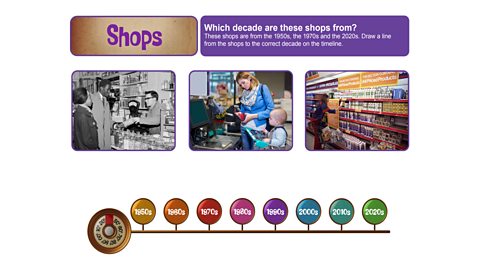
Let’s compare these photographs. Is the 1970s shop A, B or C?
The shop in this photo looks small. It has scales for the shopkeeper to weigh things.
The shop in this photo has many more items on the shelves, but it doesn’t look like a big supermarket.
The shop in this photo has lot of aisles, as well as shopping trolleys and modern tills.
I think the photo from the 1970s decade is…
B!
That’s right!
This is Hitsy…
He has lots of stories to share about shops.
So, what would you like to know?
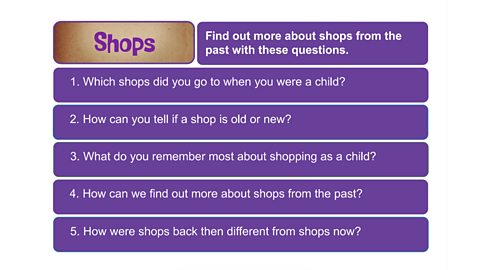
When you were a child, where did you shop?
I was born in the 1960s and I used to go to the market stalls with my mother, but most people had to go to bakeries for bread, butchers for meat, groceries for fruit and veg and we had no big supermarkets like we do now.
How can we tell if a shop is old or new?
Well, a new shop will be big as you walk in, bright lights on the inside, plenty of different products that you can buy. They usually have more than one till as well, and nowadays there are lots of big supermarkets.
How can we find out more about shops from the past?
You can find out more about shops from the past by asking your grandparents, older people that you know, friends and family who have worked in stores. You could ask them about what they used to buy and what the shop actually looked like.
How were shops back then different to shops now?
Well shops didn’t sell as much as we do now, back then they didn’t have electronic tills, they didn’t have barcodes, the shopkeeper had to add everything up individually, and we didn’t have modern ways of paying like contactless and we had to pay with cash all the time.
Shops have changed a lot since the 1950s. Shops now sell many more items and people shop in different ways.
Now it’s your turn… Can you describe the shops you’ve been to… and find out how they’ve changed?
Overview
Archive section
This episode explores some of the changes in shops and shopping which have happened within living memory in the UK, ie within about the last 75 years. It covers:
- changes in the types of shop - eg separate smaller shops like the butcher, grocer and bakery being replaced by larger supermarkets
- the variety of shopping experiences from markets to online shopping
- the variety and choice found in large supermarkets
- changes in technology - eg electronic weighing machines rather than traditional weighing scales; barcodes on items and items being scanned; self-checkout machines.
Quiz
The quiz shows a variety of shops from contrasting decades. The children are invited to use what they have learned in the archive section to identify the shop from the 1970s.
Interview
The interview is with shopkeeper, Hitsy Patel.
Hitsy recalls going shopping with his mother as a child in the 1960s. He remembers going to the market with her and also that people went to separate shops like the grocer, baker and butcher.
Hitsy explains that there weren’t large supermarkets like there are now. He remembers using his pocket money to buy ‘pick and mix’ sweets and chocolate for a treat.
Hitsy considers old and new shops. He explains that new shops are often large, have bright lighting, many different items to buy, several checkouts and scanning devices and card-readers for paying.
He says that you can find out more about shops from the past by asking adults about their experiences when they were younger.
Follow-up activities
Questions sheet
Use the questions sheet and invite some parents or grandparents to visit your classroom. Practise the questions with the children before the interview day and ask the visitors about their memories of going shopping as a child or about working in a shop.
Sorting worksheet
Use the sorting worksheet to sort the shops to the right decades by drawing a line to match the pictures to the decades. Discuss with the children what can be seen in each of the images and relate this to what they saw in the archive section of the episode.
Ask the children to draw three shops or shop fronts that they have visited. Is it a big shop or a small shop? What type of items do the shops sell? Is it an old shop that has been there for a long time or a new shop?
Resources
Teacher Notes
Click to download / print the Teacher Notes

Sorting worksheet. document
Click to download / print the sorting worksheet
Questions sheet. document
Click to download / print the questions sheet