This episode explores some changes in clothes which have happened within living memory in the UK.
The video
Changes within living memory: Clothes
There are lots of different types of clothes.
These are clothes…
And these are all clothes!
But how are clothes now, different from the past?
Here’s our timeline! Let’s look at the clothes from the 1950s to the 2020s, to find out more…
In the 1950s, lots of men and boys wore smart suits, and many women and girls wore smart dresses. Some people made or repaired their own clothes at home as it was cheaper than buying new clothes.
But by the 1960s, most people bought new clothes more often. And many young people wanted to dress like famous singers of the time in cool leather jackets and patterned short dresses.
In the 1980s, sporty clothes like tracksuits and colourful stretchy leggings became popular.
In the 1990s, many people liked wearing cargo trousers with pockets down the sides, baggy jeans, and puffer coats. And some people still do. Today, there are many different styles of clothes to choose from. But because there’s so much choice, it’s important to think about what we buy, how it’s been made and how long it will last.
Clothes have changed a lot over time…
They have! Can you remember what popular 1980s clothes were like?
Let’s compare these photographs. Is the 1980s clothing A, B or C?
In these photos, the people are wearing smart dresses and smart shirts.
In these photos, the woman is wearing a short dress and the man is wearing a leather jacket. He looks like famous singer.
In this photo, the people are wearing colourful leggings and other things called legwarmers. They look very sporty.
I think the photo from the 1980s decade is…
C!
That’s right!
This is Claudine…
She has lots of stories to share about clothes.
So, what would you like to know?
When you were a child, what clothes did you wear?
I was born in the 1970s, so my shirts had big collars and I wore big flares. I really loved bright colours and lots of prints and I still do now.
How can we tell if clothes are old or new?
It can be hard to tell if clothes are old or new because fashion goes in cycles. So, something that may have been made last year could look like it came from a long time ago. The labels on clothes can tell you more. Old clothes tend to have less information, but labels in newer clothes are more detailed.
What do you remember most about clothes as a child?
I remember that a lot more people made their own clothes. My mum taught me how to sew and knit when I was really small, and I started making my own clothes and I still do now.
How can we find out more about clothes from the past?
You could visit charity shops and second-hand shops with a grown-up and find out more about what they wore as a child.
Clothes have changed a lot since the 1950s. Clothes now are made of different materials and people get new clothes in different ways.
Now it’s your turn… Can you describe what your clothes are like… and how clothes have changed?
Changes within living memory: Clothes
Archive section
The opening archive section explores changes in clothes which have happened within living memory in the UK, ie within about the last 75 years. It covers:
- changes in fashion styles through the decades
- changes in materials
- that fashions can go in cycles, so some fashions may become popular again
- people becoming more conscious about recycled fabric, how long clothes last and how they are made.
Quiz
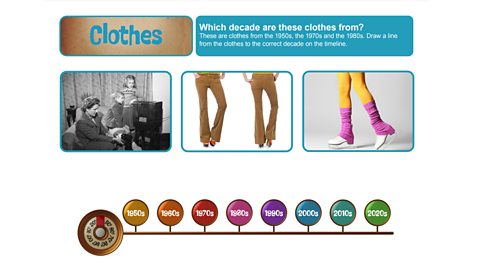
The quiz shows clothes from three contrasting decades and invites the children to use what they have learned in the archive section to identify the clothes from the 1980s.
Interview
The interview is with fashion designer, Claudine Rousseau.
Claudine discusses her favourite styles and the styles she wore in the 1970s. She recalls that her mum taught her to knit and make clothes. In the past more people made their own clothes at home rather than always going to clothes shops.
Claudine considers old and new clothes. She talks about the changes and differences in new clothes - especially that fashions can go in cycles, so old styles can become popular again (like flares).
She considers that in the past clothes labels did not have as much detail and that important information about the clothes we buy can be found on the labelling.
Follow-up activities
Questions sheet
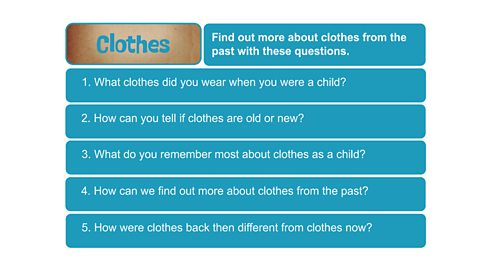
Use the questions sheet and invite parents or grandparents to visit your classroom. Practise the questions with the children before the interview day and ask the visitors about the clothes they remember wearing as a child. It would be helpful, if the adults could bring in some photos that show different fashions. If this is not possible, you could use this as a home learning activity.
Sorting worksheet
Use the sorting worksheet to match the different styles of clothes to the timeline. Some children might add information about other fashions they know about. You might want to discuss with your class that fashion can go in cycles, or that a particular style may remain popular for a long time, so the clothes might match more than one decade.
Ask the children to think of the clothes people wear for different purposes - eg protective clothing for firefighters, smart clothes for a celebration or special event like suits and gowns, clothes for sports.
Resources
Teacher Notes
Click to download / print the Teacher Notes

Sorting worksheet. document
Click to download / print the sorting worksheet
Questions sheet. document
Click to download / print the questions sheet
Where next?
The Gunpowder Plot. collection
Three short animations exploring The Gunpowder Plot of 1605 - why it happened, the main events of the Plot, and the consequences for Guy Fawkes and the other plotters.
Bitesize
Use these Bitesize resources to set homework, independent study tasks or to consolidate learning for your pupils.

Newsround
The latest news stories from Newsround to share in the classroom.