We all live with computers… but getting the most out of them… getting them to do what you need… can be kind of difficult.
But if you can understand how they process things, a computer can be the most useful housemate you’ll ever have.
Imagine if every time you took a step, it was like you were doing it for the first time… It would make for a very silly walk. But once you work out that walking is doing the same thing over and over…that’s it’s a pattern… then you’re going places.
We use patterns all the time like rules of spelling – and in music where we repeat chords or choruses.
[Ada hums the instantly recognisable opening to Beethovens’ Fifth.]
These patterns help computers too. If you want a computer to do a task efficiently, find the patterns.
Take this task: making a sandwich When you break it down – ie: ‘decompose’ it…
Are there steps that are similar to each other?
Are there any patterns?
If you’re making a sandwich, slicing is a good example of a pattern because you do the same action to several different things.
Pattern recognition is very important because it means we can use the same solution over and over again. Once you’ve been taught how to slice one thing, you can slice anything. So patterns help to solve complex problems. The more patterns we find, the better!
What if you can use your patterns again in a completely different task?.. Like making dessert?!.. After all, lots of other dishes are made from combining layers and fillings like in a sandwich. Looking for patterns is important as it can save lots of time and make your computer work more efficiently.
As long as you remember that computers….have no taste.
Ada:
That’s gross.
Voice over:
So be careful not to mix up your inputs…
Pattern Recognition - Finding similarities in complex problems!
Video summary
A teenage programmer is giving her computer instructions on making a sandwich.
She realises that the pattern of slicing and layering are repeated - and finds this useful in writing her code.
She uses a similar set of slicing and layering instructions to try to get the computer to make her dessert - with less success.
These clips are from the series How to Think Like a Computer.
Teacher Notes
Jumping off points: Discuss pattern recognition being applied to Medicine (e.g. patterns identified in diseases), Robotics, speech recognition and artificial intelligence in general.
Link to other patterns in real life such as common rules for spellings, or patterns in songs.
Discuss the difference between a rectangle and a rounded rectangle in flowcharting.
Discuss writing out the flowchart as pseudocode.
Discuss everyday patterns that students can recognise.
Discuss the contributions of women in IT such as Ada Lovelace as the main character is called Ada.
This clip will be relevant for teaching Computer Science at KS3 and KS4 in England, Wales and Northern Ireland and National 4 and 5 in Scotland.
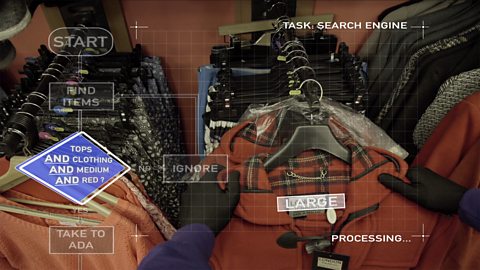
Search Engines. video
A teenage programmer explains to her computer friend how search engines can be used to filter through information more efficiently.
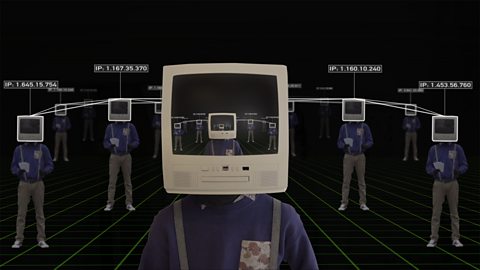
Online Safety. video
A teenage programmer (Ada) learns the importance of of being safe online with her friend Computer Head.
Bias & Reliability. video
A teenage programmer (Ada) asks her computer friend an everyday question to test any bias from the search results offered.