[SNARE DRUMS]
Narrator: Did members of your family fight or help in World War One? Well guess what? Mine did.
[PANTING]
Narrator: Sorry, I can't stop now! I'm on an urgent mission. And it's not just me. There are thousands of dogs here on the battlefront. Take my pal Bully. He's a mascot for a Battalion. It really cheers them up having him around.
[PANTING]
Lightning: Coming through, make way!
Narrator: That's Lightning. She carries urgent messages. Fast as a bullet. She's great at running across these difficult battlefields and she's very brave.
Dog 4: Psst! Yesterday I got a whiff of a spy over a thousand metres away.
Narrator: It's true! Some of us can sniff out the enemy. Others are trained to keep watch for them and we're not the only animals out here.
Horse 1: These battlefields are too tough for vehicles but horses are strong and we can get through the mud.
Horse 2: Before the war I worked on a farm. I was a family pet. We needed to walk for days and days carrying equipment, carrying food, carrying wounded men. But we keep going!
Narrator: By the end of the war millions of them will have died but they keep going.
Pigeon: So do we! Do you want to get an urgent message from the front line to HQ? Then use a pigeon! We're fast, hard to shoot down and we can always find our way home. That's why there are 100,000 of us out here.
Dog 4: Even the smallest animals can help out. These glow worms give off a natural light so they are very useful for soldiers in the dark trenches. In my job to find and help wounded and dying soldiers I carry medical supplies with me.
Soldier: Good boy!
Narrator: I'm proud of the job my family did on the battlefield. And maybe, when you next see a pigeon fly past, or a horse galloping in a field, or when you throw me one of those great crunchy sticks, you'll remember all the animals that helped in the war.
Dog Walker: Good boy!
During the war, millions of horses were used in many different roles.
Cavalry horses were used in the first battles but both sides soon realised men on horses could not win the war in the trenches.
The muddy ground, barbed wire and machine guns made it very difficult for horses, so they were used for transportation instead. In total, around 8 million horses from all sides died during the war.
Donkeys and mules were sometimes used to pull heavy equipment, including artillery.
Even elephants were taken from circuses and zoos to pull heavy guns.
Dogs were some of the hardest and most trusted workers in World War One.
These dogs stayed with one soldier or guard and were taught to give a warning sound such as growling or barking when they sensed a stranger in the area or close to camp or carried medical equipment so an injured soldier could treat himself on No Man’s Land.
They would also stay beside a dying soldier to keep him company. Dogs also helped to get messages across the front line from one base to another.
More than 100,000 carrier pigeons were also used to get messages from one military base to another.
Teacher Notes
Pupils could design their own medals or trophies for animals that became caught up in the war.
They could make their medals out of modelling clay, craft card and paper or even through junk modelling.
Curriculum Notes
This animation is suitable for teaching History at Key Stage 2 in England, Wales and Northern Ireland, and at 2nd Level in Scotland.

Attacks by the sea. video
An animation about an attack that targeted key parts of the British coastline and the impact it had on one town.
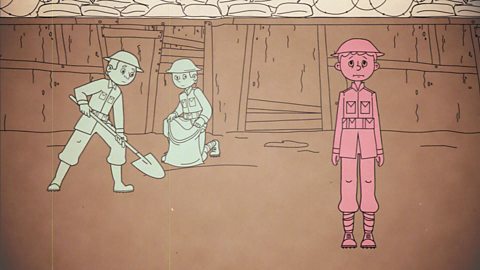
Life in the trenches. video
A look at what life was like in World War One for soldiers on the front line and the conditions that they had to live in.
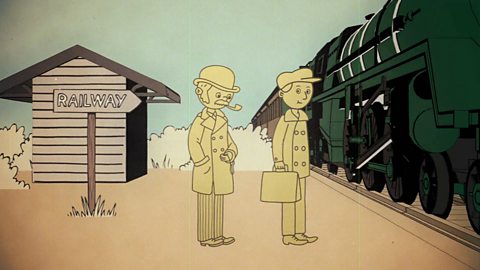
Methods of transport. video
This animation looks at why the various methods of transport were important and how they were used during World War One.
Wilfred Owen's poems. video
Explore the work of Wilfred Owen as a poet and why his writing is important in reflecting on World War One.
Edith Cavell. video
Find out about the life of Edith Cavell and how her bravery makes her a World War One hero.