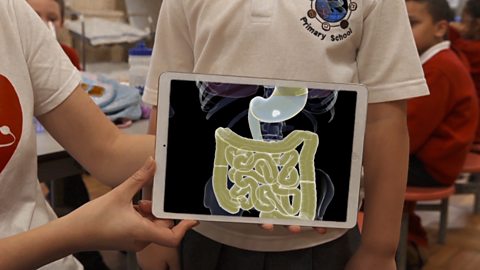
PRESENTER:'Every day, we humans, chomp and chew our way through all kinds of different foods. We are omnivores, which means that we eat food that comes from plants and animals.'
PRESENTER:In the animal kingdom, there are creatures which survive on a diet of meat, and these are called carnivores. These can be large wild animals like sharks, lions and wolves, and can also be smaller household creatures, like cats and dogs.
PRESENTER:Other animals survive on a diet of plants, fruits and vegetables, these are called herbivores. They include large animals, like elephants and horses, but also smaller animals, like rabbits.
PRESENTER:'If we only had incisors, we'd have to choose food that was easy to nibble into small bits, before swallowing. If we only had a mouthful of molars, we'd be no good at biting or tearing things into chunks. If we only had canine teeth, we would be well adapted for eating meat. Fortunately, we have a combination of different kinds of teeth, that enables us to eat a wide range of foods. Let's take a closer look at how our teeth work together.
PRESENTER:'Incisors at the front of the mouth have a thin top edge, and are used for biting into things and chewing. Next are the canines at the corners of your mouth. They have a sharp point for tearing off bits of meat or ripping through tough chewy things. Premolars have a flatter surface for crushing and breaking down food. Molars, at the back of your mouth, have a wider bumpy surface that's ideal for grinding down food into little bits.'
PRESENTER:I wonder what the difference will be between Ella's teeth, and those of her favourite herbivore.
PRESENTER:'The horses front teeth are great at biting off large amounts of grass or hay. Most horses have just incisors and molars.'
PRESENTER:I wonder what the difference will be between Ella's teeth, and those of her favourite carnivore.
PRESENTER:'A cat's front incisors are much smaller than ours, but their canines are far more pronounced and sharp. The molars chew the food, but even their molars are quite sharp, so they can't grind down their food like humans can. Cats, like most other carnivores, can only open and close their jaws, whereas herbivores and omnivores can move their jaw from side to side as well.'
PRESENTER:Sugar is the number one cause of tooth decay in humans. Whenever we eat or drink things high in sugar, the sugar is digested by bacteria in our mouths, and produces acid.
PRESENTER:The shell of an egg is a bit like the coating on our teeth we call the enamel. The shell protects the egg just like the enamel protects our teeth.
PRESENTER:I'm going to put this egg into some cola, and Jamie, I'd like you to pour a glass of vinegar, and Ella, can you pour a glass of water.
PRESENTER:The egg that was in the water looks the same as it did before.
PRESENTER:Let's look at the one that was in the fizzy drink. It's been stained a darker colour.
PRESENTER:But what about the egg that was in the vinegar?
ALL:Eww!
PRESENTER:The vinegar has eaten away at the egg shell, making it soft.
PRESENTER:'Bacteria in our mouths turns sugar into acid.'
PRESENTER:Lots of the food we eat contains acid and sugar, which can damage our teeth. Which is why we need to brush our teeth twice a day, every day.
Video summary
Zoe uses graphics to explain how different animals have teeth suitable for their diet, whether carnivore or herbivore, and how the variety in human teeth allows us omnivores to chew up the wide variety of food we eat.
An experiment with an egg left in vinegar demonstrates how our teeth our softened by the acid created by sugar, and why brushing our teeth is important.
This short film is from the BBC series, Biological processes of the human body.
Teacher Notes
You could recreate the experiment that’s in this short film, with an egg left in vinegar for three days, an egg left in cola for three days, and an egg left in water for three days.
Compare the results and see what happens. Can your pupils explain the results?
Pupils could compare the teeth of omnivores, carnivores and herbivores.
Look at real case-studies; such as rabbits, cats and humans.
Draw the different types of teeth, and label them to see how they're different.
This short film will be relevant for teaching the topic of the human body at KS2 in England, Wales and Northern Ireland and Second Level in Scotland.
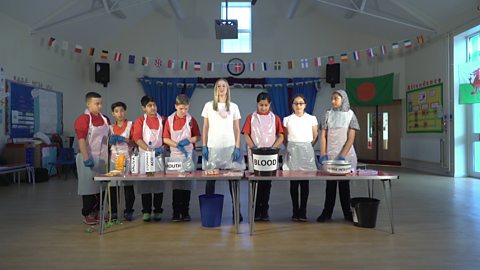
Digestion - how does breakfast affect your day? video
The impact of having a healthy breakfast is explored, and a rather disgusting experiment highlights how the body gets nutrients out of food.
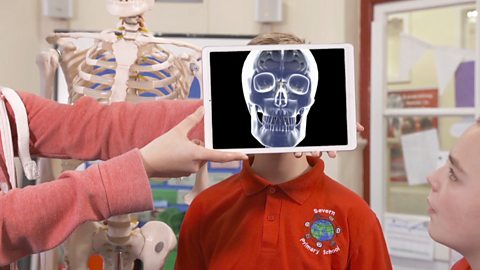
How do muscles and bones work? video
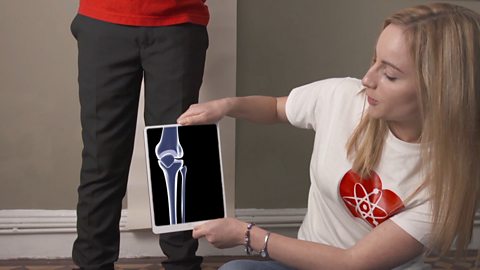
A model skeleton, elastic bands and rubber gloves are used to demonstrate how our muscles and bones allow our bodies to move.
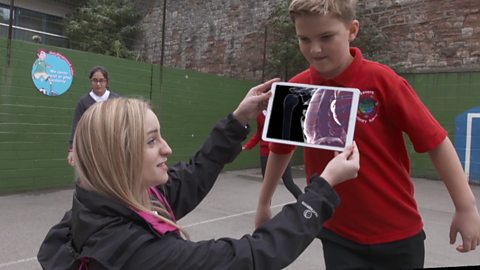
Respiration - how is oxygen transported round the body? video
Exploring how oxygen is transported around our bodies using an experiment to test lung capacity.
How our circulatory system keeps us alive. video
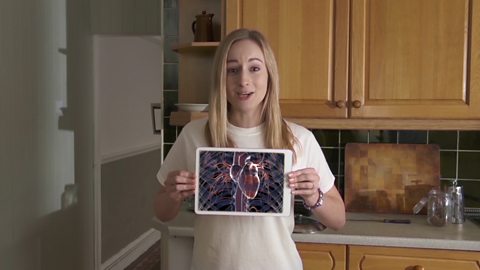
Zoe uses CGI graphics to explain the structure of the heart and the difference between veins and arteries.
How the human body grows. video
Zoe talks us through the process of human life, using graphics to show how we grow inside the womb.
What causes us to burp and break wind? video
A light-hearted look at the biological processes that make us burp and fart.