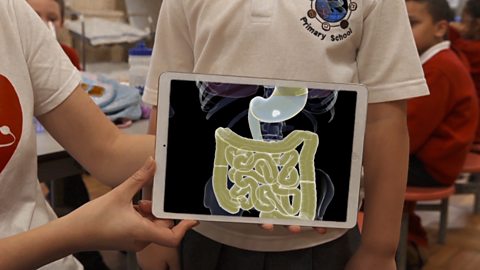
PRESENTER:'Ella has P.E. today, and her circulatory system is going to have some exceptional challenges to overcome.'
BOTH:Bye mum!
PRESENTER:'We are going to follow the action in extreme detail.'
PRESENTER:The heart is one of the most important organs in your body.
PRESENTER:It's the key organ in your circulatory system, and it keeps the blood flowing around your body.
PRESENTER:'The heart is a very strong muscle. It's made up four chambers, two upper and two lower chambers. Blood enters the upper chambers. These squeeze and push the blood into the lower chambers, which then squeeze and push the blood out of your heart and off around your body.
PRESENTER:'The tubes that carry blood away from your heart, are called arteries, shown in red here. The tubes that carry blood back to your heart, shown in blue, are called veins. The flow of blood is controlled by strong valves, which is why you can hear your heart going "lub-dub, lub-dub, lub-dub".'
PRESENTER:Blood carries oxygen around our bodies. When we exercise, our bodies need more and more oxygen to keep on moving. You can find out your heart rate by feeling your pulse. Your heart rate is how many times your heart beats in one minute. The average resting heart rate for a human is around 80 beats per minute, but everyone is different and yours may be higher or lower than that.
PRESENTER:Let's see how much exercise affects our heart rate.
PRESENTER:'Here is a demonstration of the cycle of blood around the body. The heart is actually two pumps. The right side of your heart pumps blood to your lungs. Here the blood, represented by the red balloons, picks up oxygen from the air you are breathing in. The blood, now carrying oxygen, travels back to the left side of your heart where it gets a second push out to the other parts of your body, your muscles, brain and other organs. Having delivered the oxygen, the blood, represented by the blue balloons, now travels back to the heart and the whole cycle begins again.'
PRESENTER:Well done, all of you! Now let's see how your heart rate has been affected by the exercise. Are you ready? Three, two, one, go!
PRESENTER:'We can plot this information on a graph. First the resting heart rate, then the rate after exercising.'
PRESENTER:And stop. What was your number?
CHILD #1:188.
PRESENTER:'And then every minute afterwards.'
PRESENTER:What was your number?
CHILD #2:124.
PRESENTER:'You should see the rate return to normal gradually over time.'
PRESENTER:And your number?
CHILD #3:108.
CHILD #4:80.
PRESENTER:'The speed at which your heart rate returns to normal, is a good indicator of your fitness level.'
PRESENTER:Well done! Your heart rates have all returned back to where they started after a few minutes. Remember, we can all help to keep our hearts healthy by exercising regularly and by eating healthy diets.
CHEERING
Video summary
This short film explains how the heart and circulatory system work, taking a close look at the four chambers, two sides, and the valves of the heart.
They also show the system of veins and arteries throughout our body, and how our blood carries oxygen from our lungs.
Zoe asks a group of children to perform a heart rate experiment, taking their own pulses.
They record their resting heart rate, their heart rate after exercise and how quickly it slows down over the next few minutes, with Zoe making a graph to plot the results.
She explains how returning to a normal heart rate quickly indicates fitness, and the importance of exercise to stay healthy.
This short film is from the BBC series, Biological processes of the human body.
Teacher Notes
You could recreate the blood cycle / circulation by using red balloons and blue balloons to represent oxygenated and deoxygenated blood.
After doing the demonstration for 1-2 minutes, plot your pupils' heart rates, to ascertain heart rates whilst the body is exerting itself.
After 1 minute measure heart rates again, and again after 3 minutes, and plot the difference within a graph.
Work out the average heart rate whilst working hard, and the average after 3 minutes and discuss what can be learnt from the exercise.
This short film will be relevant for teaching the topic of the human body at KS2 in England, Wales and Northern Ireland and Second Level in Scotland.
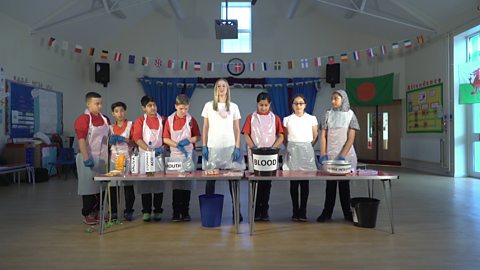
Digestion - how does breakfast affect your day? video
The impact of having a healthy breakfast is explored, and a rather disgusting experiment highlights how the body gets nutrients out of food.
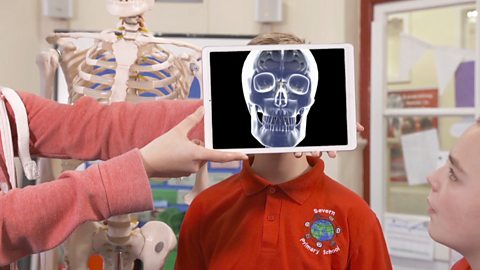
How do muscles and bones work? video
A model skeleton, elastic bands and rubber gloves are used to demonstrate how our muscles and bones allow our bodies to move.
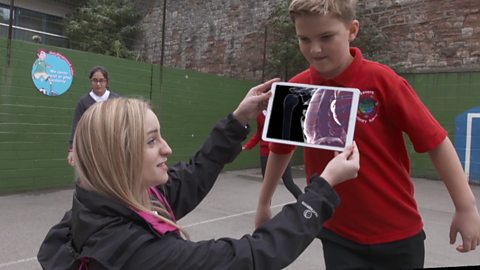
Respiration - how is oxygen transported round the body? video
Exploring how oxygen is transported around our bodies using an experiment to test lung capacity.
Teeth - how they help animals eat. video
How different types of animals use their teeth to help them eat their food.
How the human body grows. video
Zoe talks us through the process of human life, using graphics to show how we grow inside the womb.
What causes us to burp and break wind? video
A light-hearted look at the biological processes that make us burp and fart.