PRESENTER:'It's quiet and everyone is fast asleep.'
PRESENTER:Muscles and bones keep us moving 24 hours-a-day, even when we're asleep. Without muscles or bones, we wouldn't even be able to get out of bed, or even smile or blink.
PRESENTER:Our skeletons are made of bones. They give our body shape and support our weight.
PRESENTER:Imagine what my hands would look like if they didn't have any bones to support them. Try shaking hands, with hands like these.
PRESENTER:Not all animals have their skeletons on the inside of their bodies like ours. Some animals, like crabs and lobsters, have their skeletons on the outside, and this is called an exoskeleton. It protects their inner parts from harm. Our skeletons help protect us too.
PRESENTER:Bones called ribs protect our heart and lungs. And our skull protects our brain and eyes.
PRESENTER:'Our skeleton has over 200 bones from the largest - our leg bone, or our femur, to the smallest - the bones in our ears.
PRESENTER:'Bones are made of calcium and other minerals. This makes them strong, but slightly flexible, and this property helps protect and support the body.'
PRESENTER:Skeletons can't move by themselves. I can make it move because it has joints.
PRESENTER:But to make it really move, it needs muscles.
PRESENTER:'Muscles can only pull, they can't push. This is why our joints are controlled by more than one muscle. For example, our elbow joint in the arm has two muscles, to move your forearm up and down. these are the biceps that pull your arm up, and the triceps that pull your arm down.'
PRESENTER:Our muscles are a little bit like elastic bands, they can get longer or shorter. Often, our muscles work in pairs to move our bodies. In our leg, if the muscle on the back of our thigh contracts and gets shorter, it bends our leg at our knee joint. If we want to extend our leg, the muscle on the front of our thigh contracts and gets shorter, and it extends our leg.
PRESENTER:Lots of different muscles work together to help us move, and do lots of different things, like running around, jumping up and down, throwing balls, and scoring goals.
CHEERING
Video summary
Using a skeleton, elastic bands and rubber gloves, Zoe demonstrates to a group of children how our muscles and bones allow our body to move.
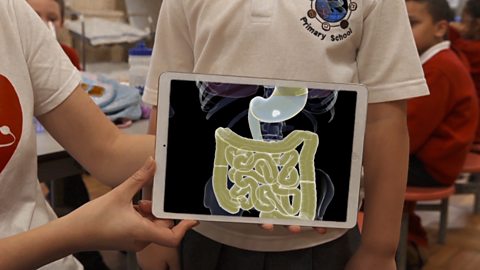
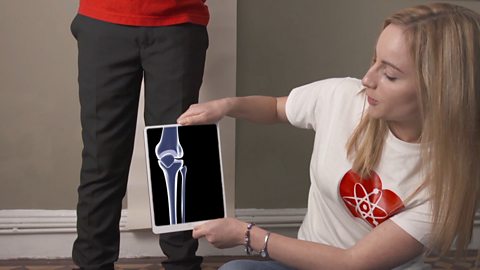
We hear about how some animals have exoskeletons, and graphics on a tablet demonstrate the bone structures holding the children up.
The number of bones in the body and the calcium that forms them are also covered.
Zoe explains about joints, and how muscles work in pairs, contracting to pull parts of our bodies in different directions.
This short film is from the BBC series, Biological processes of the human body.
Teacher Notes
You could get a skeleton model and connect rubber bands to the bones in order to demonstrate how one muscle contracts, while the other expands, and how they work together to move the bones.
Pupils could create a poster with a list and pictures of animals with an exoskeleton and others who have their skeletons on the inside of their body.
They could discuss and note on the poster what are the advantages and disadvantage of having your skeleton on the outside and the advantage and disadvantage of having your bones inside your body.
This short film will be relevant for teaching the topic of the human body at KS2 in England, Wales and Northern Ireland and Second Level in Scotland.
Digestion - how does breakfast affect your day? video
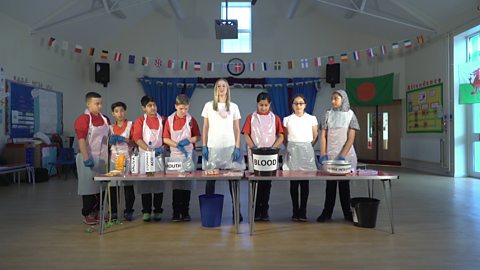
The impact of having a healthy breakfast is explored, and a rather disgusting experiment highlights how the body gets nutrients out of food.
Respiration - how is oxygen transported round the body? video
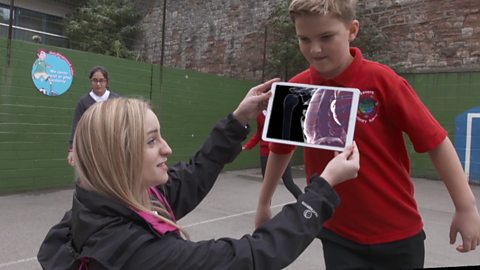
Exploring how oxygen is transported around our bodies using an experiment to test lung capacity.
Teeth - how they help animals eat. video
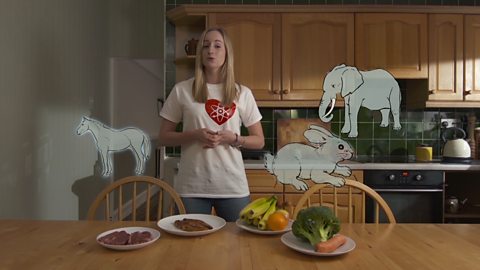
How different types of animals use their teeth to help them eat their food.
How our circulatory system keeps us alive. video
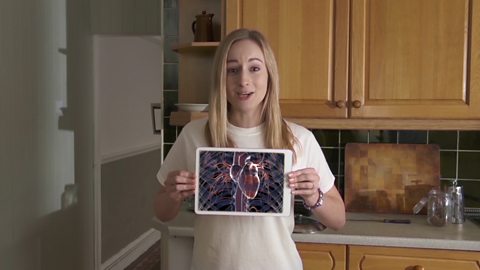
Zoe uses CGI graphics to explain the structure of the heart and the difference between veins and arteries.
How the human body grows. video
Zoe talks us through the process of human life, using graphics to show how we grow inside the womb.
What causes us to burp and break wind? video
A light-hearted look at the biological processes that make us burp and fart.