PRESENTER:'Ella is making a good start, with a healthy breakfast of porridge, with dried fruit and yoghurt. She's washing it all down with fruit juice and water. A good mix of different types of food, that's going to give her a steady release of energy throughout the day. And boy, is she going to need it.'
BOTH:Bye mum!
PRESENTER:Jamie and Ella have given themselves very different starts to the day. We need to eat to give our bodies fuel for all the things we do every day, as well as growing and repairing ourselves. There are three main food groups protein, carbohydrates and fats.
PRESENTER:A balanced healthy diet means we eat the right amounts of foods in each food group. Let's take a look at what Ella and Jamie had for breakfast, and what their fuel levels are like.
PRESENTER:'Ella ate porridge with fruit, yoghurt and fruit juice. This breakfast will give her a lot of nutrients and energy, and keep her full until lunch time. What did Jamie have? A chocolate biscuit, hmm. Not a very balanced breakfast. It contains a lot of sugar, which will give him a burst of energy now, but his body is going to need more fuel. Jamie's really going for it running around, using up lots of energy. How does that energy get from food to your muscles? We created an experiment to show how digestion works.'
PRESENTER:Digestion starts at our mouths, and ends when we go to the toilet. For our meal, we’re going to have a bit of a strange meal. We're going to have some baked beans, bread, some cake, a drink of orange juice as well. Now our teeth start to chew up our food. Add in some saliva. Now our tongue grabs our food and brings it all together into a ball, so we can swallow it.
ALL:Eww!
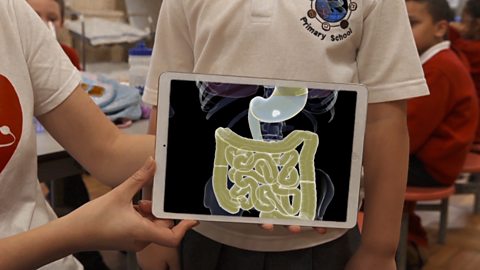
PRESENTER:After we swallow our food, it travels down our oesophagus. Let's take a closer look at what happens.
PRESENTER:'We can see the food descending into the stomach acid, where it is squeezed and broken down further by enzymes and bacteria. Then the food is passed into the intestines, where they are finally absorbed by the intestinal villi, and then carried into the blood.'
PRESENTER:Can you see all of these, all of this liquid, all of the nutrients, being absorbed into our blood.
PRESENTER:So our villi absorb lots more water and nutrients from our large intestine, and that ends up in our blood. So what's left, after all the nutrients and water have been absorbed, enters our rectum.
ALL:Eww!
PRESENTER:And then, when we're ready to go.
ALL:Eww!
PRESENTER:'Another important thing to do when you are being active, is to keep hydrated by drinking plenty of water.
PRESENTER:'Both Jamie and Ella have a maths test today, so they have to concentrate really hard. Thinking hard uses up energy. Your brain uses energy than any other organ in your body. Ella is relaxed and well hydrated. She seems to be concentrating well. Can you guess who did better on their test today?'
Video summary
Ella eats a healthy balanced breakfast whilst Jamie just eats a chocolate biscuit.
Zoe explains how a mix of foods with slow-release energy give us the nutrients we need and fills us up.
She then performs a demonstration of the journey our food takes from our mouth through our body, using a collection of buckets, a potato masher, a sponge and some rather nauseated pupils!
Meanwhile Ella's healthy breakfast has given her the fuel to perform well in her maths test.
This short film is from the BBC series, Biological processes of the human body.
Teacher Notes
This could be used to compare different types of breakfasts; look at their ingredients and create a graph and art poster of what nutrients that they contain. For example, how much fat, protein, sugar and carbohydrate.
Decide based on the results what is the best breakfast to have before going to school, and create a poster to advertise it at the school's breakfast club.
You could re-create the experiment in your class that demonstrates how food is broken down in the stomach using the kitchen utensils buckets and tubes, baked beans and a pair of tights and a potato masher.
This short film will be relevant for teaching the topic of the human body at KS2 in England, Wales and Northern Ireland and Second Level in Scotland.
How the human body grows. video
Zoe talks us through the process of human life, using graphics to show how we grow inside the womb.
How do muscles and bones work? video
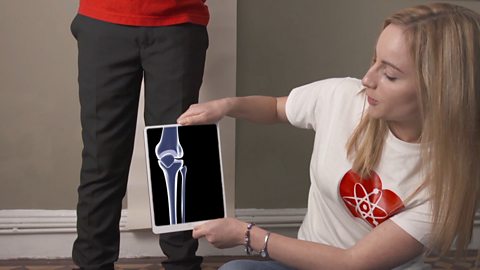
A model skeleton, elastic bands and rubber gloves are used to demonstrate how our muscles and bones allow our bodies to move.
Respiration - how is oxygen transported round the body? video
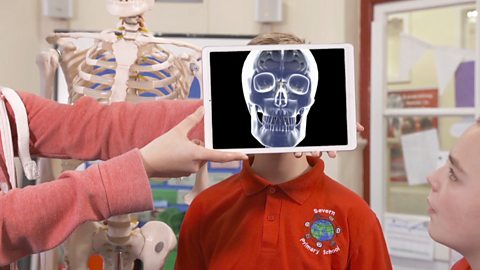
Exploring how oxygen is transported around our bodies using an experiment to test lung capacity.
Teeth - how they help animals eat. video
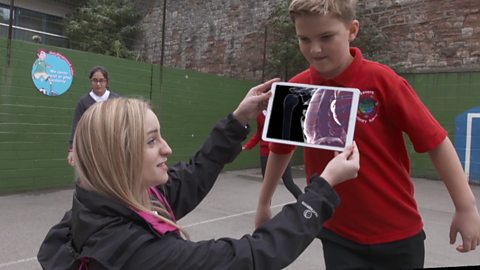
How different types of animals use their teeth to help them eat their food.
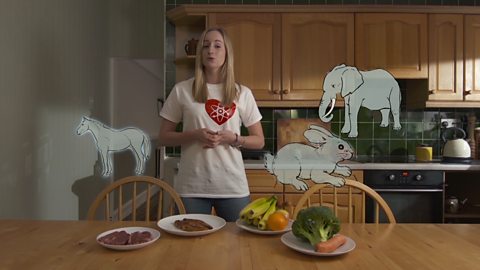
How our circulatory system keeps us alive. video
Zoe uses CGI graphics to explain the structure of the heart and the difference between veins and arteries.
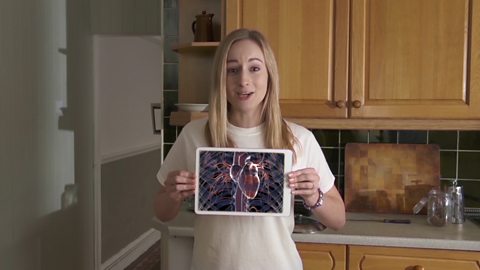
What causes us to burp and break wind? video
A light-hearted look at the biological processes that make us burp and fart.