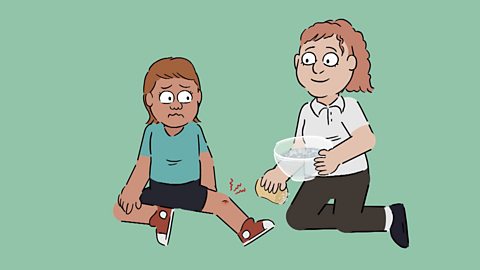
Dr Emeka:
Hey, I’m Dr Emeka and this is Dr Emeka’s Essential First Aid.
Just to warn you! This film contains animations of blood and bleeding.
If someone’s bleeding it’s important to know how to help them and what to do if they go into shock. Let me explain!
If someone is bleeding, make sure you keep them calm. That means you’ve got to keep calm too. It might help if you explain to them what you’re doing as you do it.
One - if possible put on gloves.
Two - check if there is anything in the wound. If there is - leave it there! Even if it is something big, like a knife.
Three - you need to apply pressure to stop the bleeding. Find a clean dressing or pad to put on the wound but be careful not to push down on the object. If you can’t find anything then ask them to use their own hand. If this isn’t possible, you may need to use the cleanest thing you can find.
You need to make sure the dressing isn't so tight that it stops blood circulating around the body. You can check this by squeezing the tip of their finger to make it go white - the colour should return pretty quickly. If it does, you know it’s OK.
If the cut is severe, won’t stop bleeding or has something in it, call 999 or 112.
Sometimes, if there is severe bleeding, the casualty might go into shock. Shock is when there isn’t enough blood going around the body to keep the organs working. It can be life threatening so needs immediate attention.
If someone is in shock they might struggle to breathe, they might feel weak or dizzy, have chest pain, their heart might beat really fast, or they could be cold and clammy.
Lie them gently down.
Raise their legs.
Call 999 or 112.
Loosen any tight clothing.
Keep them warm and keep them reassured!
If someone’s bleeding, remember:
Put on gloves
Apply a dressing
Press it
Leave any objects in the wound
And make sure you’re ready to treat shock!
If someone’s in shock:
Lie them down
Raise their legs
Call 999 or 112
Loosen clothing
Keep them warm
And reassure them!
Video summary
In this short film, Dr Emeka explains how to treat bleeding wounds, what shock is and what to do if someone goes into shock.
With the help of animation, he goes through each step in helping someone who is bleeding and how to recognise and help if someone is going into shock.
This short film is from the BBC Teach series 'Dr Emeka’s Essential First Aid'.
Teacher Notes
This short film could be used in the wider context of a PSHE lesson on first aid and how to treat injuries you incur yourself, or that happen to those around you.
It should be used in the wider context of learning about how to stop bleeding (applying pressure and raising the wound above the heart), the signs and symptoms of a severe wound and when to get help.
Students should also learn about what a tourniquet is and when it is best used (when blood is spurting). They could list items that they have on them, that could be used as an improvised tourniquet should this be necessary.
Students should understand the severity of shock and how important it is to recognise the signs and symptoms. Students could explore the different organs in the body and the function of each of them.
Students could also learn how to manage a nose bleed and understand the correct process to stop the bleeding:
- Sit and lean forward.
- Pinch the soft part of your nose for ten minutes.
- Stop, check, repeat if necessary.
Activities
Students could create a leaflet or a poster on how to treat shock and bleeding.
Students could discuss where you can find a sterile or clean dressing in a given environment.
The class could be shown a first aid kit and its contents.
Students could discuss the implications of an embedded object in a cut and how this can have different effects on different areas of the body.
Students could role play in groups or pairs, the different stages of treating someone who is bleeding and additionally someone who goes into shock.
Other subject areas
- In science students could learn more about the circulatory system and the role of oxygen in the blood.
- This could lead to further study of the composition of blood.
- Students could also learn about the anatomy of the body and the function of each organ.
This short film touches on elements of PSHE first aid as introduced to the curriculum in England from September 2020 for Key Stage 3.
While not on the curriculum specifically, it could also be used in Wales and Northern Ireland at Key Stage 3 and in Scotland at 3rd and 4th level.
How to make a call to emergency services. video
A short film teaching pupils how to recognise an emergency and how to make a call to emergency services.
Burns and scalds. video
Dr Emeka gives an introduction to dealing with the types of burns and scalds that can occur in domestic settings.
Choking. video
In this short film Dr Emeka gives an introduction for pupils on how to help someone who is choking.
Head injuries. video
In this short film Dr Emeka explains how to tell if a head injury is minor or severe, and what to do in each situation.
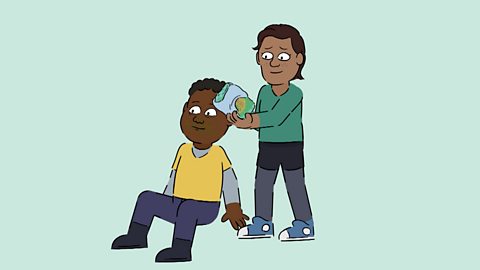
Bone fractures. video
In this short film Dr Emeka explains to how to manage a broken or suspected broken bone.

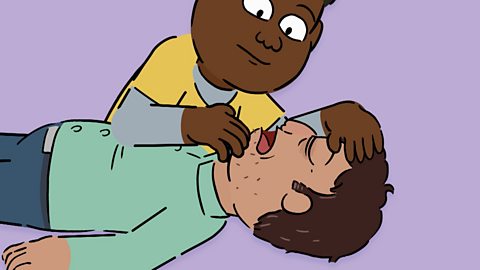
How to administer CPR. video
In this short film, Dr Emeka introduces the process for administering CPR and how to use an AED (automated external defibrillator).
How to administer CPR during the Covid-19 pandemic. video
In this short film Dr Emeka introduces the process for administering CPR and how to use an AED (automated external defibrillator), with specific tips for staying safe during the Covid-19 pandemic.
Bites and stings. video
In this short film Dr Emeka teaches pupils how to deal with bites and stings on themselves, or those around them.