Dr Emeka:
Hey, I’m Dr Emeka and this is Dr Emeka’s Essential First Aid.
Sometimes, when we’re eating, food can get stuck in our throat which means that the air we need to breathe, can’t get into our body. This is called choking.
If someone is choking, they need immediate help. So stay calm and help them to clear the blockage.
If you think someone is choking, ask them! They might not be able to talk so you can look for other signs; they might have gone red in the face, they may be wide eyed, look distressed or be pointing to, or holding their throat.
There are three ways you can help someone who’s choking.
Cough it out - encourage them to cough!
If that doesn’t help then: Slap it out - using one had to support them at the front, use the base of your other hand, to give them five sharp back blows between their shoulder blades.
And if that doesn’t work then: Squeeze it out! Stand behind them - put one hand around their waist between the bottom of their chest and belly button. Make a fist and hold it with your other hand. Pull sharply in and up. Do this five times. If it still isn’t clear call 999 or 112 and keep going until help arrives.
Remember -
Cough it out,
Slap it out,
Squeeze it out,
And call 999 or 112 whilst you repeat.
Video summary
In this short film Dr Emeka gives an introduction for pupils on how to help someone who is choking.
He explains the basic procedures while the animated sequences helps demonstrate the correct techniques.
This short film is from the BBC Teach series 'Dr Emeka’s Essential First Aid'.
Teacher Notes
This could be used for further discussion around managing a choking baby, as opposed to an adult or child. Additionally, the understanding of what to do if the choking individual becomes unresponsive (CPR and calling the emergency services).
Activities
Students could be asked to make a poster of the five headlines of how to assist someone who is choking and summarise below each one (cough it out, slap it out, squeeze it out, call 999, repeat.)
It is vital that children understand that performing these manoeuvres when there isn’t a real emergency can be dangerous. Students could point to where on their back and front, these manoeuvres would take place in a state of emergency, without performing any actions.
Students could name things that could be a choking hazard for babies, children of their age and adults. They could learn how to help a baby who might be choking and the difference between helping infants and adults and children.
Students could explore different ways to communicate or get someone’s attention, or let them know you are in danger, without using your voice: When someone might be choking they aren’t able to communicate verbally.
Other subject areas
- This short film could be used in science when looking at the digestive or circulatory system.
- It could also be used to help children understand non-verbal communication.
- The subject of choking also leads into other areas of PSHE First Aid: CPR, Calling Emergency Services.
This short film touches on elements of PSHE first aid as introduced to the curriculum in England from September 2020 for Key Stage 2.
While not on the curriculum specifically, it could also be used in Wales and Northern Ireland at Key Stage 2 and in Scotland at 1st and 2nd level.
How to make a call to emergency services. video
A short film teaching pupils how to recognise an emergency and how to make a call to emergency services.
Burns and scalds. video
Dr Emeka gives an introduction to dealing with the types of burns and scalds that can occur in domestic settings.
Bleeding and shock. video
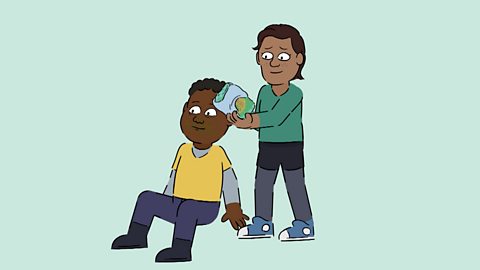
Dr Emeka explains how to treat bleeding wounds, what shock is and what to do if someone goes into shock.
Head injuries. video
In this short film Dr Emeka explains how to tell if a head injury is minor or severe, and what to do in each situation.
Bone fractures. video
In this short film Dr Emeka explains to how to manage a broken or suspected broken bone.

How to administer CPR. video
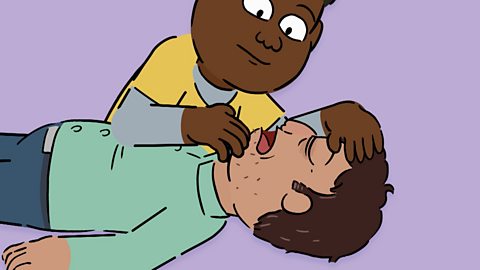
In this short film, Dr Emeka introduces the process for administering CPR and how to use an AED (automated external defibrillator).
How to administer CPR during the Covid-19 pandemic. video
In this short film Dr Emeka introduces the process for administering CPR and how to use an AED (automated external defibrillator), with specific tips for staying safe during the Covid-19 pandemic.
Bites and stings. video
In this short film Dr Emeka teaches pupils how to deal with bites and stings on themselves, or those around them.