Dr Emeka:
Hey, I’m Dr Emeka and this is Dr Emeka’s Essential First Aid.
Your head contains arguably the most important organ in your body – your brain… So it’s really important that you know what to do with a head injury.
First things first. You need to work out if a head injury is minor, which means it isn’t very serious, or severe, which means it is very serious and therefore could be dangerous. Here’s how you do it.
People with minor head injuries might show any of these six signs.
One - they might not respond to you.
Two - you might see a cut or bump on their head.
Three - they might be dizzy or feel sick.
Four - they might have memory loss at the time of the injury, or just before.
Five - they might have a headache. Or six - they might be confused.
Sit them down, treat their wound and give them something cold like an ice pack or a bag of frozen vegetables to reduce the swelling and keep an eye on them, they might get worse and need more help.
Severe head injuries are a serious business. If someone has a severe head injury…
They might have a blow to the head. They might be unresponsive. There might be blood or fluid coming from their ear or nose. Or their pupils might be different sizes.
If you find someone in this condition dial 999 or 112. Then check that they can breathe by making sure their throat isn’t blocked; but be careful not to move them. They might have other injuries.
Remember - if someone has a head injury, work out if it is minor or severe.
If it’s minor -
sit them down,
treat any wounds and
keep an eye on them.
If it is severe - call 999 or 112,
don’t move them,
check they can breathe and stay with them until help arrives.
Video summary
In this short film Dr Emeka explains how to tell if a head injury is minor or severe, and what to do in each situation.
With the help of animation, he goes through the six signs for checking whether a head injury is minor or severe.
Once this has been established, the steps needed for helping people with both minor and severe injuries are described.
This short film is from the BBC Teach series 'Dr Emeka’s Essential First Aid'.
Teacher Notes
This short film could be used as an introduction to head injuries and how to treat them. It is best used in conjunction with more study on how head injuries can happen, the different types of head injuries, the signs and symptoms of severe head injuries and how best to treat them.
Additionally, students should understand that a head injury may cause a seizure or a fit that could happen close to the time of head injury or sometime after. Students should explore what to do if someone has a seizure or a fit (only move them if they’re in danger, cushion their head, loosen tight clothing, once recovered put them in the recovery position, stay with them and keep calm, take note of length of seizure) and when to call for help.
Students could explore the different types of head injuries (concussion, compression and skull fracture), how these could occur, and the sign and symptoms that relate to each of these.
Students could explore brain function and the reasons why it is so important to treat head injuries quickly and properly and to recognise when urgent help is required.
Students could research and evaluate different ways to test responsiveness.
Activities
Students could explore how we breathe in air and what it means to have our airway open.
Students could think of a list of meanings for the words MINOR and SEVERE.
Students could explore the role of the skull in protecting the brain.
Students could be given a list of fake and real side effects of head injuries and note which refer to a severe head injury, which apply to a minor head injury, and which don’t signify a head injury.
Students could role-play with pairs or groups how to manage a situation involving a head injury, as set up by the teacher.
Students could create an acronym or other way to remember the signs and symptoms of a minor or severe head injury.
Other subject areas
- Students could expand their understanding of the function of the brain through biology and which parts of the brain control which parts of the body.
- This could lead to further study of the nervous system and how the body moves.
- There is also the option of combining this PSHE first aid lesson with hand-eye coordination in PE and other sports activities.
This short film touches on elements of PSHE first aid as introduced to the curriculum in England from September 2020 for Key Stage 2 and 3.
While not on the curriculum specifically, it could also be used in Wales and Northern Ireland at Key Stage 2 and 3 and in Scotland at 1st, 2nd, 3rd and 4th level.
How to make a call to emergency services. video
A short film teaching pupils how to recognise an emergency and how to make a call to emergency services.
Burns and scalds. video
Dr Emeka gives an introduction to dealing with the types of burns and scalds that can occur in domestic settings.
Choking. video
In this short film Dr Emeka gives an introduction for pupils on how to help someone who is choking.
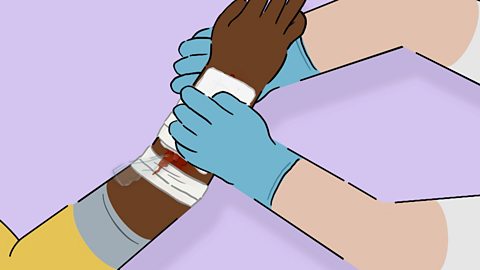
Bleeding and shock. video
Dr Emeka explains how to treat bleeding wounds, what shock is and what to do if someone goes into shock.
Bone fractures. video
In this short film Dr Emeka explains to how to manage a broken or suspected broken bone.

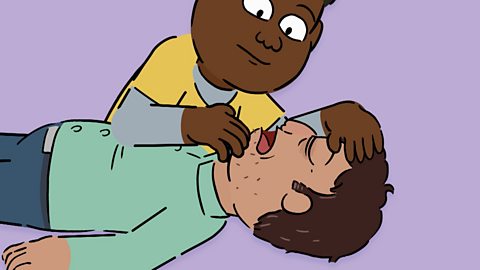
How to administer CPR. video
In this short film, Dr Emeka introduces the process for administering CPR and how to use an AED (automated external defibrillator).
How to administer CPR during the Covid-19 pandemic. video
In this short film Dr Emeka introduces the process for administering CPR and how to use an AED (automated external defibrillator), with specific tips for staying safe during the Covid-19 pandemic.
Bites and stings. video
In this short film Dr Emeka teaches pupils how to deal with bites and stings on themselves, or those around them.