SINGING: That means… In the middle of España
Lived un hombre who was wild
He went mad
From reading booksOf caballeros y doncellas
He believed he was a knight
La cabeza was no there
With his ropa old and rusty
And his caballo tired but trusty
He took a name from where he cameAnd went to find a lot of fame
¡Ven! Soy Don Quixote de la Mancha
Con mi amigo Sancho Panza
Yo soy loco
He is lazy
Yo soy vago but he is crazy
Sancho Panza was diferente
Me gusta mucho el dinero
Always hungry¡Tengo hambre!
He thought Quixotemight have had a sombrero
Quixote saw a peasant girl
Me encanta la doncella
Soy Aldonza
Aldonza that's your name?"
No I'm going to call you DulcineaWith his ropa old and rusty
And his caballo tired but trusty
He took a name from where he came
And went to find a lot of fame¡Ven!Soy Don Quixote de la Mancha
Con mi amigo Sancho Panza
I am loco he is lazy Yo soy vago but he is crazyUn lunes off on una adventure
In La Mancha in Castille
Don Quixote he got confusedWhen faced with muchos windmills
Son gigantes!
They are giants
No no no no no noSon molinos!
They are windmills
No no no no no no¿Cuántos molinos hay?
Uno dos tres cuatro cinco¿Cuántos molinos hay?
Seis Siete Ocho Nueve ¡Diez!
¡Diez!
Oh no ¡Está loco!¡Ven! Soy Don Quixote de la Mancha
Con mi amigo Sancho Panza
I am loco he is lazyYo soy vago but he is crazy.
HE BURPS
Video summary
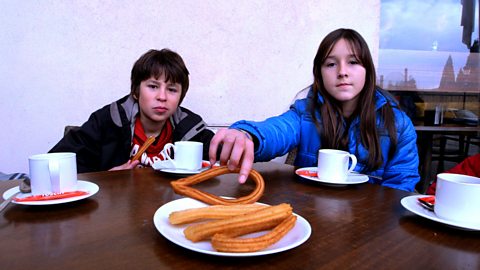
A song in English and Spanish that tells the story of Don Quixote, Sancho Panza and Dulcinea based on the book 'Don Quixote' by Miguel de Cervantes.
The first verse tells how a man imagined himself to be Don Quixote, taking the name of the region as his knight name and travelling around on his trusty horse.
Verse two is about Sancho Panza, his friend who liked money and eating, and Dulcinea, a peasant girl.
Verse three talks about los molinos (windmills) that Don Quixote thought were ‘gigantes’ (giants) and they count them ¿Cuántos molinos hay?
The chorus features the two men comparing ‘loco’ (mad) Don Quixote with ‘vago’ (lazy) Sancho Panza.
This clip is from the series Virtually There Spain.
Teacher Notes
Pupils could retell the story in English, describing the characters, what they were like, was Don Quixote really a knight and how do they know?
Don Quixote chose his name from La Mancha, pupils could choose a knight name by selecting a region and using Don (Sir) or Doña (Lady) For example, Doña Smith de Cataluña; Don Butt de Canarias. They might even want to choose a Spanish family name like García, Alonso, Martín etc.
This clip is suitable for teaching Key Stage 2, Level 2, or beginners in Spanish of any age.
Spanish KS2: A song in Spanish about days of the week and activities. video
A song in Spanish and English to practice the days of the week and typical Spanish activities.
Spanish KS2: A song about the gender of nouns in Spanish. video
A song in Spanish and English to practice the gender of nouns in the language.
Spanish KS2: Painting and colours in Spanish. video
Ashleigh practices colours and adjectives in Spanish by talking to her friends in Toledo as they paint portraits.
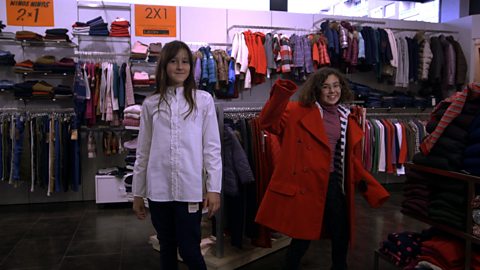
Spanish KS2: Shopping for clothes in Spanish. video
Ashleigh, an English school girl, talks to her friends Sara and Cristina in Spain using a tablet.
Spanish KS2: Giving directions in Spanish. video
An English schoolgirl called Ashleigh gives directions in Spanish.
Spanish KS2: Introductions in Spanish. video
British school girl Ashleigh learns how to introduce herself in Spanish.
Spanish KS2: Meeting a Spanish family. video
Ashleigh talks to her Spanish friend Cristina via a tablet about the festival of Reyes (kings), and compare the traditions with English Christmas.
Spanish KS2: Playing sports and music. video
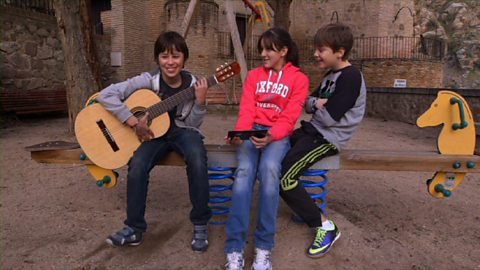
An English schoolgirl called Ashleigh talks to her Spanish friends about sports and music.
Spanish KS2: Shopping, cooking and preparing food. video
An English girl watches her Spanish friends, Javier and Sara, via a tablet as they shop for the ingredients of a paella.