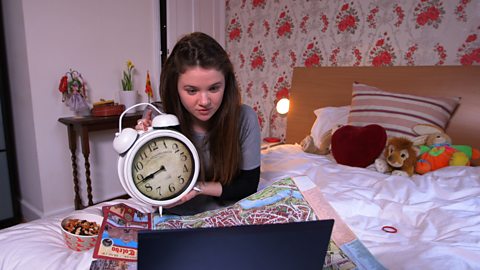
JAVIER: ¡Hola!
ASHLEIGH: ¡Hola! I'm having a lazy Saturday. Where are you?
JAVIER: En el mercado.
ASHLEIGH: 'El mercado.' Oh the market.
JAVIER: Bien. Vamos a comer paella hoy.
ASHLEIGH: Paella. You're having paella for lunch. What's that?
SARA: Es una comida española. ¡Está muy rica con arroz.
ASHLEIGH: Arroz. Rice. So it's a Spanish rice dish.
SARA: ¿Te vienes?
ASHLEIGH: ¡Sí por favor.
JAVIER: ¡Guay! Para la paella se necesita ajo.
SARA: Una cabeza de ajo por favor. Gracias. Una cabeza de ajo.
ASHLEIGH: Ajo. Una cabeza de ajo. You say a head of garlic for a bulb of garlic in Spanish.
SARA: Una cebolla.
ASHLEIGH: Una cebolla 'Una' and 'un' both mean one.
SARA: Dos pimientos.
ASHLEIGH: Dos pimientos. Dos.
SARA: ¿Rojos o verdes?
JAVIER: Para la paella verdes.
ASHLEIGH: Dos pimientos verdes.
SARA: Dos pimientos verdes.
ASHLEIGH: Verdes. When it's more than one object you add an 's' to the describing word.
SARA: Tres tomates.
ASHLEIGH: Tres tomates. Tres.
SARA: Tres tomates.
JAVIER: ¿O cuatro mejor?
ASHLEIGH: Cuatro. Four. Four tomatoes. The more the merrier.
SARA: Cuatro tomates. Me gustan los tomates.
ASHLEIGH: ¿Broccoli?
JAVIER: ¿Qué más?
SARA: ¿Para la paella? ¡No!
ASHLEIGH: What about peas? I love peas. Guisantes.
SARA: ¿Tenéis guisantes?
WOMAN: No. Guisantes no hay.
SARA: No hay.
ASHLEIGH: No no hay. They don't have any.
SARA: ¿Cuánto es?
WOMAN: Cinco euro.
SARA: Uno dos tres cuatro cinco.
WOMAN: Gracias.
ASHLEIGH: So 'gracias' is thank you.
JAVIER: Y ahora la pescadería.
ASHLEIGH: Pescadería. Yeah let's go to the fish stall.
ASHLEIGH: Oh what's that? It looks like squid. I've never had squid before.
SARA: Seis calamares pequeños.
ASHLEIGH: Seis little whats? ¿Qué?
SARA: Seis calamares. 'Seis calamares.' That's that funny-looking squid maybe.
SARA: Seis calamares por favor.
ASHLEIGH: Yes it is.
FISHMONGER: Uno… dos… tres… cuatro… cinco… y seis calamares. Seis calamares.
ASHLEIGH: How do you put all that together then? Mm that looks good. So that's a yummy Spanish dish paella. It makes a change from this. A traditional way to end a meal in Toledo is with marzipan. They even claim it was originated there. Can we go and get some Javier and Sara?
SARA: Buenos días.
WOMAN: Hola buenos días.
SARA: Doce mazapanes por favor.
WOMAN: Sí.
ASHLEIGH: 'Por favor.' That's 'please' in Spanish. Por favor. I wonder how many 'doce' is. That's what Sara said. Oh there's five already.
WOMAN: Seis siete…
ASHLEIGH: Siete.
ASHLEIGH: Ocho.
WOMAN: ocho
ASHLEIGH: Nueve.
WOMAN: nueve
ASHLEIGH: Diez.
WOMAN: diez
Oh we're having lots. ¡Muchos!
ASHLEIGH: Once.
WOMAN: once
ASHLEIGH: Doce.
WOMAN: doce.
Doce twelve. Oh I could eat them all myself.
SARA: Mm me encanta el mazapán.
ASHLEIGH: Mm that looks good. I hope I get to try mazapán one day.
Video summary
An English girl watches her Spanish friends, Javier and Sara, via a tablet as they shop for the ingredients of a paella.
Javier and Sara speak only Spanish so Ashleigh repeats and explains key vocabulary.
They first go to el mercado (market) to buy the vegetables and then to la pescadería (fishmongers) to buy the calamares or squid.
They count out the items needed into their bag, ask the price ¿Cuánto es? and pay in euros.
We see footage of the finished paella before Sara and Javier go to buy some typical mazapanes from Toledo to finish the meal.
Teacher Notes
This clip could be used to introduce or revise food and shopping vocabulary.
Pupils could continue with a shopping roleplay, or writing a shopping list in Spanish. They could also talk about the foods they like using the phrases ‘me gusta’ (I like) and ‘me encanta’ (I love).
This clip is suitable for teaching Key Stage 2, Level 2, or beginners in Spanish of any age.
Spanish KS2: Introductions in Spanish. video
British school girl Ashleigh learns how to introduce herself in Spanish.
Spanish KS2: Meeting a Spanish family. video
Ashleigh talks to her Spanish friend Cristina via a tablet about the festival of Reyes (kings), and compare the traditions with English Christmas.
Spanish KS2: Playing sports and music. video
An English schoolgirl called Ashleigh talks to her Spanish friends about sports and music.
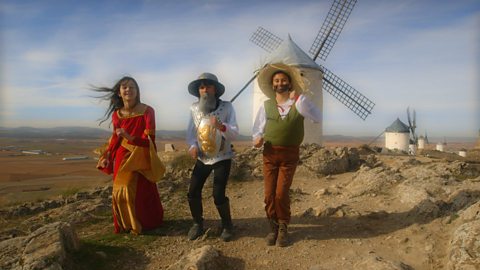
Spanish KS2: A song about 'Don Quixote' video
A song in English and Spanish that tells the story of Don Quixote, Sancho Panza and Dulcinea based on the book 'Don Quixote' by Miguel de Cervantes.
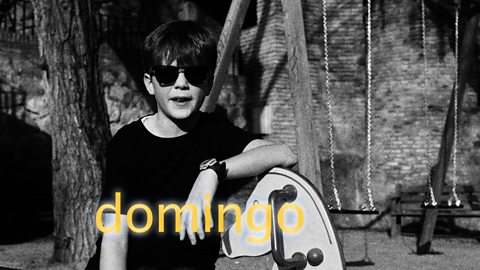
Spanish KS2: A song in Spanish about days of the week and activities. video
A song in Spanish and English to practice the days of the week and typical Spanish activities.
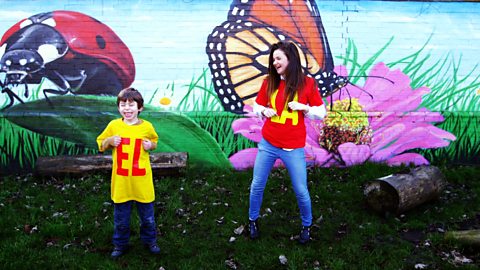
Spanish KS2: A song about the gender of nouns in Spanish. video
A song in Spanish and English to practice the gender of nouns in the language.
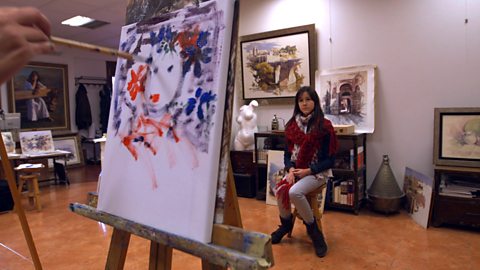
Spanish KS2: Painting and colours in Spanish. video
Ashleigh practices colours and adjectives in Spanish by talking to her friends in Toledo as they paint portraits.
Spanish KS2: Shopping for clothes in Spanish. video
Ashleigh, an English school girl, talks to her friends Sara and Cristina in Spain using a tablet.
Spanish KS2: Giving directions in Spanish. video
An English schoolgirl called Ashleigh gives directions in Spanish.