There was a clear formula for a female artist to secure professional respect. Act like a man, train like a man, paint like a man. And yet those who even attempted it faced ridicule or worse. But real change was finally in the air. In the 1870s, a group of artists in Paris showed that art could be fast, distinctive, requiring no formal training. Dubbed the Impressionists, they were rebelling against the rules and restraint of the art establishment. And they would inspire one female artist in particular, nestled in the idyllic Surrey countryside, to take a love of impressionism and push the boundaries of art.
Far beyond gallery walls and onto a larger canvas. Gertrude Jekyll is one of the most celebrated garden designers in history.
But to see her as a mere horticulturalist is to miss the flavour of her genius. She was first and last an artist. She saw the garden as a canvas on which the gardener paints or embroiders his picture, more or less formed in his mind. Using, for his pigments, the plants that best suit his purpose.
Gertrude Jekyll was born in 1843, and, in a career that spanned over 60 years, she would design over 400 gardens, publish 14 books, and write over 1,000 articles, all determined to inspire us all to see the potential lying just outside the window. But long before she picked up the spade, she held a paintbrush. Jekyll trained as an artist at the Female School of Art in London.
She was intent on becoming a professional artist. But her career was to be threatened before it had even begun. Like all professional artists, Gertrude Jekyll partly trained by copying the paintings of others, and here's her version of Turner's Ancient Rome. I think you can see her personal fascination with Turner's sublime use of subtle colour contrast and light.
But she faced a terrible handicap, short sight of the severest kind. Inadequate and painful. She admitted, "My natural focus is just two inches."
What a handicap in a woman who had the ambition to paint on this scale. Jekyll was forced to find a different way to channel her creativity. Embroidery, embossing, glass making, collage. Activities that, for centuries, had been dismissed as merely craft. But in the latter half of the 19th Century, the Arts and Crafts movement placed them right in the spotlight.
Arts and Crafts came about during the industrial revolution. It was fighting against soulless mass production and trying to preserve rural traditions and handicraft. Suddenly, Jekyll found her blend of art and craft was cutting edge, and she saw that one arena in particular was ripe for reinvention.
The garden.
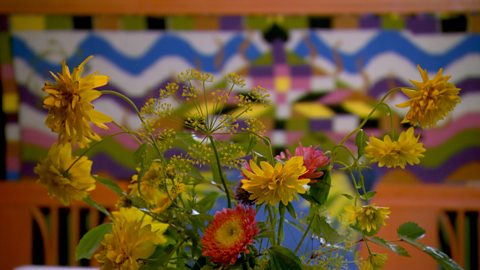
She broke absolutely with the formal conventions of the Victorian flowerbed, 'the kind of thing you can still see today in corporation parks or at the seaside.' Here, she seems to have dabbled the white on with a painterly eye, and these flowing free drifts of white and pastel pink.
She argued that creating a beautiful garden was harder than creating a beautiful painting. Her gardens were designed to be seen from many different vistas. They changed over the course of the day. This is art wrested from nature. Art in 3D.
Jekyll threw away the rulebook and gave birth to a national obsession. Encouraging the public to experiment with plants and colour in their own backyard. A legacy that is still with us to this day. No other garden designer has had such a lasting impact on our landscape. Her obituary in The Times acclaimed her as a pioneering gardener, but also as a true artist with an exquisite sense of colour.
Gertrude Jekyll was an unlikely revolutionary. But she not only demonstrated the artistic value of traditional female domestic crafts, but rejected the idea that art had to hang on stuffy gallery walls. It could be anything and anywhere.
Video summary
Until the 1870s, the only way women could become artists was by training as men had done.
In the 1870s a style of art known as Impressionism made it easier for people without formal training to paint.
Historian Amanda Vickery explains how Gertrude Jekyll (1843-1932) used an impressionistic style to design gardens and achieved success and fame for it.
Jekyll started as a painter, but suffered from short-sightedness so had to find another form of art.
The Arts and Crafts movement was popular at the time of the Industrial Revolution and a reaction to the increase in factory-made goods: people wanted attractive, hand-made and original objects.
Jekyll became a garden designer at a time when people wanted to see more craft and art in every day settings.
Jekyll designed gardens in a non-traditional way: she made them to look like paintings instead of the highly formal style of the time.
Jekyll's work encouraged home-owners to experiment with different colours in their own gardens.
Thanks to her influence, gardens began to be seen as works of art in themselves: alive and three-dimensional, and yet just as valid as those hanging on gallery walls.
This clip is from the series The Britain That Women Made.
Teacher Notes
This could be used in lessons on relevant key historical concepts such as change and continuity and causation, or relevant historical periods like the Industrial Revolution and the social, political and economic change of the 18th century.
Students could be encouraged to discuss the barriers women faced as artists.
What were the factors which helped Jekyll become successful?
Consider the importance of her determination, her education, her personal health and the popular tastes in art at the time.
Which of these factors was most important in her success?
This clip is suitable for teaching Art and Design and History at Key Stage 3 and Third Level.
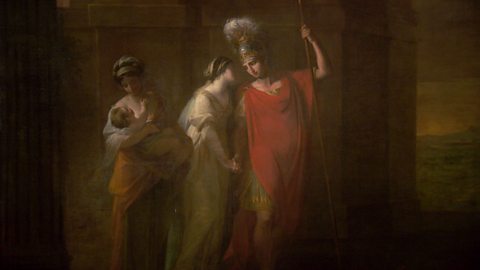
Angelica Kauffmann and the Royal Academy. video
Amanda Vickery shows how Angelica Kauffman (1741 - 1807) became a successful artist.
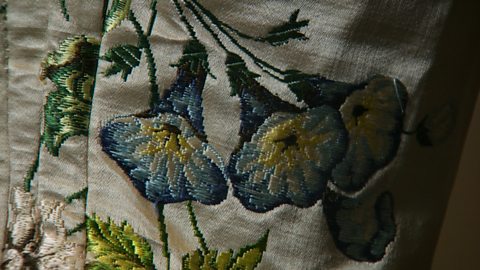
Anna Maria Garthwaite and textile design. video
Historian Anna Vickery explains how Anna Maria Garthwaite designed patterned silks during the Industrial Revolution, at a time women were kept out of art and industry.
Karin Larsson and interior design. video
Historian Amanda Vickery explains how Karin Larsson used her craft skills to transform her home and in turn inspire the "Swedish Style" that Ikea has taken around the world.