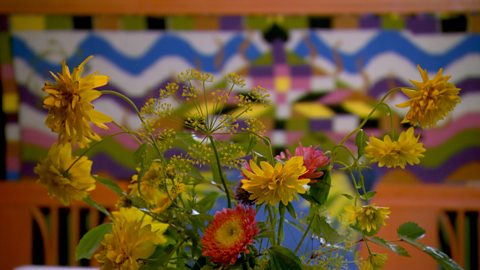
Art today is regarded as liberating, a form of self expression – it may be hard to imagine but for centuries it was in fact a trade, a job… and like most professions in history it was man’s work.
Male Artists were professionally trained taking up apprenticeships in the workshop – where they learnt from their masters – women on the other hand found their creative horizons limited…
Amanda:
For centuries the proper place for female creativity was the home. In the 18th Century that meant watercolours and needlework, at best described as decorative arts, at worst mere craft.
So any woman with artistic ambitions was up against this prejudice.
But industrialisation brought a glimmer of hope. The 18th Century boom of manufacturing and overseas trade opened up new possibilities for women to take their creativity out of the home, to the wider world…
By the early 18th Century the textile industry was fuelled at the top end by wealthy individuals buying embroidered silk in vast amounts for their grand homes and wardrobes – but on the workshop floor most women like children were relegated to the low paid, low status roles – spinning wool, winding silk. The weavers and designers remained typically men…
Not everyone could wear patterned silks but almost everyone had glimpsed them. And 800 of the most prized patterns were by a woman – Anna Maria Garthwaite.
She is one of the great unsung heroes of British design and she lived and worked here in Spitalfields in London. Frustratingly we know little of Garthwaite’s early life other than the fact that she was a vicar’s daughter from Lincolnshire and demonstrated some early education in amateur art. Here’s a paper cut made when she was just 17. It reveals her flair for working precisely on a minute scale - draftmanship that would serve her well when she moved to London and set herself up as a designer.
Being able to paint flowers – watercolours – this is a typical female, polite accomplishment in this period. But to be a designer you have to understand how to lay out a design with mathematical accuracy. I’ve got here a mere selection of over 800 watercolour designs by Garthwaite. Here, she’s laid two of her designs onto squared paper to aid the weaver.
What’s impressive to me about all of this is evidence of the way that Garthwaite used a traditional female talent – water colour painting of flowers – and translated it into an industrial product.
Garthwaite treated the loom like a canvas - such artistry saw her achieve unimaginable success, becoming one of the most eminent silk designers of her time. Her patterns graced the richest and most influential women, not only in Britain and Europe but even in America.
Amanda:
Do you think it was hard for her to break in to silk design?
Clare:
Curiously some of her designs have the inscription sent to London before I came down. And of course they wouldn’t necessarily have needed to say there were by a woman. And so a possibility is that these designs were shown to weavers or mercers ‘would you like more where this come from’ and then the weavers or mercers were hooked by this extraordinary talent and carried on patronising her even though she was a woman.
Amanda:
That’s interesting I hadn’t thought about that, that a male agent might have acted for her.
Clare:
It’s possible. It was a very male dominated business. The weavers’ company was all about men.
Amanda:
Yes. It’s rather fantastic that one of their most successful designers was a woman.
Clare:
Yeah and entirely it reflects her extraordinary talent.
Amanda:
Garthwaite had used a traditionally female accomplishment to establish an independent professional career, and yet there remained one inescapable fact…
Despite the intricacy and sheer beauty of Garthwaite’s designs – her work would still be seen as a craft and not an art…
Video summary
Historian Amanda Vickery presents the life and work of Anna Maria Garthwaite (1690-1763).
During the 18th Century, being an artist was seen as a man’s work.
Men were trained as apprentices with masters.
Women did not have the same opportunities.
Their creativity was limited to the home doing needlework and watercolours.
These were considered ‘crafts’ rather than ‘art’.
We are told the Industrial Revolution meant women’s artwork could be used when making manufactured goods.
Anna Maria Garthwaite had over 800 of her designs used on fine silks worn by the upper classes.
We see shots of her patterns, watercolours and finished textiles.
She turned her floral watercolours into technical templates that were used to produce patterned textiles on an industrial scale.
She became the most famous silk designer of her time, both in the UK and America.
Rich and important women wore her silks. Even though she was a success, her work was still seen as ‘craft’ and not as ‘art’.
This clip is from the series The Britain that Women Made.
Teacher Notes
This could be used in lessons on relevant key historical concepts such as change and continuity and causation, or relevant historical periods like the Industrial Revolution and the social, political and economic change of the 18th century.
Students could be encouraged to discuss how technology changed the way people worked.
How did technology help women do work that was thought just for men?
How did the Industrial Revolution change the status of women artists?
This clip is suitable for teaching Art and Design and History at Key Stage 3 and Third Level.
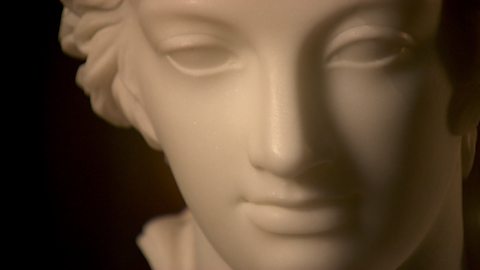
Anne Seymour Damer and sculpture. video
Historian Amanda Vickery explains how Anne Seymour Damer (1749 - 1828) became a sculptor.
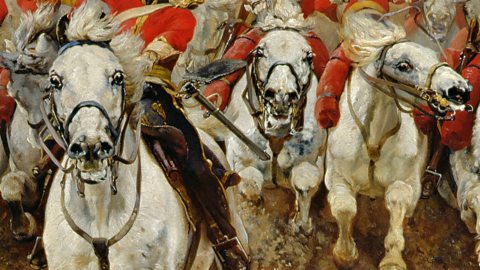
War Artist Lady Elizabeth Butler. video
Historian Amanda Vickery explains how Lady Elizabeth Butler became a famous and successful war artist, at a time when war art was thought to be just for male artists.
Karin Larsson and interior design. video
Historian Amanda Vickery explains how Karin Larsson used her craft skills to transform her home and in turn inspire the "Swedish Style" that Ikea has taken around the world.