In the remote Swedish village of Sundborn, some 160 miles north of Stockholm - there lies the home of a woman whose story shows just how easy it is to underestimate and overlook the impact of female creativity over a century ago Karin Larsson’s creative vision would completely revolutionise the family home.
Karin Larsson is not a revolutionary in the conventional sense at all. She embraced the traditional roles of a wife, mother, and homemaker. Yet it was in the very role of homemaker, and in the lifestyle that she crafted in this house, that she did so much to influence the way we see our own.
Born in 1859, Karin was lucky to have wealthy parents who supported her education. She studied as a painter at the Swedish Academy of Art and might have become a professional artist herself had she not met and fallen in love with another Swedish painter - Carl Larsson.
They married in 1883 and Karin followed the conventional path of so many women – giving up her own painting – and started a family…
But it in fact it is only by looking at Carl’s paintings of his family that the world discovered that Karin had not stopped her creativity – she had merely refocused it – she was crafting a beautiful and warm family home.
What a cheerful vibrant family dining room, this is not a palace, clearly Karin Larsson interior decoration is on a domestic scale and everything is decorated with her own hand.
Karin and was rejecting outright the weight and gloom of 19th Century interior decoration… with a joyful combination of bright colours, mismatched furniture, abstract patterns and loose bunches of flowers.
We are so familiar with this informal look, it’s easy to forget that in the early years of the 20th century this was once shockingly new.
The house here at Sundborn is certainly remote, but as this study reveals was anything but cut off. I see it especially in the periodicals that Karin kept up with – Art and Decoration from France, The Studio, an arts and crafts magazine from England and Culture and Decoration, a German periodical. Karin Larson was engaged with international aesthetic debate – this is not some artless recreation of peasant life it is intellectually informed, exciting and new.
Looking at this rustic family home with fresh eyes you can see just how modern Karin’s vision is… there is nothing of grandma about her weaving with its weird and wild motif.
I think here we have something really rather disturbing… it’s like a cartoon image out of manga. There is a stylised animal here gripping no with nasty teeth. What an earth is this creature? But also there is something charming and hidden here – here in the corner is a a lovely little pear and family tradition has it that her little daughter Brita came in eating a pear while he mother was at the loom and said please put my pear in your weaving - Karin Larsson is absolutely turning her back on the bourgeois conventions of Victorian art and at the same time putting children at the centre of her production.
Larsson’s vision of a home was informal, imaginative and playful - but it amazes me to think that without the popularity of Carl Larsson’s paintings we might never have known what she had achieved.
Karin had created the perfect model of the modern home –but it would take more than half a century for the rest of us to catch up – finally in the 1950s and 60s her vision for our domestic interiors would take hold – and Ikea has seen this conic Swedish style travel the globe…colourful, cheerful, family focused, – this is lifestyle as art!
It's ironic that a woman who gave up a professional career as a painter and pursued no personal recognition has nevertheless left an artistic legacy more palpable and tangible and relevant to modern commerce and the way we live now than any painting hanging in any museum in the world.
Video summary
In a small farmhouse on a remote Swedish lakeside, 4 hours north of Stockholm, lived Karin Larsson: a housewife whose creativity transformed not only her own family home but the way we all see our domestic space.
Presenter Amanda Vickery explains how Karin, an educated woman, was on course to be a professional artist until she met and fell in love with a fellow Swedish artist called Carl Larsson.
They married and Karin gave up a career to start a family.
By looking at Carl’s paintings it is revealed that Karin was still being creative behind closed doors: she was crafting a family home with local flowers, hand-woven tapestry and local furniture.
The established dark and gloomy taste of the time was a far cry from Karin’s light, relaxed, colourful and distinctly modern style.
Despite living remotely, Karin kept up with art developments across the continent.
Her tapestries had such modern design that they stand up to present-day tastes.
Without Carl’s paintings we would never know what Karin had achieved.
She created lifestyle as art and her influence is seen in the Swedish firm Ikea, whose designs have travelled the world.
Karin Larsson gave up an artistic career and yet has left a more tangible legacy to modern commerce than any painting hanging in any gallery in the world.
This clip is from the series The Britain That Women Made.
Teacher Notes
This could be used in lessons on relevant key historical concepts such as change and continuity and causation, or relevant historical periods like the Industrial Revolution, and the social, political and economic changes of the 18th century.
Students could be encouraged to discuss the barriers women faced as artists.
What were the social barriers which Karin Larsson had to overcome in order to become a successful at her craft?
In their answers, students could consider how those barriers could have been used to her advantage.
What economic advantages did Karin Larsson enjoy which helped her to become successful?
To what extent did Karin Larsson have to battle and fight prejudice in order to achieve success?
This clip is suitable for teaching Art and Design and History at Key Stage 3 and Third Level.
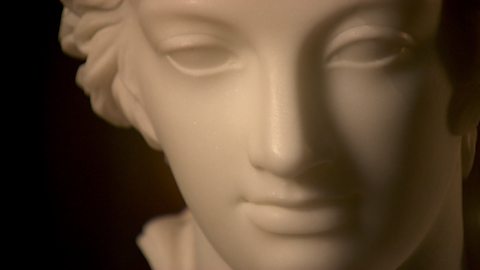
Anne Seymour Damer and sculpture. video
Historian Amanda Vickery explains how Anne Seymour Damer (1749 - 1828) became a sculptor.
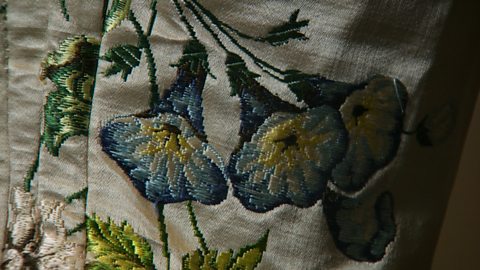
Anna Maria Garthwaite and textile design. video
Historian Anna Vickery explains how Anna Maria Garthwaite designed patterned silks during the Industrial Revolution, at a time women were kept out of art and industry.
Angelica Kauffmann and the Royal Academy. video
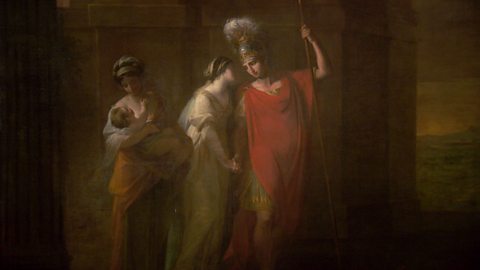
Amanda Vickery shows how Angelica Kauffman (1741 - 1807) became a successful artist.