To be recognised as an artist in Britain, you needed to gain the acceptance and approval of the art establishment, a challenge for women, throughout history. But in 1768, the opening of the Royal Academy finally seemed to open the door for female creativity to be displayed, even celebrated.
The Academy had three goals: to put on shows of contemporary art, to protect the professional interests of its members, and thirdly, to offer training. This was the defining moment for the infrastructure of British art. Perhaps the moment for female artists had finally come.
But it was, in fact, very much a boy's club, as you can see if you study this engraving of the Royal Academy's founding members. There were, in fact, two female founding members, but where are they? They're here, relegated to portraits on the wall, literally side-lined. Mary Moser and Angelica Kauffman.
Moser reflected the ideal image of a female artist, painting flowers, a favourite of the queen. But it was Kauffman whose ambition and determination was to challenge the notion of what female artists could and should paint.
To be truly acclaimed a great, she had to master history painting, the most prestigious genre. But here, she confronted her toughest obstacle. History paintings were packed with full-length figures in dynamic poses. A convincing attempt required detailed knowledge of human anatomy. But the moral standards of the time meant women were barred from the life-drawing class. No 18th Century lady could do what I'm doing, gazing at this naked man, far less drawing him. What was Kauffman to do? Her sketchbook shows how she tackled her modest ignorance of the male body.
This is some sort of Roman or Greek hero, in his sandals, and with a bit of a cape over his arm. But what's missing is the very thing that defines manhood. He's completely smooth in the loins, rather like Barbie's Ken. And in a nutshell, this demonstrates the problem that Angelica Kauffman faces. If she can show that she understands the male body, then her reputation would be blown, smashed to smithereens. But on the other hand, without detailed, exact knowledge of the male body in movement, she would never ever become a great history painter.
Even Kauffman, who was so determined to be taken seriously as a painter, was not prepared to court such controversy. Instead, she sketched from other people's sculpture, a poor second. However, she would ingeniously turn such restriction to her advantage, forging her own unique artistic style.
I'm standing in front of a wall of Kauffman's history paintings. Here, we have Penelope taking down the Bow of Ulysses. And this painting epitomises one of her favourite strategies, which is focusing on the female heroines of Classical and British myth. But when Kauffman chose to depict men as men, she used, what is for me, one of her most ingenious strategies. I'm sure most male painters would have chosen to present Hector out on the battlefield, defending Troy.
Instead, Kauffman presents him saying farewell to the lovely Andromache, who's weeping, "Don't leave me, don't make me a widow, don’t make our son an orphan."
Angelica Kauffman had mastered a delicate balancing act, demonstrating that a female artist could tackle epic history painting, and yet, by placing her focus upon feminine sentiment, she had never risked her lady-like reputation. A tactic that worked well for her. While she may have remained on the fringes of the Royal Academy, she had got her well-shod foot in the door. Kauffman's fame soon spread, and she would find a very modern way to cash in.
This decorated porcelain represents the very top end of her merchandising. From teapots, cups and plates to fans, to pieces of furniture, Angelica's imagery reached down to the middle market. As one printer and engraver said of her, "The whole world is Angelica-mad."
Angelica Kauffman was a pioneer, earning her rightful place in the art establishment. But she was shrewd enough to realise that society could not tolerate women living and painting on equal terms with men.
Video summary
Historian Amanda Vickery explains that in the 18th and 19th centuries women faced challenges in being accepted as part of the art establishment.
It was hard for them to be taken seriously as artists and hard for them to train. In 1768, the Royal Academy opened and made it easier for women to become part of the art establishment, but it did not make female artists equal to men.
We see an engraving showing male founding members chatting in a room with two founding female members represented by portraits on the wall.
The two female founding members were Mary Moser and Angelica Kauffman.
We see portraits of the two women and learn that whilst Moser painted flowers and was a favourite of the Queen, Kauffman wanted to master 'history' painting.
This was difficult for a woman as it was thought only men should do this 'serious' work.
Also to do 'history' painting well she would have to paint full male figures often with few clothes, but women were not allowed to paint nudes because of moral standards of the time.
Kauffman studied the male form by looking at Roman and Greek statues and other people's sketches.
We are told Kauffman painted the emotional aspects of historical scenes to avoid people thinking she was trying to paint something only male artists should. This way she avoided criticism.
We see 'Penelope Taking Down the Bow of Ulysses', a painting that showed how Kauffman painted classical historical scenes focused on women.
Amanda praises Kauffman for making 'history' paintings at a time when most people did not think it was right for women to paint the male form.
Contains some nudity. Teacher review recommended prior to use in class.
This clip is from the series The Britain that Women Made.
Teacher Notes
The relevant key historical concepts are covered in this video: change and continuity; causation Relevant historical periods: Industrial Revolution; social, political and economic change of the 18th century.
The teacher could post the following questions: How did technology help change the way people worked?
How did technology help women get a higher status?
How did technology help women do work that was thought just for men?
How did the Industrial Revolution change the status of women artists?
This clip is suitable for teaching Art and Design and History at Key Stage 3 and Third Level.
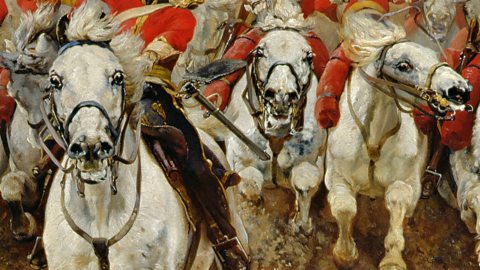
War Artist Lady Elizabeth Butler. video
Historian Amanda Vickery explains how Lady Elizabeth Butler became a famous and successful war artist, at a time when war art was thought to be just for male artists.
Gertrude Jekyll and garden design. video
Historian Amanda Vickery explains how Gertrude Jekyll became a successful artist using garden design as her medium and finding inspiration in the Impressionists.

Karin Larsson and interior design. video
Historian Amanda Vickery explains how Karin Larsson used her craft skills to transform her home and in turn inspire the "Swedish Style" that Ikea has taken around the world.