NARRATOR: 'Cycling is really popular in Germany. There are twice as many bikes as cars. And here in Berlin it's flat, great for bikes, and there are special cycle paths everywhere. Fahrradwege.'
'People start cycling young and it is often the quickest way to get to school. But there is a catch, when you reach year 4, you have to take the cycling test. Fahrradtest. First, of course, your bike has to be safe.'
BENE: Hallo, ich bin Bene.
LAURA: Und ich bin Laura.
BENE: Jetzt müssen wir gucken, ob die Bremsen von Laura in Ordnung sind.
NARRATOR: 'Bremsen.'
BENE: Ja, die sind in Ordnung.
LAURA: Jetzt testen wir das Licht. Los, Bene!
NARRATOR: 'Licht.'
LAURA: Alles OK, Bene.
BENE: So, jetzt müssen wir gucken, ob Luft in den Reifen ist.
NARRATOR: 'Reifen.'
BENE: Ja, da ist genug Luft drinne.
LAURA: Jetzt brauche ich noch meinen Helm.
NARRATOR: 'Helm.'
LAURA: Jetzt kann ich losgehen.
NARRATOR: 'You have to show you can turn corners to pass the test. Bene and Laura are practising turning left. Links abbiegen.'
BENE: Man schaut über die linke Schulter, gibt ein Handzeichen und fährt um die Kurve.
NARRATOR: 'OK.'
BENE: Und jetzt alles rechts herum. Man kuckt über die rechte Schulter, gibt rechtes Handzeichen, und fährt um die Kurve.
POLICE: Stellt euch bitte zu euren Fahrrädern.
NARRATOR: 'That is enough practising. For the test, everyone has to use a course that's been specially designed with all the signs you're likely to meet out on the road.'
CHILDREN: Das ist ein Vorfahrtsschild. Das ist eine Ampel. Das ist eine Baustelle.
NARRATOR: 'Getting safely round roadworks is part of the test.'
BENE: So und jetzt müssen wir unseren Fahrradtest machen.
NARRATOR: 'Finally the test can begin. And they are off. They have to cycle for 12 minutes. Their teacher and a policewoman keep a close watch on them.'
TEACHER: Benedict mit der Nummer 13, er hat ein Fehler, er hat sich einmal nicht umgeschaut. Und die Laura mit der Nummer 14 die war heute Spitze. Perfekte Leistung. Ich habe null Fehler, ich habe bestanden.
NARRATOR: 'They have all passed. Herzlichen Glückwunsch und gute Fahrt!'
The topic of cycling, and its popularity in Germany and Berlin in particular, is introduced.
In year 4, students have to take a cycling proficiency test.
They demonstrate how to check a bike is safe, before practising for and taking their test.
This clip comes from the BBC2 series, Being German.
Teacher Notes
- This video can be used to introduce words for means of transport and road safety.
- You could show a picture of a bicycle on an interactive whiteboard and ask the pupils to name the parts as introduced in the clip.
- You could perhaps show people on bicycles with safety clothing missing and ask the pupils to comment on them.
- You could compare cycling in Germany and cycling in Britain.
- Are any of the pupils cycling to school? Maybe give them words for other means of transport and introduce the phrase: 'ich fahre mit …'. Then invite them to comment on how they are getting to school.
- Perhaps widen the discussion and ask the pupils how they are travelling on holidays.
Curriculum Notes
This short film is relevant for teaching German at KS2 in England and Wales, KS2 in Northern Ireland and second level in Scotland.

More video clips on Living in Germany:
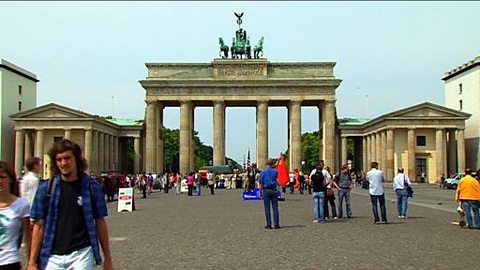
A tour of Berlin. video
A young German boy called Emil introduces his city - Berlin. He then shows where he likes to play football and takes a tour of various sights in the capital, including the Brandenburg Gate, the Berlin Wall and the Reichstag.
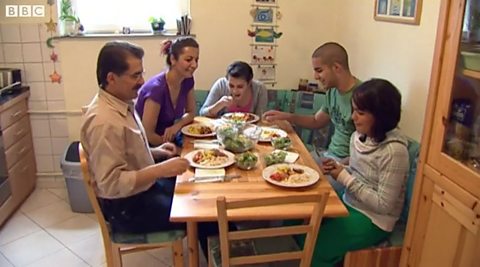
People living in Germany from other countries. video
Selin, a young girl who was born in Germany but has Turkish parents, lives in Kreuzberg, the Turkish part of Berlin. She shows her family's flats and introduces her family during their evening meal.
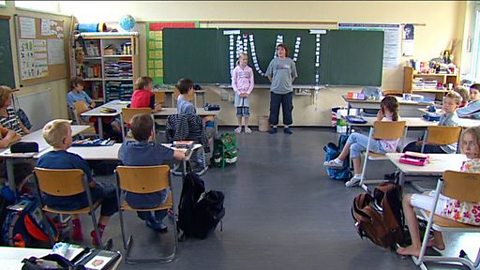
The school day in Germany. video
An introduction to the school day in Germany including lessons, timings and breaktime activities. Two primary school pupils, Nikolas and Sara, take a tour of their school in South Berlin.
Allotments in Germany. video
An introduction to the issue of urban living in Berlin and the lack of green space. Jan and Sven's families have allotments instead of gardens. They take a tour of the small houses on the allotments and explain what activities they and their families do there.
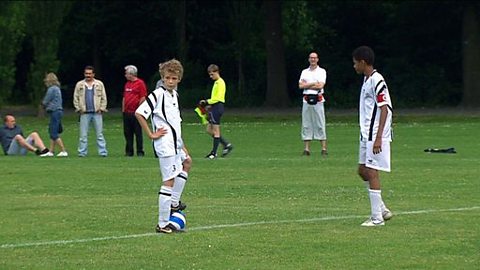
Football in Germany. video
Members of the Hertha Berlin youth football team talk about their ambitions for the future. They are training in preparation for a semi-final match and the names for the different positions are mentioned.