NARRATOR: 'These young footballers play for Hertha Berlin, the biggest football club in the city.'
'All of them have a dream, they want to become professionals.'
PHILLIP: Also, ich heiße Phillip, ich bin Stürmer…
NARRATOR: 'Stürmer.'
PHILLIP: … und (ich) möchte mit Barcelona die Champions League gewinnen.
JONAS: Hallo ich bin der Jonas, von Hertha BSC in Abwehr.
NARRATOR: 'Abwehr.'
JONAS: (Ich) möchte gerne bei Manchester United oder bei Hertha BSC spielen.
MARIUS: Hallo, ich heiße Marius, ich bin Torwart…
NARRATOR: 'Torwart.'
MARIUS: … und (ich) möchte auch gern in der Nationalmannschaft spielen von Deutschland.
NARRATOR: 'Here in the Olympic Park, they train three times a week.'
'Pascal is the midfielder.'
'Mittelfeldspieler.'
PASCAL: Ich spiele im Mittelfeld.
Normalerweise haben wir in der Woche dreimal Training.
NARRATOR: 'Hanir is a very good striker and he is also captain of the team.'
HANIR: Ich bin der Kapitän der Mannschaft und wir müssen jetzt erstmal hart trainieren, weil wir am Samstag ein Halbfinalspielgegen SC Charlottenburg haben.
NARRATOR: 'Das Halbfinalspiel, the semi-final will take place on Saturday.'
'Everyone is determined to get through to the championship final.'
'Es ist Samstag. They're ready for the match and the coach tells them who is in the team.'
COACH: Die Mannschaft mit zu motivieren. Links, Hanir, das was du kannst.
NARRATOR: 'There’ll be a big crowd watching today and the team is a bit nervous.'
COACH: Jetzt gehen wir raus!!!
ALL: Loooos!!!
HANIR: Die Mannschaft ist schon ein bisschen nervös, vor den ganzen Zuschauern.
Das war jetzt der Anpfiff.
NARRATOR: 'At half-time Hertha Berlin are leading 3:0. Only Pascal is disappointed, he hasn't had the chance to play yet'
PASCAL: Ich finde es schade, dass ich nicht spiele, aber vielleicht klappt es das nächste Mal.
NARRATOR: 'Half-time. The coach still wants more out of them.'
COACH: Die nächsten zehn Minuten sind wichtig, schießt mir noch zwei Tore.
NARRATOR: 'The first ten minutes will be important he's told them. But the boys are confident that they'll score even more goals in the second half.'
HANIR: Das ist jetzt die zweite Halbzeit, mal sehen, wieviele Tore wir noch schießen.
NARRATOR: 'No chance for their rivals. Hertha wins with eight goals to one.'
HANIR: Wir haben acht zu eins gewonnen und sind im Finale.
NARRATOR: 'They made it through to the final. Viel Glück!'
Members of the Hertha Berlin youth football team talk about their ambitions for the future.
They all plan to become professional footballers and explain where they hope to play.
They are training in preparation for a semi-final match and the names for the different positions are mentioned.
This clip comes from the BBC2 series, Being German.
Teacher Notes
- This video could be used to introduce football and sports vocabulary.
- You could show the video a couple of times and then ask the pupils to guess the meaning of 'Stürmer', 'Abwehr' and 'Torwart'. Maybe they can guess just looking at the word 'Stürmer' - which word is hiding in it (Sturm - storm).
- Are any pupils in the class playing football? You could ask them what their position is and give them the German words for it.
Curriculum Notes
This short film is relevant for teaching German at KS2 in England and Wales, KS2 in Northern Ireland and second level in Scotland.

More video clips on Living in Germany:
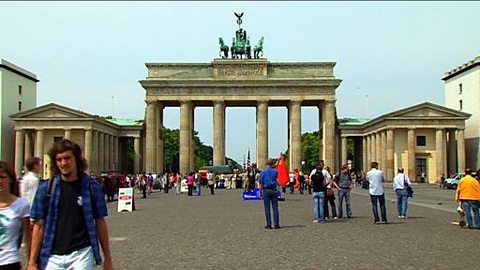
A tour of Berlin. video
A young German boy called Emil introduces his city - Berlin. He then shows where he likes to play football and takes a tour of various sights in the capital, including the Brandenburg Gate, the Berlin Wall and the Reichstag.
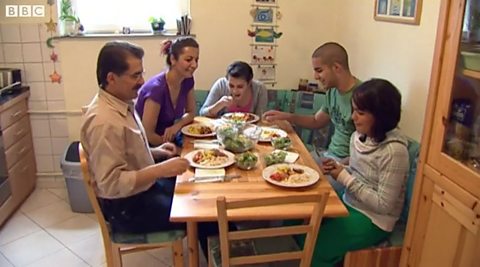
People living in Germany from other countries. video
Selin, a young girl who was born in Germany but has Turkish parents, lives in Kreuzberg, the Turkish part of Berlin. She shows her family's flats and introduces her family during their evening meal.
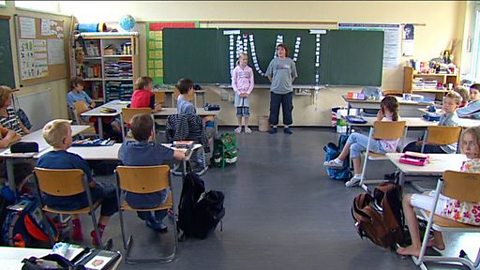
The school day in Germany. video
An introduction to the school day in Germany including lessons, timings and breaktime activities. Two primary school pupils, Nikolas and Sara, take a tour of their school in South Berlin.
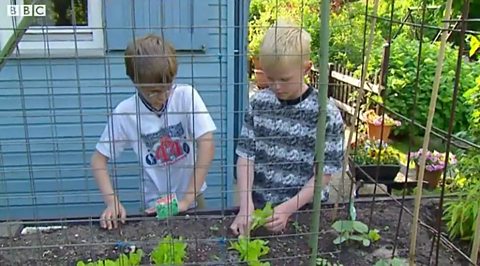
Allotments in Germany. video
An introduction to the issue of urban living in Berlin and the lack of green space. Jan and Sven's families have allotments instead of gardens. They take a tour of the small houses on the allotments and explain what activities they and their families do there.
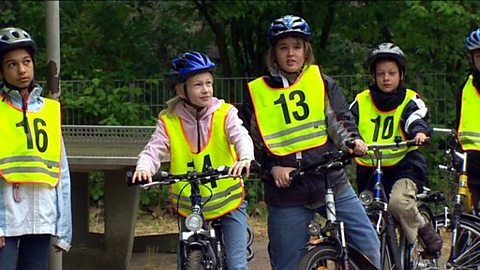
Cycling in Germany. video
The topic of cycling and its popularity in Germany and Berlin in particular is introduced. In year 4, students have to take a cycling proficiency test. They demonstrate how to check a bike is safe, before practising for and taking their test.