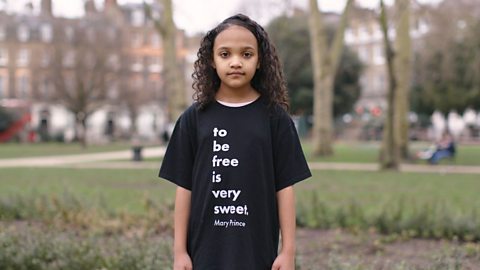
IRIS:Hi, my name is Iris, and I'm 11 years old. I'm meeting up with my neighbour, Abiodun Macdonald Williams, known to his friends andfamily as Mac. Today we're going to visit an amazing old mine where he was part of an exhibition. Mac used to work in coal mining, which was one of the United Kingdom's biggest industries in the past. Until the late 1960s, coal was the main source of energy. Burning it helped heat homes, produce electricity and provide people with jobs. But working down in the mines was really tiring and very dangerous. Mac kept workers safe by making sure there was plenty of air to breathe in the mines and that no dangerous gases had been released by all the digging they did miles underground. He was a ventilation officer and ventilation is all about airflow, like when people talk about ventilating their house by keeping lots of windows open. Some people might be surprised to know that there were black miners but in the last century, there were many hundreds.
MAC:My father came to this country in 1942, met my mother in Manchester, and a few years later they got married in Newcastle. So really, I'm half Nigerian and English. I started working at Dawdon Colliery at the age of 15 years and 2 months. There were other opportunities which I'd have liked to have done, but I thought, well, The National Coal Board paid good wages, very good wages for a 15 year old.
IRIS:So what exactly is a colliery?
MAC:A colliery really is another name for a mine, or an underground mine, where it employs many miners to extract coal from under theground. Iris, Dawdon Colliery was the apple of a lot of people's eyes within the coal industry. In fact, in the 60s, it extracted 1,000,000 tonnes of coal.
IRIS:That's a lot of coal!
MAC:It certainly is, dear, and it certainly made a lot of money. So Iris, after all the training I did, I became a ventilation officer and I had three assistants that used to assist me to do the work. As a ventilation officer, Iris, I used to carry with me a methanometer.
IRIS:What's one of those?
MAC:A methanometer is an instrument which indicates or shows the percentage of methane in the atmosphere or near the roof. It's a very, very important job. Methane doesn't only affect a person's health, it can cause explosions. There were times, Iris, when you had to take a canary down the pit.
IRIS:That's a type of bird, isn't it?
MAC:That's right. The canary was taken down because they would warn you if there was any carbon monoxide gas, which obviously was lethal. It would jump about the cage, it would really, really screech. I've heard it. There was one scary time, Iris, when I was working alone two miles underground when my methanometer wasn't working properly, nor was my safety lamp.
IRIS:So how does it feel to be in that situation, Mac?
MAC:Quite scary, quite frightening. The reason being is because you don't know what's in the atmosphere, what you're walking into and no one knew where I was.
After I left the Coal Board, the industry started to decline, rapidly. I worked in many collieries throughout the coal fields. A lot of them aren't here now, they were made into museums for mining.
On the 21st of April 2017, Britain went without any coal power for the first time in about 200 years. I will always remember the miners are the salt of the earth.
IRIS:And what do you mean by salt of the earth?
MAC:There's no one better.
IRIS:Speaking with Mac has made me realise how hard and how dangerous working in the mines could be. Without people like Mac keeping the air safe, lots of miners could have been injured or worse, and Britain couldn't function without a constant supply of coal back then. Miners like Mac helped make Britain become successful.
Video summary
In this short film Abiodun MacDonald Williams, known to his close friends as Mac, talks to his neighbour, 11-year-old Iris, about what it was like working as a ventilation officer in County Durham in the 1960s.
Mac, who is half Nigerian and half English, was born in Newcastle and got a job working in Dawdon Colliery, County Durham, when he was 15 years-old.
He had a number of important roles in the industry, including as a ventilation officer, and worked to check the air around the workers was safe.
Mac talks with passion about this industry and Iris reflects at the end of the film on how the UK could not function without coal back then and it was miners, like Mac, that helped make the country successful.
This short film is from the BBC Teach series, Black British Stories.
Teacher Notes
Before watching the film
You may wish to introduce your pupils to a brief history of coal mining. Even though it dates back to Roman times, the Industrial Revolution created a huge demand for coal to power ships, steam engines and to warm homes. Coal, a fossil fuel, has been mined to produce electricity since the 1880s. In Victorian times, women and children also worked down in the coal mines. However the Mines and Collieries Act 1842, forbade women and girls of any age to work underground, and introduced a minimum age of ten for boys employed in underground work.
In this short film, Mac talks about the dangers of working so deep underground. Pupils could discuss the dangers associated with mining to familiarise themselves with this concept before watching the film. Pupils could discuss other minerals that are mined (e.g. tin, lead, diamond, gold, gas) and the uses of different minerals in everyday objects (e.g. parts of a mobile phone and computers).
You may want to discuss some of the reasons people came to Britain looking for work between 1948 and 1973. Mac already lived in England as his dad emigrated from Nigeria in 1942. Many of the black miners who worked alongside Mac would have been part of the Windrush Generation, and would have answered advertisements looking for workers to come to Britain to help kick-start the economy after the war.
Please note that discussions on immigration should be treated with sensitivity and approached with particular care if there are pupils in the class who are refugees or asylum seekers. As part of your preparation, you may also find it helpful to consider how to manage discussion of topics such as identity, heritage, interracial relationships and skin tone with the pupils in your class.
Questions to consider
Depending on the focus of your lesson, you may want to pause the video at certain points to check for understanding, asking questions such as:
- Mac started work at the age of 15. What is the age that most people start full-time work these days?
- Why do you think Dawdon Colliery, County Durham was thought of as the “apple of a lot of people’s eyes?”
- How do you think it felt having the responsibility of being a ventilation officer?
- How do you think Mac felt being one of the few black miners in County Durham?
- How do you think it felt for Mac being on his own, two miles underground?
- Why was the canary so important to the miners' safety?
- Why do you think Mac says, “miners are the salt of the earth?”
- Why do you think miners like Mac helped Britain to become successful?
- Until 1989 women weren’t allowed to work under the ground in mines in the UK. Why weren’t women allowed to work in mines? Should women be miners too?
Activities to further explore learning
History of mining: Pupils could research the history of coal mining and the impact it has on the way we live today. Challenge pupils to present this as an information leaflet. The leaflet could be related to a theme such as: migration to the coal mine, finding work as a miner, training and types of work in a mine, accident and injury, teamwork and camaraderie and life after mining and legacy.
Life in a mine: Mac describes an event where he was two miles underground and his methanometer and lamp stopped working. No-one knew where he was and he describes being extremely frightened. Challenge pupils to imagine they were Mac and write a diary entry describing this experience and his relief when he finally was able to get out above the ground.
Renewable sources of energy: Challenge pupils to research the damaging effects burning coal has had and continues to have on the environment. Pupils can then look at different sources of renewable energy. They could write a letter to the Head Teacher to persuade them to look at making the school a greener place in the local community.
Key Vocabulary
- Coal mining - Coal is the most abundant fossil fuel on Earth. It was a vital energy source in Britain during the 18th and 19th centuries and fuelled the Industrial Revolution. Mining is the process of extracting coal from the ground.
- Colliery - An underground coal mine.
- Community - A group of people living in a particular area.
- Discrimination - The unjust or prejudicial treatment of different categories of people.
- Diversity - Differences in racial and ethnic, socioeconomic, geographic, and academic backgrounds.
- Emigrate - To move out of a country into a foreign one to live permanently.
- Immigrant - A person who comes to a country to take up permanent residence.
- Immigration - The process of moving to a new country, with plans to live there permanently.
- Interracial marriage - Interracial marriages/relationships are between people of different races or ethnicities. Interracial marriage was illegal in some US states until 1967. The UK never forbade interracial marriages by law, but people of Mac’s generation experienced racism.
- Mixed race - A mixed race, dual heritage or biracial person has parents or ancestors of different ethnicities. Please note that biracial, dual heritage and mixed race are often used interchangeably and that everyone has the right to define their own identity.
- Prejudice - A preconceived opinion that is not based on reason or actual experience.
- Racism - The belief that people of different races or ethnic groups have different value in society, and using this against them.
- Ventilation - The movement of fresh air through a room or building.
This short film is suitable for teaching KS2 / 2nd level pupils and links to various areas of the curriculum including history (black history or industrial changes), geography (distribution of natural resources), and personal, social and relationships education (community, work and career).
Diversity in the communityThe film raises questions about the different roles people can play in a community and how a community can be made up of many people from a variety of backgrounds.
Care for the environmentThe film raises questions about what we can do to look after our environment and how important it is now to seek alternative sources of energy.
Alison Bennison - Working as a NHS nurse. video
This short film for primary schools follows Alison Bennison's journey to Britain from Barbados in 1960, to train as a nurse and work for the National Health Service. The story is told by Alison's granddaughter, Lindsey, and nine-year-old Dontay.
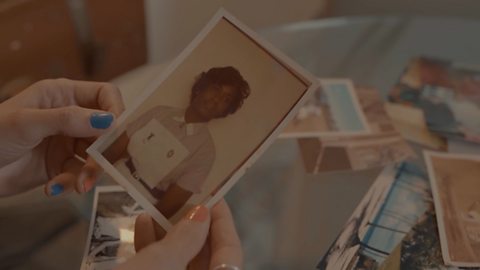
Christina Shingler - Becoming an author of children's literature. video
In this short film Felix, aged 10, talks to his grandmother Christina (Tina) Shingler, a writer who decided to do something about the lack of black characters in British literature.
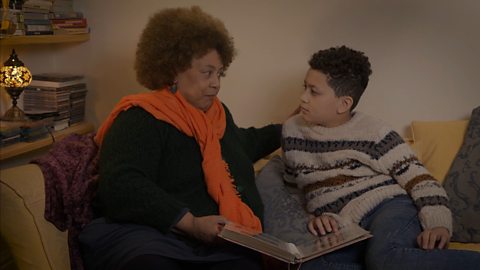
David Mwanaka - Becoming a farmer in Britain. video
In this short film 11-year-old Anashe meets David Mwanaka, and finds out about his journey from Zimbabwe to becoming a farmer in Britain.
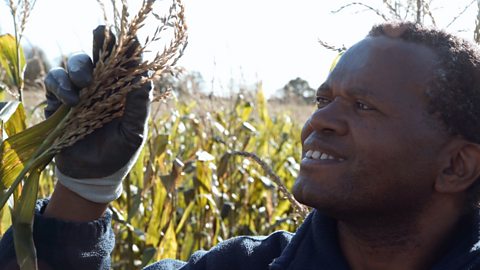
Dennis Morris - Becoming a photographer. video
This short film tells the story of Dennis Morris, a well-known photographer from London, originally from Jamaica, who photographed famous musicians including Bob Marley.
Elsie Owusu - Becoming an architect in Britain. video
In this short film 11-year-old Kendra meets Elsie Owusu, who moved from Ghana to the UK as a child and became an architect, and dealt with the challenges of working in a white, male-dominated profession.
Eunice Olumide - Breaking into the fashion business. video
In this short film 12-year-old Lore meets Eunice Olumide, a second generation Nigerian who was born and grew up in Scotland and become a professional model.

Magid Magid - Becoming the youngest ever Lord Mayor of Sheffield. video
In this short film 14-year-old Abdirahman meets Magid Magid, a Somali-British activist and politician who served as the youngest ever Lord Mayor of Sheffield from May 2018 - May 2019.
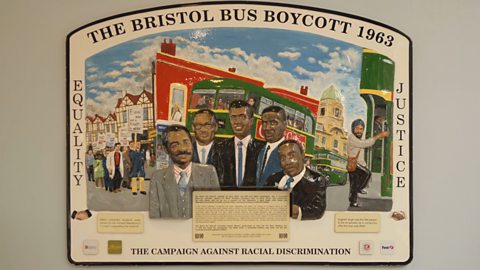
Vernon Samuels - The Bristol Bus Boycott of 1963. video
In this short film 13-year-old Amelia and Vernon Samuels, who represented Great Britain in the 1988 Olympics, tell the story of the Bristol Bus Boycott and Vernon's father, who was the first black bus driver in Bristol.
Yesha Townsend - A Bermudian poet in London. video
This short film tells the story of Yesha Townsend, a Bermudian poet who currently lives and works in London, and how she has been influenced by Mary Prince, a black woman who escaped from slavery.