On June 28th 1914, a Serbian man called Gavrilo Princip, shot and killed Archduke Franz-Ferdinand, heir to the Austrian Hungarian Empire.
This was the spark the started the First World War
Tension had been rising in Europe for many years as competing European powers claimed new territories
The race to have bigger ships and armies also built tension
.By the start of the 20th century, countries in Europe had made deals to look after each other
The British, French and Russians joined together to create a big alliance called the Triple Entente, known as the Allied Powers
The Germans teamed up with Austria-Hungary
They later became known as the Central Powers with Bulgaria and the Ottoman Empire, run by Turkey
However, forming gangs did not help the tense situation
The assassination of Archduke Franz Ferdinand led to events that meant even if people didn’t want to fight, they had made promises which had to be kept.
28th July 1914 – Austria-Hungary declared war on Serbia
Russia asked Germany to get Austria-Hungary to hold back and when they refused Russia prepared her army to fight
1st August 1914 Germany declared war on Russia, to defend her ally, Austria-Hungary
France, who had a treaty with Russia now had to get involved
3rd August 1914 – Germany had a plan to beat France quickly but this meant they had to invade neutral Belgium
4th August 1914 – Britain protests at the invasion of Belgium and declares war on Germany
And that was how it all began
And it was to last 4 years bringing in even more countries along the way!
Video summary
This short film is for teachers and review is recommended before use in class.
Captions, photographs, maps, graphics and commentary explain how the assassination of Austria-Hungary’s Archduke Franz Ferdinand triggered World War One.
Events are traced from the shooting by Serbian Gavrilo Princip on 28th June 1914, through to the responses of the two rival military alliances.
There is also a brief account of the tensions caused by the expansionist ambitions of the major European powers.
This clip is from the series WW1 A to Z.
Teacher Notes
Pupils could identify on a wall map of Europe all the countries mentioned in the commentary.
They could add pins or flags to the map, with labels to represent key moments in the outbreak of war.
They could find out more about the death of Franz Ferdinand from a range of information sources and discuss the question, ‘How could one man’s death spark a world war?’
This short film is suitable for teaching history at Key Stage 2 / Second Level or above.
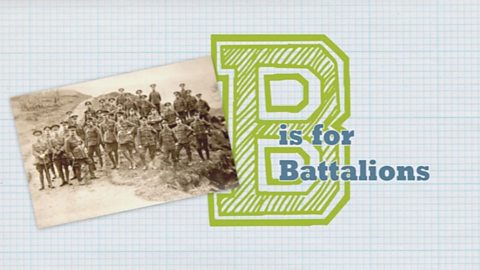
B is for Battalions. video
Newsreel and dramatic footage illustrate how the British army recruited groups of friends and neighbours to fight together.
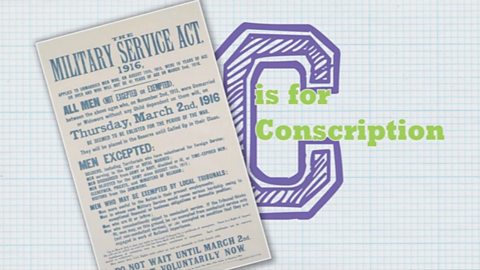
C is for Conscription. video
Newsreel and dramatic footage describe how Britain introduced conscription - compulsory army recruitment - in 1916.
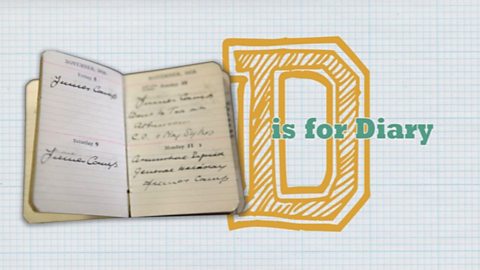
D is for Diary. video
Pupils examine wartime diaries and discuss the value of first-hand accounts. In a monologue, a war widow reads from her husband’s diary.