When World War 1 started, the British Army wasn’t as big as the German Army.
The British Government asked men to volunteer
Lots of friends and neighbours joined together
Pals Battalions were formed
By the end of September 1914, over 50 towns had Pals Battalions.
- Private Frederick Prescott. 13th York and Lancashire Regiment. Nineteen years old.
I hope I do alright tomorrow. Going over the top. Feeling a bit nervous . Don’t want to let the lads down. At least we’ll all be together – Me, Billy and Arthur. Known each other since we were kids. Lived on the same street, all worked at Brantons in town. They said if you joined up with your mates you’d all stay together. There’s hundreds of lads from our town in this regiment. Loads of us joined up on the same day. They call us The Barnsley Pals.
Training were hard at first. No-one were properly fit. On first day we went for a run and we were all coughing like old men. Food were good though. We had porridge, bread and jam, soup, beef stew. I loved that stew. Every day we did marching, physical training, bayonet fighting. It were great. Best bit about training were doing it with your mates. Staying together with your pals.And then we all got our kit. (He shows us ) So much stuff. We looked at each other, Me, and we said. ‘That’s it lads. We’re proper soldiers now.’
FX : shell fire getting louder
And now we’re in France. For the past two days we’ve been marching up to the front line. It gets louder the closer you get and then finally …you’re here. Front line. Fire trench. Germans are just over there.
Anyway - we’ve just had the talk. Tomorrow morning there’s a big push and we’re all going over the top together, Billy, and Arthur. We’ll be alright. ‘Course we’ll be alright. We’re the Barnsley Pals, us.
Video summary
This short film is for teacher use and contains potentially upsetting content; teacher review is recommended before use in class.
Newsreel and commentary describe the British approach to recruitment through the formation of ‘Pals’ Battalions’ where friends and neighbours joined up together.
A dramatic monologue introduces Private Fred Prescott, who describes his initial training along with his mates in the ‘Barnsley Pals’.
Fred is nineteen years old. We follow him to the front line, where he is about to go into battle for the first time.
Teacher Notes
Pupils could discuss the advantages of Pals’ Battalions.
Why were friends, relatives and neighbours keen to enlist together? Can pupils think of any disadvantages? For example, how might a large number of casualties affect a single community?
Pupils could go on to improvise and script monologues for others in Fred Prescott’s life, such as his pals in the battalion or his family at home. How does each of these people feel about Fred joining up?
This short film is suitable for teaching history at Key Stage 2 / Second Level or above.
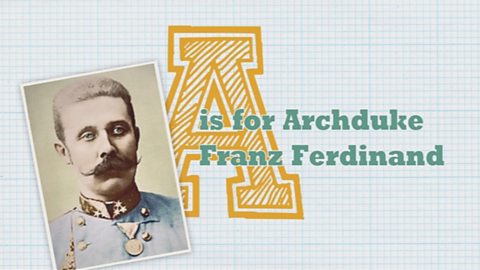
A is for Archduke Franz Ferdinand. video
Pictures and commentary explain the beginning of World War One in 1914, sparked by the assassination of Austria-Hungary’s Archduke Franz Ferdinand.
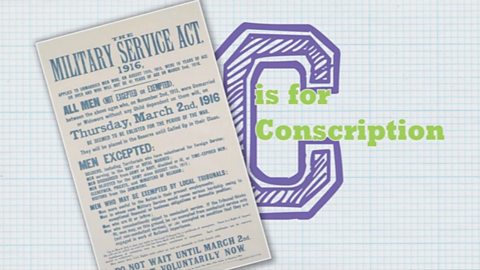
C is for Conscription. video
Newsreel and dramatic footage describe how Britain introduced conscription - compulsory army recruitment - in 1916.
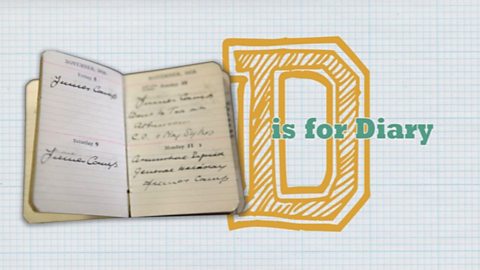
D is for Diary. video
Pupils examine wartime diaries and discuss the value of first-hand accounts. In a monologue, a war widow reads from her husband’s diary.