Sources can be challenging for historians. On the one hand, we could take them at face value. On the other hand, we could say, "Oh, it's biased, we can't use this." In actual fact, all sources are biased to some degree. The trick is to be sensitive to this issue.
I've come to the National Library of Wales in Aberystwyth to see some sources relating to the thousands of children evacuated to Mid Wales during World War II. I want to find out more about the way the experiences of these children were portrayed by the local media. My starting point is a set of newspaper photos, taken the day after war broke out.
We get this sense of what's happening on the day. These children would have come from Birkenhead, which is near Liverpool. They're being taken off for processing, to go and meet the people that they're going to be staying with for who knows how long at this point. They've got little labels attached to them, about who the child was, where the child was from.
But if we look a little bit closer at the photos, what else can we see? And it's the fact that you can see the emotions. They look quite excited in some of them, although this little girl over here looks quite worried. She looks to be holding her brother's hand. Why does this boy play up to the camera? Does he really feel like this, or is he just reacting like this because there's a camera in front of him?
For some, it was a little bit like an adventure but, for others, it was something that they didn't necessarily want to do. So photographs are really useful for historians. They allow us to see some of the reactions. But they are from a particular perspective. So there are issues here. You know, why did the photographer decide to focus in on this little boy?
As historians, it's important to be aware that choices like these are made whenever a photo is taken or an article is written. These photos were all taken by a famous Welsh photographer, Geoff Charles. And my second source is one of his photos, used by the Montgomeryshire Express and Radnor Times.
So here we have an image of the children. Some of them are sitting on top of this farm gate, and some of them are standing in front. And they all look very happy. And, actually, if we look a little closer, we can see that there is a caption here. It says, "We are so happy, none of us want to go home." It's difficult to imagine that this caption is accurate. Some of the children were bound to be wondering when they were going to see their parents and the rest of their families again.
So we've got this really bold statement and, yes, the children look happy. But it's a posed photograph - it's carefully arranged. The newspaper caption has got my historian's brain working. Why would a local paper choose to write something like, "We are so happy, none of us want to go home"? Why put this slant on the story?
Time for another source. We've got another great source here from the Montgomeryshire Express, and it gives a generally positive account. Here, we've got the title. "Arrivals of evacuated children - Montgomeryshire's part in the great scheme." And, over here, we've got this subheading, "The time of their lives." It's got lots of little humorous stories, bringing out all of these differences between these city kids and the rural environment.
So it says, "One thing that the country children have not quite fathomed yet is why the newcomers all shout. They're used to the milling traffic and din of busy Merseyside, accustomed to shouting at one another." And so it's giving these nice little pieces which give a flavour of the difference, but in a very positive, light-hearted way.
But we know that it wasn't all like this. Even the paper itself admits this. It describes some of the children were "looking glum and forlorn." So it does acknowledge that there is a problem here. But it doesn't emphasise that. Some people might say this is propaganda. Why did the press do this? Well, the government are putting pressure on the press. They want to make sure that parents don't take their children back. There's another issue here - they have to maintain morale, so they want the general population to be focused on the happier stories.
So, we've explored three sources that could all be regarded as biased. We saw how photographers carefully select the subjects of their photographs, we saw the bold claim under the photo, and how the newspaper article highlighted the positive above the negative. Nevertheless, all three sources are useful in giving us a sense of the children's experiences, and are even more useful as evidence of how the media - and possibly the government - were controlling the stories that people were able to read at the time.
So what does the historian do next with all of these questions? Well, you build upon these sources, and you go looking for more, in order to build a bigger picture about evacuation.
Video summary
This film looks at historical sources relating to the experiences of children evacuated during World War 2.
Dr Sam Caslin from Liverpool University looks at how photos taken by leading Welsh photographer Geoff Charles, can help tell us more about the lives of the children concerned.
Dr Caslin shows how decisions about what to photograph, and which prints were selected, tells us something about attitudes to the war and evacuation.
The film also looks at how the local newspaper used the photographs in articles portraying the evacuees’ experiences in a positive light.
She asks if this is evidence of government propaganda pressurising the media to present the evacuation in a positive light.
This clip is from the series Hunting for History.
Teacher Notes
Students could be asked to write a short response to the following task: ‘All sources are useful to the historian’. Explain why.
This clip will be relevant for teaching KS3 History in England, Wales and Northern Ireland and 4th level People, past events and societies in Scotland.
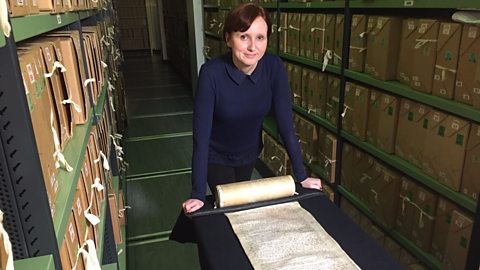
Magna Carta. video
A look at what sources can tell us about the importance and origins of Magna Carta.
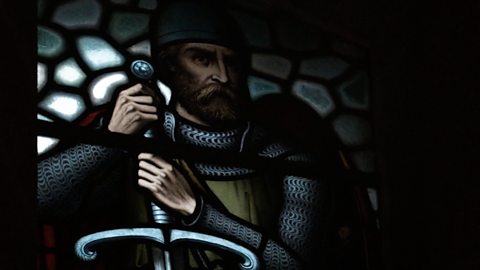
William Wallace. video
A look at how sources can help separate the myth from the man that is William Wallace.
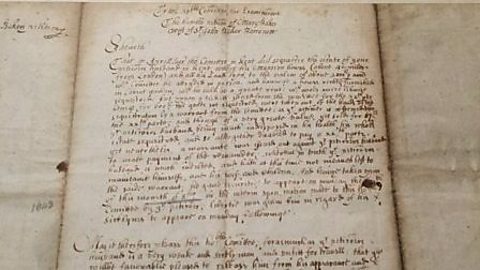
The British Civil Wars. video
An exploration of how sources can help us understand the impact of the British Civil Wars on ordinary men and women.
The History of Women's Football. video
Exploring sources that reveal the remarkable success of the Dick Kerr’s ladies football team during World War One.
Burke and Hare. video
An exploration of how historical sources can help to explain the motivation for Burke and Hare’s 19th century killing spree in Edinburgh.
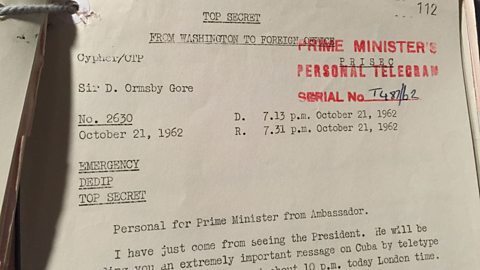
The Cuban Missile Crisis. video
Exploring what historical sources reveal about how close Britain came to nuclear war in the early 1960s.