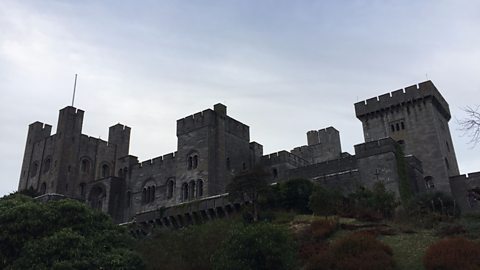
I'm standing outside Parliament where the country is ruled from today. But we should remember that it took brutal civil war, fought by men here like Oliver Cromwell, to establish the power of Parliament and to make sure that monarchs respected that power. The Civil Wars of the 1640s were perhaps the most violent and destructive episodes in British history. This was a struggle between King Charles I and Parliament over how, and in whose interests, the country should be governed. But what about the soldiers themselves and the people caught in the firing line? I'm here at the National Archives in Kew to find out more about what sources can tell us about them.
The Civil War divided the nation and it had a terrible effect upon ordinary people. Here at Kew, they've got this wonderful book of bound letters. This one here is by an officer in the Parliamentary army, Nehemiah Wharton, and he wrote it to an acquaintance. In this letter, written during the early stages of the Civil Wars, he describes a range of actions by the opposing Royalist troops. "Certain gentlemen of the country informed me that Justice Edmund, a well-spoken man, was robbed by the vile bluecoats of Colonel Chomley's regiment and lost even their beds." Later, in the same letter he writes, "We had news that Prince Rupert, that evil Royalist, had surrounded Leicester and demanded £2,000 or else threatened to plunder the town." We could dismiss this source as being biased towards the Parliamentary side of the argument but all sources are biased in their own way. It does tell us about the effects of the war upon civilians.
The first source is a soldier's observations of the scale of human suffering, but what about those people on the receiving end? Other sources reveal that the war was having a huge impact on ordinary people on both sides. Here I have a second source relating to the Civil War. It's a petition or a plea to a County Committee - the County Committees were instructed by Parliament to raise taxes in support of the Parliamentarians' war effort. This particular one outlines the case of a woman named Mary Baker. It says, "Mary's husband is in very poor health, his whole estate has been seized, and so he cannot pay an extra 20th part or 5%. Yet a warrant was issued against Mary's husband to pay the rest." Mary is begging on behalf of her husband here, so, on the face of it, the situation seems pretty bad. Now it could be that they are just exaggerating in order to get out of paying their taxes. But the shelves here at the National Archives contain many other cases like this one. In the first source, the Royalists were doing the plundering. Here, in this source, it seems as though the Parliamentarians are doing their own type of plundering.
The two sources we've looked at give us a great sense of the war's immediate impact upon men and women. But we need a longer-term picture. And here's a source that provides it. It's a petition from a group of widows in Liverpool, and it gives us a sense of the devastating impact of the war on whole communities. It talks about the effects on, "The many hundreds of widows and fatherless children, whose husbands and fathers lost their lives and estates." What we get from this source over and above the other two is an impression of the sorry state that the women and children were left in as a result of the war. "Houses were burned and many of your petitioners' husbands were barbarously massacred and the rest imprisoned and all despoiled and robbed of their estates." The petition blames the Royalist Army for the carnage and plunder. And in this source they're saying to Parliament, "We supported you, we made sacrifices and now we want compensation for this."
The sources we've looked at take us beyond the textbooks and their usual focus on leaders like Oliver Cromwell. The story of war is the story of how it affected ordinary men, women and children, people like Nehemiah Wharton who described his experiences as a soldier or Mary Baker who pleaded for compensation after her property and possessions were plundered or the Liverpool widows whose lives were devastated by the conflict. The sources we've looked at today show us how the Civil War affected ordinary people like you and me.
Video summary
Dr Sam Caslin from Liverpool University looks at the power of historical sources to show how ordinary men and women were affected by the British Civil Wars.
The Civil Wars of the 1640s were perhaps the most violent and destructive episodes in British history.
They were a fierce struggle between King Charles I and Parliament over how, and in whose interests, the country should be governed.
But, as usual in wars, it was ordinary men and women who experienced the brunt of the suffering.
Dr Caslin investigates a number of sources at Kew National Archives to discover the full impact of the conflict.
These include letters from Parliamentary soldiers about Royalist plunder, and evidence of the punitive measures by the Parliamentarians to extract funds from their own supporters to finance the wars.
This clip is from the series Hunting for History.
Teacher Notes
Students could be asked to consider why, in 1648, most people in England no longer cared whether Parliament or the King ruled the country and just wanted an end to the fighting.
They could then watch Dr Caslin analyse each of the sources, and after each one they could be asked to explain how the source was useful evidence in trying to answer this question.
This clip will be relevant for teaching KS3 History in England, Wales and Northern Ireland and 4th level People, past events and societies in Scotland.
Magna Carta. video
A look at what sources can tell us about the importance and origins of Magna Carta.
Medieval Antisemitism. video
A look at what sources can reveal about Antisemitism in Medieval times.
The lives of WW2 Evacuees. video
Explore what sources, such as photos and newspaper articles, can tell us about the experiences of children evacuated during World War 2.
The History of Women's Football. video
Exploring sources that reveal the remarkable success of the Dick Kerr’s ladies football team during World War One.
Burke and Hare. video
An exploration of how historical sources can help to explain the motivation for Burke and Hare’s 19th century killing spree in Edinburgh.
The Slave Owner. video
An exploration of how sources allow historians to understand more about the life and views of a wealthy slave owner (Richard Pennant).