If we want to understand the past, we have to understand the people who lived in the past. We can study monarchs, we can study ordinary people, we can study heroes, but sometimes we have to study people who maybe we don't like the sound of all that much.
I'm here at Penrhyn Castle in North Wales, the ancestral home of Richard Pennant, a wealthy landowner who made his money from slavery during the 18th century. But who was Richard Pennant and what did he think about slavery? He was 1st Baron of Penrhyn, he was an MP, and he owned over 1,000 slaves. In fact, he was a passionate defender of slavery and he even argued against the people who wanted to see it abolished.
DOOR CREAKS
The castle was rebuilt in 1822 and is now owned by the National Trust, but it retains this grand dining room where Richard's portrait hangs, as it would have done when he was alive. It was painted at the height of Richard's power, when he was an MP speaking regularly in support of the slavery that had made him so rich. Portraits like these were incredibly expensive and were statements about your wealth and status. I found a source online which covers a debate that was introduced by William Wilberforce to Parliament on 12th May 1789.
This was a powerful debate about whether or not slavery should be abolished. Many of the MPs spoke saying that they thought it should be. In amongst all this, though, Lord Penrhyn, or Richard Pennant, speaks up and gives his verdict in support of keeping slavery. He says this - "The question, therefore, was, "if they passed the vote of abolition, "they actually struck at the 70 millions of property…" …they ruined the colonies, and by destroying an essential nursery for seamen, give up the dominion of the ocean at a single glance.
MEMBERS OF PARLIAMENT: Hear! So what he's talking about here is the potential for Britain to lose her colonies, the potential for Britain to lose control of the seas, so his arguments in favour of keeping slavery are very much about influence, power, money, and not at all about compassion.
Publicly, Richard was a strong defender of the slave trade, but what about in private? Can sources reveal anything more about this man?
In fact, Richard left hundreds of letters he wrote to his plantation managers in Jamaica and they're stored a few miles away, in the archives of Bangor University. Richard Pennant wrote these letters in the 1780s, when he inherited the estate from his father.
If we take this one, for example, which he's written to his plantation manager, he says, "The life and health of the negroes "is of the utmost importance. "They should not be overworked "and that they should be treated with tenderness "when they are ill "and with humanity and some attention at all times." So on the surface, he's concerned about welfare, but if we read between the lines, we can see that there's actually something else going on here. He says, "Humanity, "as well as the interests of the proprietor, "demand that they should be taken care of." He's interested in seeing his slaves taken care of because he wants an efficient plantation.
He goes on - "That the negroes may have provisions "and the cattle food." He's lumping them in together and talking about them in the same context. This makes me think, how much is his care about the slaves motivated by his concern for their welfare and how much is he really just concerned about them as commodities? And in this way, this source is great. It allows us to understand the mentality of Richard Pennant in a little bit more detail. We've seen some fascinating sources that really allow us into the mindset of Richard Pennant. The portrait showed us that he thinks of himself as this great man, the speech allows us to see how he justified slavery in public and, with the letters, we saw that he thought of slaves as commodities.
What else would we do next as historians?
If we want to understand more about the mentality of slave owners, we'd look for other sources which would allow us to do just that.
Video summary
Please note that this video contains (through the reading of historical sources) highly offensive language and distressing archive images relating to slavery. Teachers are advised to view the video before showing a class to check suitability for their cohort.
In this film, Dr Sam Caslin from Liverpool University looks at historical sources relating to the life of Richard Pennant; a wealthy landowner, politician and industrialist who made money from slavery.
Even though we regard slavery with abhorrence today, it is sometimes useful for historians to try to understand the mentality of the people who supported it.
In the film, Dr Caslin visits Penrhyn Castle in North Wales, the rebuilt former home of Richard Pennant, and studies a huge portrait of him hanging in the castle’s dining room.
Dr Caslin highlights a Parliamentary speech from 1789 in which Pennant argues forcefully about the benefits - in his view - of slavery to Britain.
Dr Caslin also visits the National Museum of Wales, where she reviews a series of letters that Pennant sent to his plantation managers in Jamaica. In the letters it’s clear that although Pennant expresses concerns about the welfare of enslaved people, he saw them as mere commodities, likening their supervision to his cattle.
This classroom film is from the BBC series Hunting for History, in which Dr Sam Caslin interrogates historical sources to uncover historical events and individuals.
Teacher Notes
Historians use sources to try to understanding the mind-set and values of people in the past. Students could be told a little about Sir Richard and that he was a defender of slavery.
They could then be asked to speculate as to what arguments he might have made.
They can then follow Dr Caslin’s analysis of the sources and see how far their speculations were valid.
This clip will be relevant for teaching KS3 History in England, Wales and Northern Ireland and 4th level People, past events and societies in Scotland.
Magna Carta. video
A look at what sources can tell us about the importance and origins of Magna Carta.
Medieval Antisemitism. video
A look at what sources can reveal about Antisemitism in Medieval times.
Elizabeth I. video
A look at what sources can reveal about the personality of Elizabeth I.
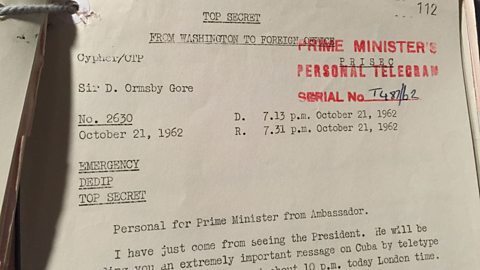
The Cuban Missile Crisis. video
Exploring what historical sources reveal about how close Britain came to nuclear war in the early 1960s.
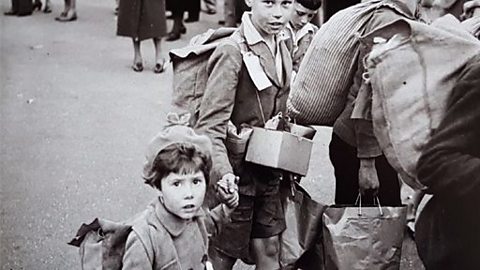
The lives of WW2 Evacuees. video
Explore what sources, such as photos and newspaper articles, can tell us about the experiences of children evacuated during World War 2.
Burke and Hare. video
An exploration of how historical sources can help to explain the motivation for Burke and Hare’s 19th century killing spree in Edinburgh.