Animals were very important in the war.
Horses were used as transport and to pull heavy machinery and weaponry.
Over 8 million horses died during the war.
Pigeons were used to send messages between troops.
Dogs were used to sniff out gas attacks and to pull machinery.
Also to send messages across no mans land.
Stubby. Dog. Boston Bull Terrier. Three years old.
The most famous dog in the whole of America. The only dog who made it to sergeant in the US Army. Yeah. Sergeant Stubby, that’s my full name.
I was a stray when Corporal Robert Conroy found me. He called me Stubby and liked me so much that when he was sent to France to fight the Germans he took me with him. Smuggled me onto the ship in a big wooden box. That’s how I ended up in the middle of war and got to be a hero.
Yeah that’s right! I got to be a war hero and if you don’t believe me look at this coat they made me. See all these medals pinned on it? I won them fair and square. You’re thinking how does a dog win medals in a war? I’ll tell you how!
We dogs got good noses see and if the Germans let off gas I’d smell it long before the soldiers would. First sniff of gas and I’d go crazy jumping up and down and barking and they’d know it was time to put their masks on. They said I saved a lot of lives that way.Got another medal for finding wounded soldiers. I could sniff ‘em out see. Even in the dark I could find people and then I’d bark to let the stretcher bearers know where to come.
I was in seventeen different battles in France and I got wounded one time myself. Shrapnel from a grenade hit my front leg and that’s when they made me a sergeant.
And that’s why I’m famous. The war’s over now but everyone’s heard of Sergeant Stubby.
Video summary
This short film is for teachers and review is recommended before use in class.
Newsreel and schoolchildren’s commentary illustrate and describe the role animals played in the trench warfare of World War One.
Horses were used for transport and to draw heavy guns.
Over eight million horses died during the war.
Homing pigeons were used to send messages.
Dogs pulled machinery and were used to sniff out gas attacks and search for wounded soldiers.
A dramatic monologue, accompanied by animated photos and graphics, tells the story of a dog called Sergeant Stubby.
Stubby was a stray, smuggled to the front by US Corporal Robert Conroy.
Stubby’s exploits in 17 battles made him famous.
The US Army promoted him to the rank of Sergeant and awarded him medals for his bravery under fire.
Teacher Notes
Pupils could discover more about the role of animals in warfare from books and websites.
Do the children think the armies of World War One were right to use animals in their battles?
Children could design their own monuments to animals used in war and make scale models of their ideas.
They could compare their designs with images of The Animals in War Memorial which stands in Park Lane, London.
This short film is suitable for teaching history at Key Stage 2 / Second Level or above.
T is for Trenches. video
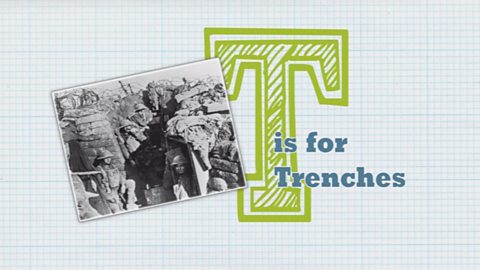
Newsreel, schoolchildren’s commentary and dramatic monologue describe the conditions of British trenches on WW1's Western Front.
V is for Victory. video
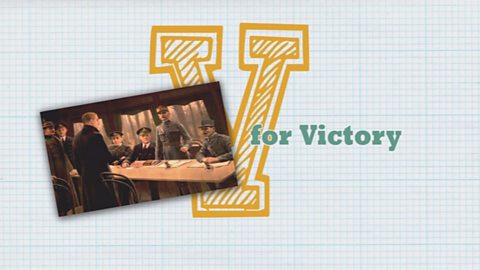
Newsreel, schoolchildren and dramatic monologue show the victory celebrations in 1918 at the end of WW1.
W is for Women. video
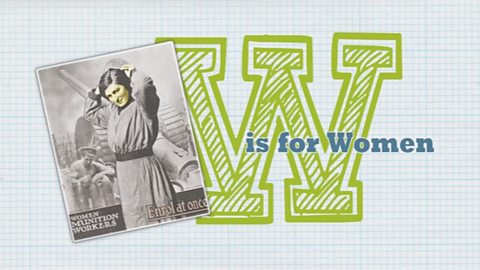
Newsreel and dramatic monologue honour the role of British women during WW1, particularly those who worked in munitions factories.