The war ended at 11 am on the 11th November in 1918.
Germany and the Allies signed the agreement to end the war at a secret location in France.
An agreement, called the Armistice was signed at 5 am.
This day is now called Victory Day.
Maude Alice Mary Thompson, schoolgirl, aged eleven.
Yesterday was the most exciting day of my whole life. I wish I could wind the clock back and live it all over again.At about eleven o’clock in the morning we heard explosions. Guns firing. Big guns.
Father said the guns meant the war had finished.
‘Get your coat, he said. ‘We’re going out. ’
Next minute I was running down the street holding father’s hand. We jumped on a tram and headed down Hampstead Road.We passed thousands of people carrying flags and ribbons, all walking south towards the city. I held tightly onto father’s hand but it wasn’t frightening. It was exciting.
On The Strand a man was selling flags and father bought me this. You should have heard the noise! A brass band was playing and bells were ringing. People were setting off firecrackers; cheering and singing and stamping their feet.
At Buckingham Palace we saw thousands of people all looking up at the royal balcony.
‘We want the king,’ we chanted. ‘We want the king.’
And then there he was! The king! I could see him with my own eyes; he was standing on the balcony with the queen. Then a band played ‘Rule Britannia’ and we all sang along as loudly as we could. It was wonderful.
Video summary
This short film is for teachers and review is recommended before use in class.
Primary school children narrate the story of the armistice agreement that ended World War One.
We hear the story of Maud Thompson, aged 11, who describes how she woke up to the sound of fireworks on the day, took part in London’s victory celebrations and saw the King and Queen on the balcony at Buckingham Palace.
Victory celebrations were sparked by news of the armistice which came into effect at 11am on 11 November 1918.
Germany and the Allies signed the agreement at a secret meeting in France at 5am on the same day.
This day was known as Victory day.
Teacher Notes
Pupils could discuss the mixed feelings that people must have had when they heard the news that the war had ended.
What was the reaction of individuals was likely to be?
What would their priorities be, now that the fighting was over?
What would their hopes for the future be?
Given the level of destruction and the huge numbers of dead, was it accurate to talk of victory?
Pupils could debate the issue, based on their research of the period. They could take a vote to decide the question.
This short film is suitable for teaching history at Key Stage 2 / Second Level or above.
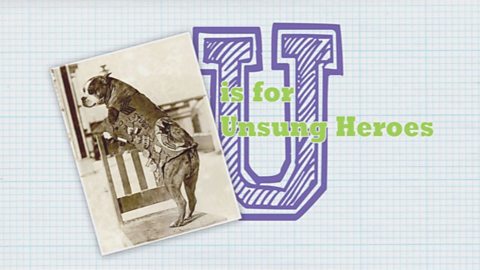
U is for Unsung Heroes. video
Newsreel, schoolchildren’s commentary and dramatic monologue illustrate the role of animals in WW1, including the famous terrier Sergeant Stubby.
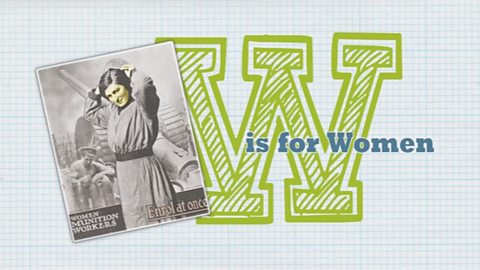
W is for Women. video
Newsreel and dramatic monologue honour the role of British women during WW1, particularly those who worked in munitions factories.
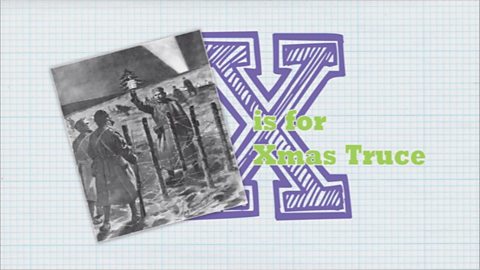
X is for Xmas Truce. video
Through newsreel, children's commentary and dramatic monologue, this short film for primary schools tells the story of one Christmas Eve in 1914 when peace broke out in the trenches.