ARCHIVE NEWS: From this Israeli frontier post, the nearest Syrian forward position is only 700 yards away. And it's on this section of the border that Israeli intelligence sources have just reported the presence of Russian military advisers.
REPORTER: In May 1967, the Soviet Union told Syria that Israeli forces were massing in northern Israel to attack it. It was a lie. The Kremlin was trying to challenge America's influence in the region, even at the risk of another war. But Syria believed it was under threat, and in the interests of Arab unity, joined forces with Egypt, much to Israel's alarm. The Egyptians then re-took the southern tip of the Sinai Peninsula and imposed a blockade on the Israeli port of Eilat. This amounted to a declaration of war, since the Straits of Tiran were the Israelis' only trade route to the eastern half of the world.
Israel faced the prospect of war on three fronts: from Jordan in the east, from Syria in the north, and from Egypt in the south. As the crisis deepened, on the 5th of June, Israel preemptively attacked Egypt. The Israeli's first move was to take the Egyptian Air Force completely out of the picture by attacking its runways. The few planes that did get off the ground were no match for the Israeli fighters. The Egyptian Air Force was completely destroyed. In the Sinai, Egypt had three times as many tanks as Israel, but with no air cover, their cause was hopeless. Israel quickly took the Sinai and Gaza. Syria and Jordan joined in the war. When the battle ended, they'd lost control - not just of the Golan Heights and the West Bank - but of East Jerusalem as well. The Israelis declared Jerusalem the new capital of the Jewish state.
PROF. MORRIS: Those Israelis who had thought that the Arab states were about to overwhelm Israel and destroy it, as was enunciated in advance by the Arab radio stations, saw it as something miraculous. Religious Israelis saw it as a sort of divine redemption and reoccupation of areas which had been the core areas of the Jewish state of Judea and Samaria, which had been the core of the Judean kingdoms.
REPORTER: The war was over in six days. By its conclusion, Israel's armed forces had more than quadrupled the territory their country controlled. The war also provoked another exodus of Palestinian refugees, who fled to camps in the surrounding Arab states. The 1967 War established Israel as the dominant military power in the region. The Israeli victory was so quick and so complete that the Arab states were left demoralised and discredited. They had huge numbers of soldiers, but compared to the Israelis they were poorly equipped and poorly led.
SOLDIERS SHOUTING GUNFIRE
The Arab failure allowed the Palestinians' own national movement, including the Palestine Liberation Organisation, to emerge as a major actor.
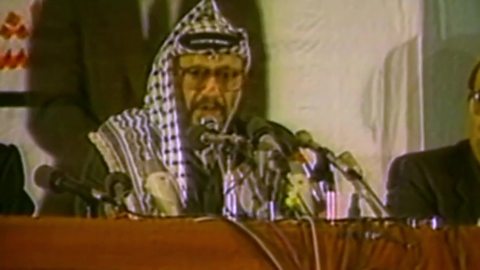
EXPERT: People like Yasser Arafat started to organise rebellion and armed resistance against the newly-occupying Israeli Army, and so they caught people's imagination. They demonstrated that the Palestinians could take their cause into their own hands; they could bear arms; they were no longer pitiful refugees; they were people who had dignity because they fought for their own rights and their destiny. We know that is not easy… but - we are ready to pay the price.
The PLO was made up of political and armed groups with different ideologies. In the 1970s, under Arafat's leadership, it became more extreme and carried out a series of attacks against Israeli and other targets.
EXPLOSION
But there was little international sympathy for a cause promoted by hijacking and bombing.
Video summary
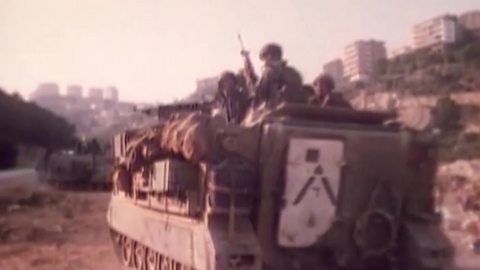
Using guest speakers, this video clip discusses how Israel defeated Jordan, Syria and Egypt in only six days in 1967. It also discusses how the war inspired Palestinian resistance movements, such as the PLO under Yasser Arafat.
This clip is part of a series which can be treated as historical sources, looking at different viewpoints of the Arab-Israeli conflict. It is one of a series of clips taken from a longer documentary about the Israel/Palestine conflict, from 2004.
The series follows the history of the conflict through the mid-late 20th century, focussing on major incidents, pressure points and conflicts.
Please note, these clips have been edited from the original 2004 broadcast version to remove some scenes young audiences might find disturbing. However, teacher review is advised.
Teacher Notes
After watching the clip, split the class into groups and have them talk about what they saw.
Does each speaker qualify as a primary or secondary source?
Summarise the speakers' perspective. Can you think of anything that might influence them?
Is there anything the speakers didn't mention, or explained differently to each other? If so, why do you think that is?
Is there anything you would still like to know about the conflict that wasn't mentioned in the video?
This video clip will be relevant for teaching history at KS3, KS4/GCSE, in England and Wales and Northern Ireland. Also at Third Level, Fourth Level, National 4 and National 5 in Scotland.
This topic appears in AQA and Edexcel.
Origins of the Arab-Israel two-state solution. video
Using guest speakers, this video clip discusses the origins of the two-state solution in the Arab-Israeli conflict, through the British Peel Commission of 1937 and the White Paper of 1939.
UN partition plan for Palestine and establishing the State of Israel. video
Using guest speakers, this video clip discusses the background and impact of the UN Partition Plan for Palestine in 1947.
Suez and the arrival of the Cold War in the Middle East. video
Using guest speakers, this video clip examines how the Suez Crisis of 1956 changed international relationships and the landscape of power in the Middle East.
The Yom Kippur War. video
Using guest speakers, this video clip examines the events surrounding the Yom Kippur War in 1973.

Sabra and Shatila massacres in 1982. video
Using guest speakers, this video clip examines the events surrounding the Israeli invasion of Lebanon in 1982.
The first Intifada and Palestinian consciousness. video
Using guest speakers, this video clip discusses the first Palestinian mass uprising in 1987, and how it became a turning point in the conflict.